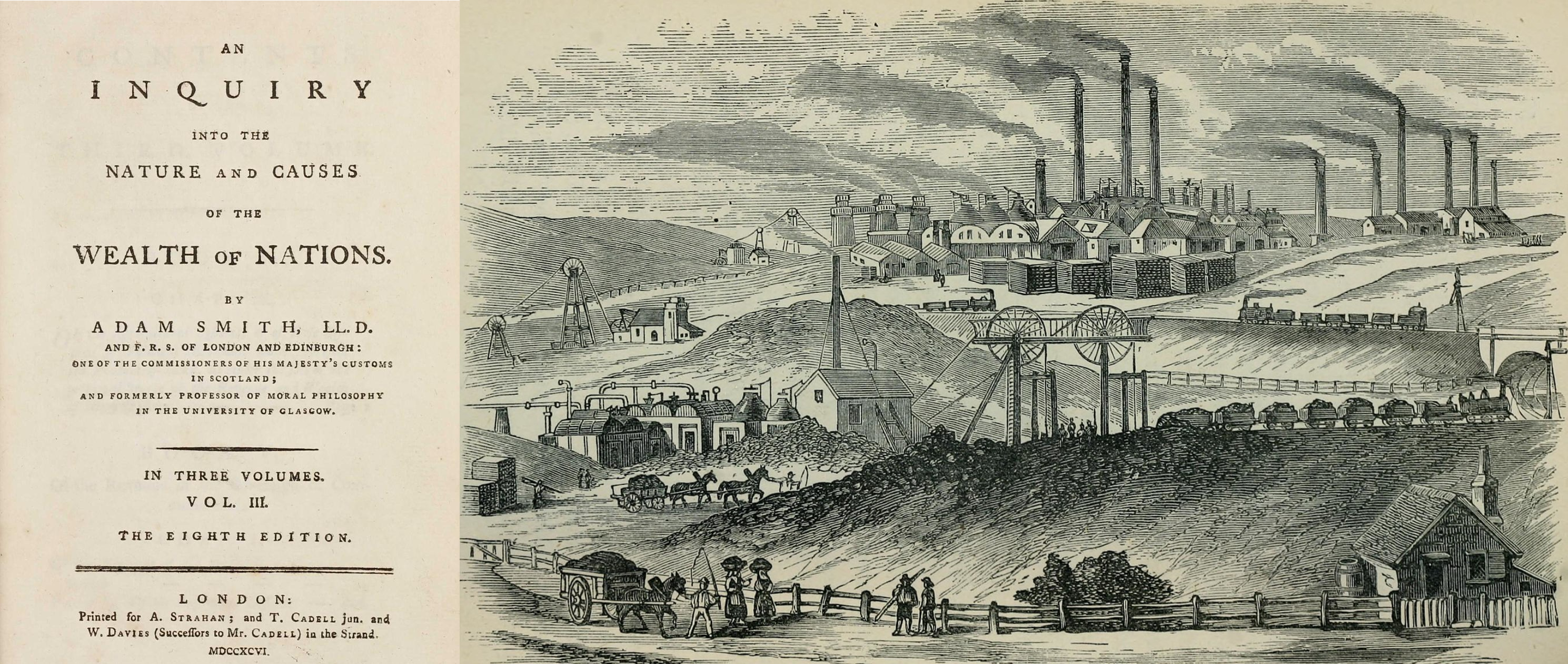
Adam Smith and the division of labor: cure or curse?

The first three chapters of The Wealth of Nations (WN, I.i-iii) are devoted to the division of labor. Although Adam Smith will later have some bad things to say about the individual effects of the division of labor in Book V of his magnum opus, [1] in chapter one (available here) his focus is on the aggregate effects of specialization on the economy as a whole. Here (chapter 1), he makes three original observations:

  1. The division of labor promotes productivity. Smith begins his book with his now famous pin factory to show how the division of labor (specialization) makes the economy as a whole more productive: when we work together as a team and when each member of the team focuses on a small number of specific tasks, the resulting increase in our combined productivity becomes exponential because we can now produce more goods and services than if we each tried to produce everything ourselves.
  2. The division of labor improves our quality of life. At the end of the first chapter, in one of the most memorable passages in the entire Wealth of Nations, Smith patiently points out that it has been the steady process of specialization that has improved our material standard of living:

Were we to examine, in the same manner, all the different parts of his dress and household furniture, the coarse linen shirt which he wears next his skin, the shoes which cover his feet, the bed which he lies on, and all the different parts which compose it, the kitchen-grate at which he prepares his victuals, the coals which he makes use of for that purpose, dug from the bowels of the earth, and brought to him perhaps by a long sea and a long land carriage, all the other utensils of his kitchen, all the furniture of his table, the knives and forks, the earthen or pewter plates upon which he serves up and divides his victuals, the different hands employed in preparing his bread and his beer, the glass window which lets in the heat and the light, and keeps out the wind and the rain, with all the knowledge and art requisite for preparing that beautiful and happy invention, without which these northern parts of the world could scarce have afforded a very comfortable habitation, together with the tools of all the different workmen employed in producing those different conveniencies; if we examine, I say, all these things, and consider what a variety of labour is employed about each of them, we shall be sensible that without the assistance and co-operation of many thousands, the very meanest person in a civilized country could not be provided, even according to what we very falsely imagine, the easy and simple manner in which he is commonly accommodated. Compared, indeed, with the more extravagant luxury of the great, his accommodation must no doubt appear extremely simple and easy; and yet it may be true, perhaps, that the accommodation of an European prince does not always so much exceed that of an industrious and frugal peasant, as the accommodation of the latter exceeds that of many an African king, the absolute master of the lives and liberties of ten thousand naked savages. (WN, I.i.11)

3. The division of labor also promotes science and the production of knowledge. Or in the immortal words of Adam Smith: “In the progress of society, philosophy or speculation becomes, like every other employment, the principal or sole trade and occupation of a particular class of citizens. Like every other employment too, it is subdivided into a great number of different branches, each of which affords occupation to a peculiar tribe or class of philosophers ….” (WN, I.i.9) More importantly, “this subdivision of employment” not only “improves dexterity, and saves time”; it also promotes knowledge: “Each individual becomes more expert in his own peculiar branch, more work is done upon the whole, and the quantity of science is considerably increased by it.” (ibid.) In short, for Smith the division of labor is not a disease; it is, on balance, a blessing!

Adam Smith quote: The greatest improvement in the productive powers of  labour, and...

[1] The division of labor also has a dark side. In Book V, Chapter 1, Part 3, Article II of The Wealth of Nations (WN, V.i.f.50), Smith writes:

“In the progress of the division of labour, the employment of the far greater part of those who live by labour, that is, of the great body of the people, comes to be confined to a few very simple operations, frequently to one or two. But the understandings of the greater part of men are necessarily formed by their ordinary employments. The man whose whole life is spent in performing a few simple operations, of which the effects are perhaps always the same, or very nearly the same, has no occasion to exert his understanding or to exercise his invention in finding out expedients for removing difficulties which never occur. He naturally loses, therefore, the habit of such exertion, and generally becomes as stupid and ignorant as it is possible for a human creature to become. The torpor of his mind renders him not only incapable of relishing or bearing a part in any rational conversation, but of conceiving any generous, noble, or tender sentiment, and consequently of forming any just judgment concerning many even of the ordinary duties of private life. Of the great and extensive interests of his country he is altogether incapable of judging, and unless very particular pains have been taken to render him otherwise, he is equally incapable of defending his country in war. The uniformity of his stationary life naturally corrupts the courage of his mind, and makes him regard with abhorrence the irregular, uncertain, and adventurous life of a soldier. It corrupts even the activity of his body, and renders him incapable of exerting his strength with vigour and perseverance in any other employment than that to which he has been bred. His dexterity at his own particular trade seems, in this manner, to be acquired at the expense of his intellectual, social, and martial virtues. But in every improved and civilised society this is the state into which the labouring poor, that is, the great body of the people, must necessarily fall, unless government takes some pains to prevent it.” (WN, V.i.f.50)

Posted in Uncategorized | Tagged , , , , , , , | 4 Comments

Prologue: Adam Smith’s political economy

Happy New Year! 2026 is the 250th anniversary of one of the most influential books to be published in the English language: Adam Smith’s Inquiry into the Nature and Causes of the Wealth of Nations. To commemorate this historic occasion, starting this weekend I will begin a new series of blog posts on Smith’s magnum opus.

Wealth of Nations Adam Smith First Edition
Posted in Uncategorized | Leave a comment

End-of-year review: my other 2025 projects

Happy New Year’s Eve! Above and beyond my teaching duties and my work on Adam Smith’s life and ideas (see my previous post), I also want to highlight a few of my many other sundry scholarly endeavors during this past calendar year:

  1. A paper describing my 2024 sabbatical at Rollins College: “My Sabbatical with Homer et al.
  2. A paper taking a second look at David Hume’s famous argument against miracles: “Evidence and Belief: David Hume in the Library of Babel
  3. A paper retracing the intellectual origins of Ronald Coase’s counter-intuitive model of reciprocal harms: “Coase’s Fable
  4. A series of blog posts on the impact of ChatGPT on the mission of higher ed: see here for a compilation of my relevant links
  5. A series of blog posts on the exchange of letters in the mid-1970s between James Buchanan and Warren Samuels: see here for a compilation of my relevant links
  6. A series of blog posts on the late Alasdair MacIntyre’s 2023 essay “On Having Survived the Academic Moral Philosophy of the 20th Century”: see here, here, here, here, and here

In addition to these papers and projects, I have also been writing up a primer on the law-liberty dilemma in modern political theory, which I will post to SSRN soon.

Posted in Uncategorized | Leave a comment

My 2025 Adam Smith papers

Among other things, in 2025 I wrote or finished editing the following works on Adam Smith:

1. A New Discovery about Adam Smith in Geneva (with Alain Alcouffe, see below)

2. A Plea to Adam Smith Scholars (published in Adam Smith Works)

3. Adam Smith’s Blind Spot (refereed article published in the Journal of Public Finance and Public Choice, 10 pp)

4. The Philosopher’s Muses: Adam Smith in the Salons of Paris (SSRN preprint with Alain Alcouffe, 34 pp)

5. Adam Smith in the City of Lights (with Alain Alcouffe, forthcoming in the Adam Smith Review, 51 pp.)

In addition, my forthcoming book with Salim Rashid, Beyond Das Adam Smith Problem, is now under contract with Palgrave Macmillan, with anticipated publication in 2026.

Posted in Uncategorized | Leave a comment

Monday medley: assorted AI doomer links

  1. Ted Gioia, “The force-feeding of AI on an unwilling public
  2. John Nosta, “What if AI isn’t intelligence but anti-intelligence?”
  3. Ronald Purser, “AI is destroying the University and learning itself
  4. Thomas Urbain, “Justice at stake as generative AI enters the courtroom
  5. Eliezer Yudkowsky (pictured below), “Pausing AI development isn’t enough. We need to shut it all down
So far, the "AI doomers" and "AI haters" were two distinct groups ...
Posted in Uncategorized | Leave a comment

Sunday song: Little Saint Nick

Happy Birthday, Sydjia!
Posted in Uncategorized | 1 Comment

Assorted Yuletide links

As a gift to my loyal readers, below are a few of my favorite Internet links that I stumbled upon at various moments during the past two years:

  1. Central Intelligence Agency, “Simple Sabatoge Field Manual” (1963)
  2. Daniel Crane, “The Law on Christmas” (2021)
  3. Jay Daigle, “Paradigms and Priors” (2019)
  4. Alice Gribbin, translation of Eugène Delacroix’s “Questions on the Beautiful” (2025/1854)
  5. Michael Huemer, “How to Philosophize” (2024)
  6. Kevin Kelley, “101 Additional Advices” (2024)
  7. Nan Ransohoff, “What virtue is undersupplied today?” (2025)
  8. Reed Schwartz, “The Georgist Roots of American Libertarianism” (2025)
  9. Joan Westenberg, “I Deleted My Second Brain” (2025)
  10. Bonus link: “A Charlie Brown Christmas Live”:
Posted in Uncategorized | Leave a comment

Friday funnies: science funding edition

Bonus Friday Funny: “Uncle Put More Thought Than Usual into this Year’s Gift Cards” via The Onion.

Happy Boxing Day!
Posted in Uncategorized | Leave a comment

The domain of Coase’s axiom

In my previous post, I explained why Ronald Coase’s reciprocal-harm insight should be treated as an axiom, i.e. an indemonstrable first principle or formal logical expression used in a deduction to yield further results. Today (Merry Christmas!), I will explore what I like to call the domain question: what is the scope of Coase’s axiom? Does it apply to all harms or only to economic harms like the ones discussed in Coase’s original FCC and social cost papers, i.e. the papers in which Coase first introduced his reciprocal-harm model? There are three logical possibilities: narrow, intermediate, and broad.

  1. Narrow: economic harms. On one end of the reciprocal-harm domain space are so-called “externalities” or economic harms (see here, for example), i.e. the spillover effects of otherwise lawful or socially-useful business activities such as cattle trespass, noise and vibrations, railway sparks, signal interference, smoking chimneys, etc.: the examples that Coase himself surveys in his FCC and social cost papers. In support of this narrow interpretation of Coase’s axiom one need look no further than the very first sentence of Coase’s social cost paper itself, which begins thus: “This paper is concerned with those actions of business firms which have harmful effects on others.” (Coase 1960, p. 1)
  2. Intermediate: involuntary harms. Although the ostensible subject matter of Coase’s FCC and social cost papers is the problem of economic harms (e.g. cattle trespass, noise and vibrations, railway sparks, signal interference, smoking chimneys, etc.), why should we limit the domain of Coase’s axiom in such an artificial or arbitrary way? Why not extend the domain of Coase’s axiom to include all involuntary or unintentional harms more generally? On this intermediate view of the problem of harmful effects, what matters is not the source of any given harm (i.e. whether the harm was generated by a business firm or not); what matters is the intent or motive of the actor who generated the harm: did he (or in the case of a business firm, it) intend to injure another party?
  3. Broad: all harms. On the other extreme of the domain space are all harms, not just unintentional harms or accidents but also deliberate and intentional ones. After all, what is a “harm” — whether unintentionally or deliberately produced — but an action or omission that imposes a disutility or cost on another party? (For general philosophical definitions of the concept of harm, see Feinberg 1984; Gert 2004.) On this broad view of harms, what matters is not the intent or motive of the actor producing the harm, i.e. whether the actor acted deliberately or not. What matters is that someone has incurred a disutility or cost without consenting to the imposition of that cost.

Which of these three logical possibilities is the most plausible one? Should it matter whether the harm is an “economic” one? (If so, how does one distinguish “economic” from “non-economic” harms?) Or in the alternative, should the motive of the person or firm producing the harm matter? (If so, why should intentionality matter?) For my part, I see no reason why the domain of Coase’s axiom should be limited to options one or two above; from a purely logical perspective, the domain of an axiom (or a set of axioms) includes anything that can be derived or deduced from that axiom or set.

PDF) The Problem of Social Cost
Continue reading
Posted in Uncategorized | Leave a comment

Coase’s axiom

Feliz Nochebuena; Happy Christmas Eve! As readers of this blog may know, I have long been fascinated with Ronald Coase’s counter-intuitive insight that harms are a “reciprocal” problem. What you may not know, however, is that this simple idea has haunted me since the fall of 1990, my first semester of law school, when I was Guido Calabresi’s torts student at Yale, for it was in one of Guido’s legendary torts lectures that I was first exposed to Coase’s paper The Problem of Social Cost, the landmark work in which Coase introduces his reciprocal-harm model.

Since then, I have published no less than 10 scholarly papers (see here, for example) in which I explore or extend various aspects of Coase’s work, but the one idea that continues to haunt me the most is Coase’s reciprocal-harm thesis. Why has the idea of “reciprocal harms” haunted me for so long? Because if Coase is right, if harms are a reciprocal problem, this proposition would have radical and far-reaching implications for moral and political philosophy. But is Coase right? Are harms really reciprocal? Also, how would we prove (or disprove!) this claim? Is Coase’s model of reciprocal harms falsifiable in the Popperian sense?

Here is where my most recent work-in-progress on reciprocal harms (“Coase’s fable”, available here) comes into play, for I have now decided to describe Coase’s destabilizing insight that harms are a reciprocal problem as an axiom. My reason for making this move is strategic: to sidestep the truth and proof questions I posed above, for axioms are supposed to be self-evident. [On this note, see footnote 6 of my paper, where I define an axiom as “a statement of proposition that is regarded as being self-evidently true”.] I concede, however, that calling Coase’s insight an axiom now opens up a new can of pesky philosophical worms, so to speak. Among these are: why are axioms “self-evident”, and is Coase’s reciprocal-harm model really an axiom?

Regarding these deeper questions, I have found Robert G. Brown’s book-length work on the history and nature of axioms to be helpful. To the point, according to Brown, a physics professor at Duke, an axiom is just a starting point, an assertion or proposition that we simply assume to be true for the sake of argument: “an axiom is not necessarily a self-evident truth, but rather a formal logical expression used in a deduction to yield further results.” [1] In other words, axioms are exempt from the necessity of independent proof: you either accept Coase’s insight as true, as an accurate or useful model of reality, or you don’t.

But even if we are prepared to accept Coase’s reciprocal-harm model as an axiom (in order to sidestep truth and proof questions about the model), we still have an even more important question to address: what is the scope or domain of Coase’s axiom? Does the reciprocal-harm model apply only to economic harms, to involuntary harms more generally, or to all harms? I will address this deeper question in my next post …

[1] Robert G. Brown, Axioms (2007), https://webhome.phy.duke.edu/~rgb/Philosophy/Axioms/axioms/ [https://archive.ph/SrpLc]. See also Yuri Balashov and Alex Rosenberg (editors), Philosophy of Science, London and New York: Routledge (2002), pp. 129-131.

Posted in Uncategorized | Leave a comment