
The greatest of all time? Yes, as a lifelong baseball fan, Shohei Ohtani has my vote!


Creative Commons
Blogs I Follow








The greatest of all time? Yes, as a lifelong baseball fan, Shohei Ohtani has my vote!
Inspired by the ideas of Robin Hanson (see, by way of example, the video below on prediction markets), I have proposed the creation of a “truth market” in order to counteract the spread of false information on the Internet, and in my previous two posts this week (see here and here), I have compared and contrasted my proposed truth market with prediction markets, described how a decentralized truth market would work in practice, and explained why such a market could dispense with two features of prediction markets: closing dates and trusted arbiters. In summary, truth markets allow people to trade belief contracts (i.e. to bet on their beliefs about past events, such as conspiracy theories, fake news, etc.), but unlike a traditional prediction market, my truth market would remain open indefinitely and would not have any final arbiters.
Today, I will address a different concern or possible objection to my proposed truth market: the likelihood of market manipulation, either by government officials who have access to secret information or to media insiders who, in turn, have access to those officials. Fortuitously, the market manipulation or “insider trading” argument is the easiest objection to refute. Why? Because from a global or information perspective, insider trading is actually a good thing! Insider trading might be morally wrong (using secret information to make a profit) or not (what’s wrong with making a profit?), but either way insider trading makes markets more efficient and more liquid. In the case of a truth market, any attempt by government or media insiders to manipulate the market would soon be reflected in the prices of the belief contracts. Alert traders would quickly spot any unusual or unexpected changes in the market price of a belief contract and seize the opportunity presented by any distortion in the price. My slogan therefore is: the more market manipulation, the better!
In my previous post I described how a “truth market” could be used to counteract the spread of false information on the Internet. To the point, my proposed truth market would operate like a betting market but would remain open indefinitely and would not have any final arbiters. That is, unlike a traditional prediction market, where participants trade carefully-worded “event contracts” and have to agree ahead of time to a trusted arbiter to decide whether the event being bet on has occurred or not by a specified date, my truth market would allow people to trade “belief contracts”, would eschew external arbiters, and would remain open indefinitely.
As it happens, my truth market paper underwent peer review earlier this year, and both of my reviewers objected to the open-ended nature of my market (no close date) as well as to the lack of final resolution (no arbiters). The objection boils down to this: without a final arbiter or “some trusted person” (to quote one of my reviewers) or other “disciplining function” (to quote the other) to resolve on some certain date the belief contracts being bet on, how could we determine whether the truth market was working or not, i.e. whether the price of a belief contract reflected the underlying truth or truth-value of the proposition being bet on?
In reply, I would ask: Why can’t the market as a whole be the arbiter? The whole point of a truth market is to allow people to bet on their beliefs about past events, but when those past events are contested or disputed, there is often no way of knowing with any degree of certainty what the truth is. This key epistemological observation is especially true in the realm of conspiracy theories and fake news. Was there a conspiracy to assassinate JFK? Did Jeffrey Epstein really kill himself? Did COVID-19 originate in the Wuhan Institute of Virology? Simply put: in each of these cases, no trusted person or institution is available to decide the truth of the matter in controversy.
A decentralized truth market, by contrast, would provide people with a creative way of generating new information about conspiracy theories and measuring the truth-values of such theories. Bettors who think the price of a belief contract in “Proposition X” will increase (where Prop X is the lone gunman theory, the Wuhan lab-leak theory, or any other popular conspiracy theory) will keep their existing belief contract holdings in Prop X or buy more belief contracts in Prop X. In the alternative, a bettor will sell his existing belief contracts or refuse to buy such contracts if he thinks the price will fall. Either way, with a sufficient number of bettors the market price of a belief contract will track belief or non-belief in the conspiracy theory being bet on with no necessary final resolution. As long as there is yet-to-be-discovered evidence that may be convincing to some bettors, at least some subset of belief contracts should move toward resolution without the need for a trusted arbiter.
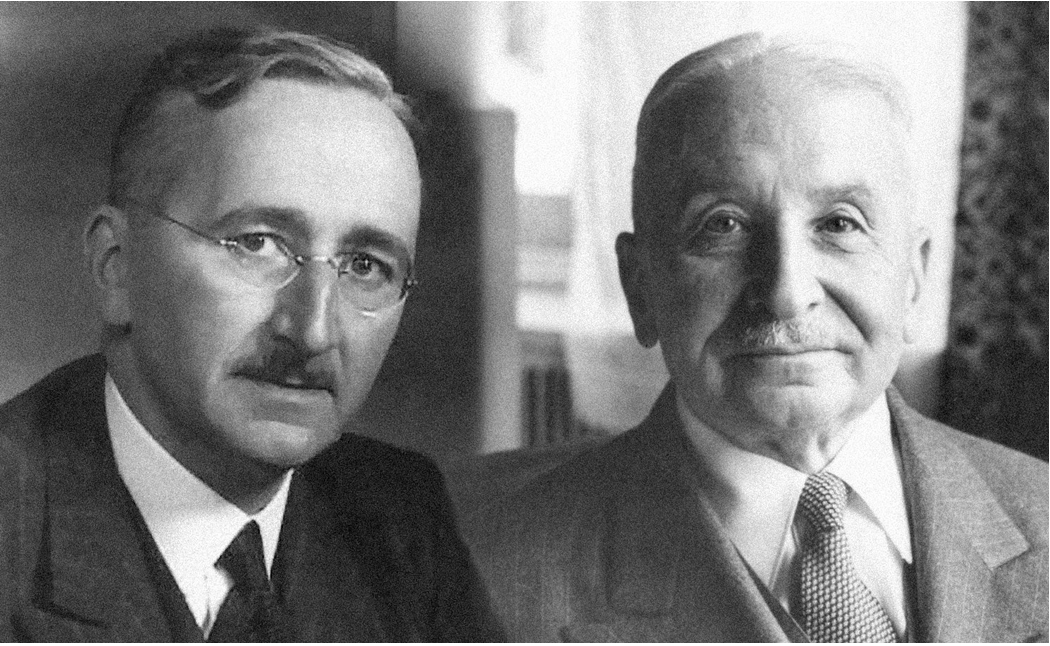
To sum up, we don’t need trusted arbiters to tells us whether a given conspiracy theory is true or not, and in any case no such arbiters exist in the real world. But by keeping truth markets open indefinitely, the market price of any given belief contract will itself be the arbiter of the truth of Prop X! How? Because markets and prices reflect dispersed or global information and rapidly adjust to changing conditions, a fundamental observation that goes back to “The Use of Knowledge in Society” by F. A. Hayek (pictured below, left), and markets are more likely to lead to the production of new information in the first place, an idea that can be traced to Ludwig von Mises’ classic treatise Human Action.
Note: I will address an additional objection to my truth market proposal in my next post: the possibility of market manipulation or “insider trading” — either by government officials who have access to secret information or to media insiders who, in turn, have access to those officials.
Earlier this year I posted a short white paper on SSRN (see here) in which I proposed the creation of a “truth market” to counteract the spread of false information on the Internet, and in a previous post, I identified three potential problems with my truth market proposal based on feedback I have received from the peer-review process and from other colleagues. Today, I will address the first and most fundamental of these three objections: how would my proposed market work in practice?
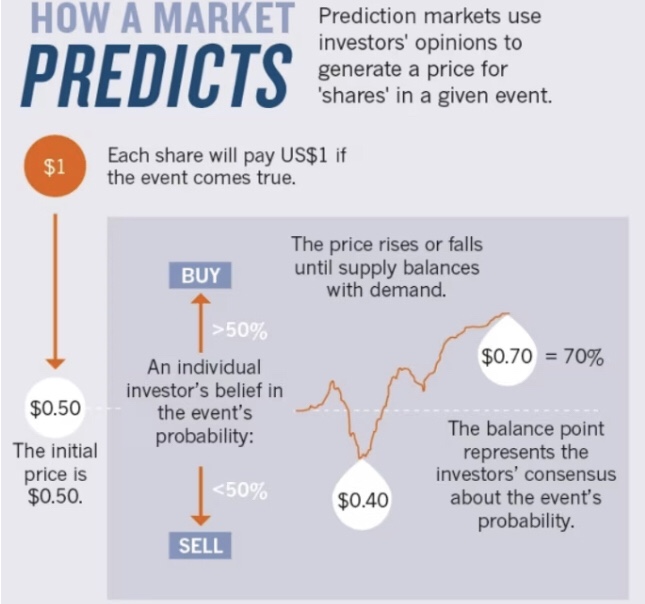
Simply put, my truth market would look like an existing prediction market such as Kalshi or PredictIt (see also the infogram pictured below) but with one major modification or tweak. First off, what is a prediction market? Broadly speaking, a prediction market is a market where people can trade “event contracts” that are tied to the outcome of an unknown future event. (By way of example: “Will Donald Trump be indicted before the end of this week?“) My tweak or modification, however, is to replace prospective event contracts with retrospective belief contracts.
My proposed truth market would thus operate like an ordinary betting market — but instead of placing bets on the outcome of future events (like an upcoming football match or basketball game), participants would trade belief contracts in which people would be able to place wagers on their beliefs about past events, such as conspiracy theories, fake news, and the like. Bettors could opt out at any time, pocketing their winnings if the current price of their belief contracts are above what they paid for them or taking a loss at the current price.
The main difference between a standard prediction market and my proposed truth market is that traditional betting markets must close by a specified date. My truth market, by contrast, would remain open indefinitely and would not have any final arbiters. Both the open-ended nature of my truth market (no close date) and its lack of formal resolution (no arbiters) are the most novel and unorthodox features of my proposal — and the most criticized. I will therefore address these concerns in my next two posts.
On this day (20 March) in 2003, the United States and Britain, along with Australia and Poland, led a full-scale and illegal war of aggression against their former ally Iraq. Alas, 20 years later none of the public officials who instigated the Iraq war have yet to be charged by the International Criminal Court in The Hague. More details about this gross miscarriage of international justice are available here.

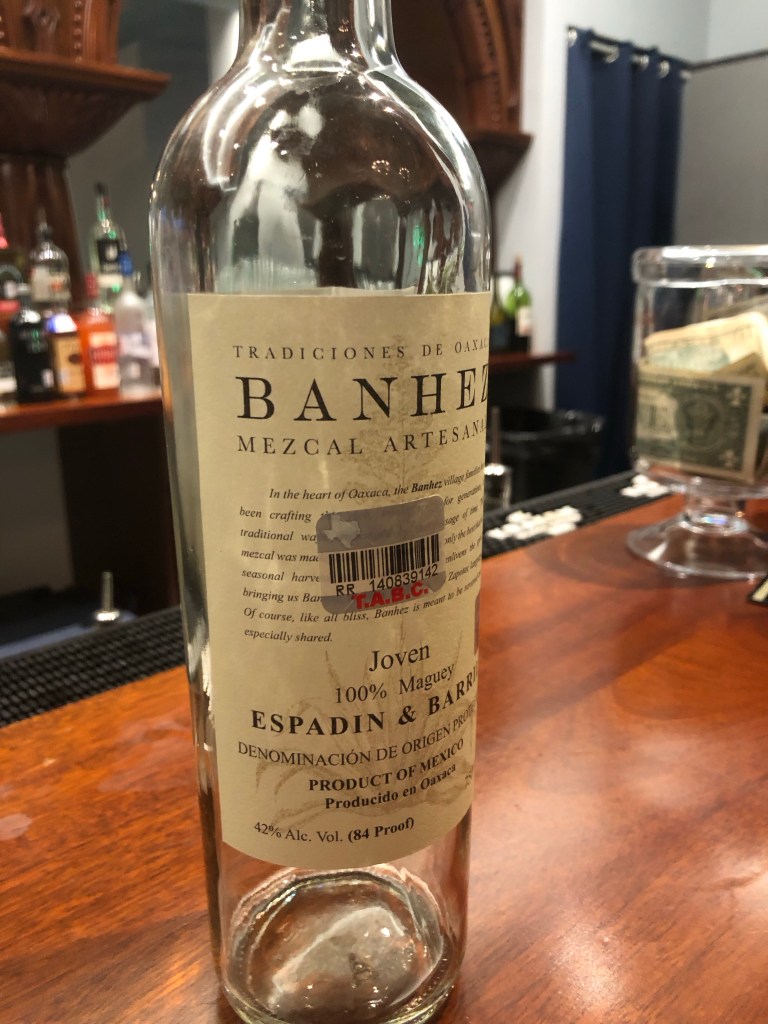
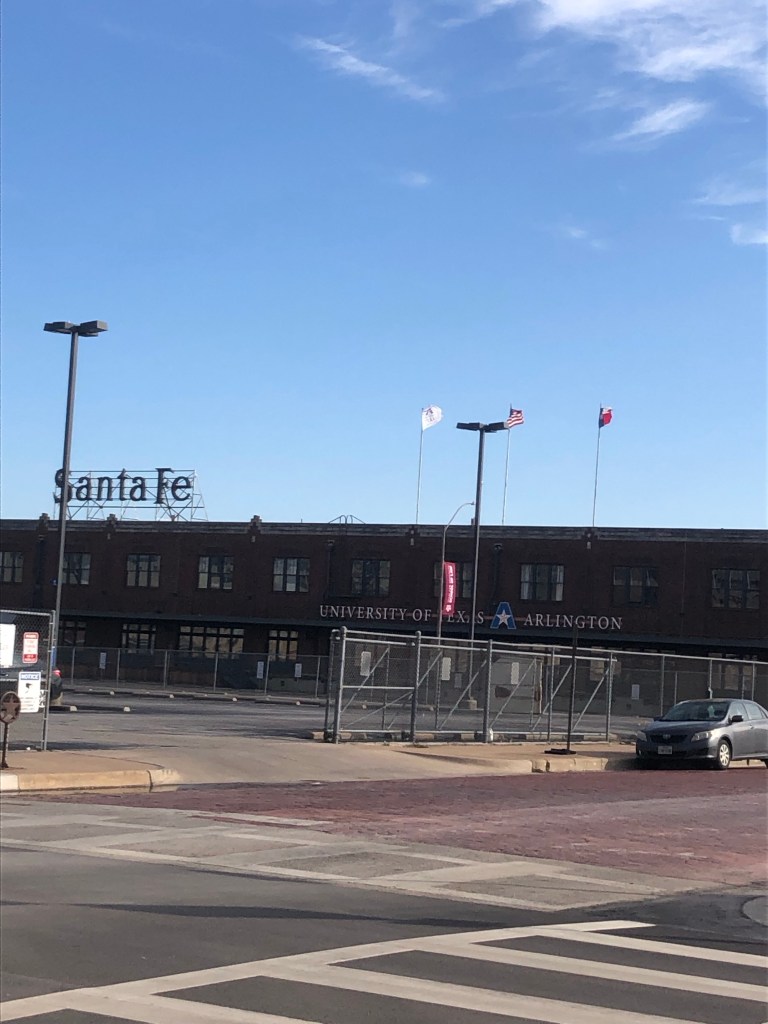
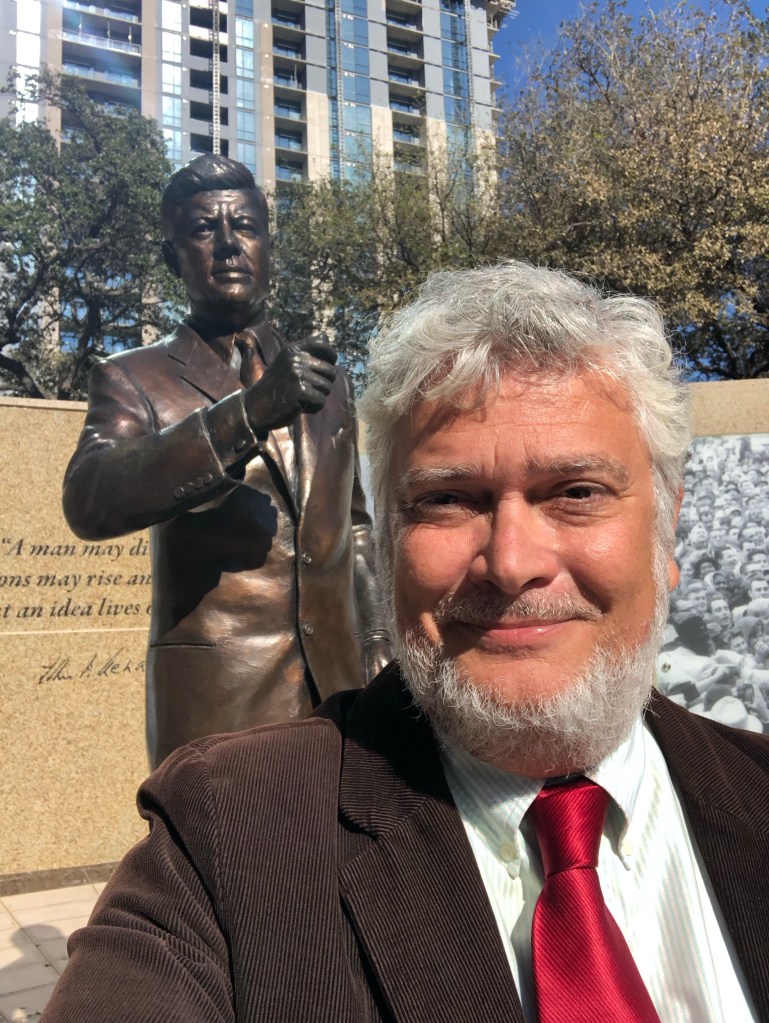
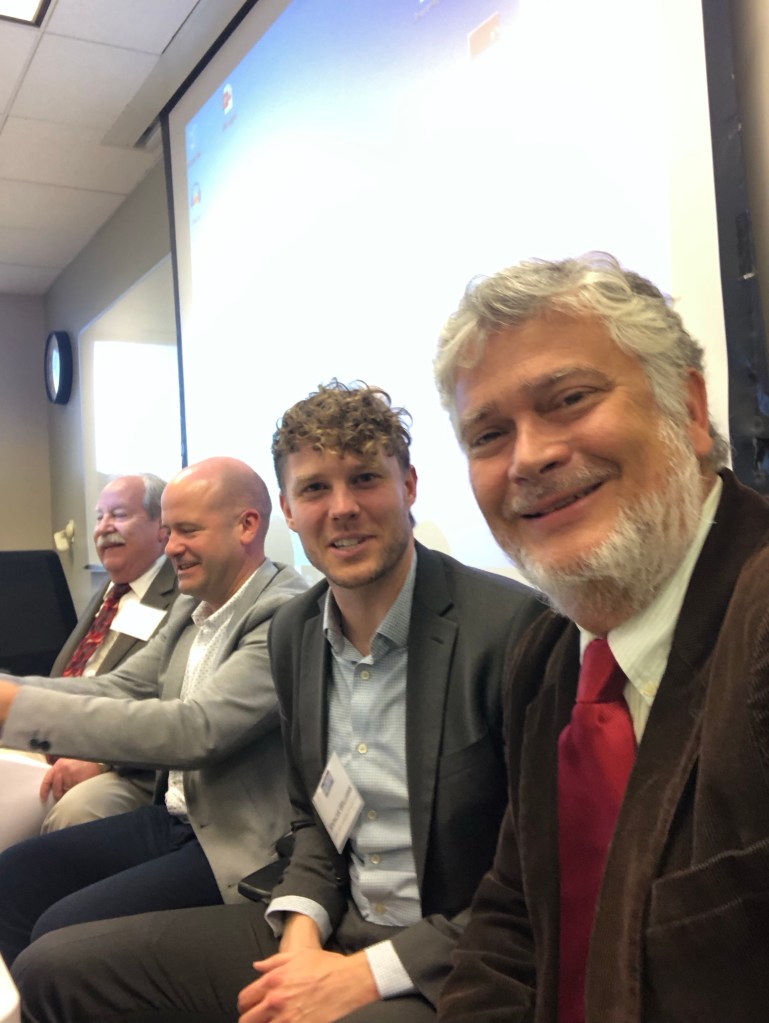
Greetings from Fort Worth, Texas! Pictured below are yours truly (far right) along with my colleagues and fellow KCON panelists: Spencer Williams (Golden Gate), who spoke on “contractual complexity”; Mitja Kovač (University of Ljubljana), who retold Cicero’s solution to the Rhodes famine case; and Mark Wessman (Tulane; far left) who moderated our panel.
Note: This blog post is designed to provide some background regarding my upcoming talk on “belief contracts” at KCON XVI this weekend.
Fake or fact? What is the best way of dealing with false information on the Internet, such as conspiracy theories, fake news, etc.? I recently proposed the creation of a truth market where people could buy and sell belief contracts regarding the truth values of conspiracy theories, disputed media reports (“fake news”), urban legends, and the like. Although I attempted to anticipate and address several possible objections to my proposal when I wrote it up (see especially pp. 8 to 14 of my “truth market” paper), two anonymous reviewers read my work and provided some additional excellent feedback after I submitted my manuscript to the Journal of Free Speech Law. Below is a summary of their main concerns and criticisms:
To begin with, one concern was logistical in nature: how would my truth market work in practice? To the point, how many contracts are initially created when a statement is proposed? How are new belief contracts created? And what is the market cap? Another concern was the possibility of market manipulation, or the potential for “insider trading” by influential media figures. But the main objection to my truth market proposal–an objection made by both of my reviewers–was the open-endedness of my truth market, i.e. its complete lack of a “disciplining function” or “external validation device” (to quote my reviewers).
In brief, unlike a traditional prediction market, where participants buy and sell carefully-worded “event contracts” and have to agree ahead of time to an arbiter to decide whether the event being bet on has occurred or not by a specified date, my truth market would eschew external arbiters and would remain open indefinitely. But without an arbiter or “some trusted person” (to quote one of my reviewers) to “resolve” on some certain date the belief contracts being bet on (i.e. to decide whether a given conspiracy theory or item of fake news is true or not), there would be no foolproof way of assessing whether my truth market was working or not, i.e. whether the price of a belief contract reflected the underlying truth or truth-value of the proposition being bet on.
These are legitimate concerns and objections, and I will respond to them next week.
I just attended a talk by N.Y. Times columnist Ross Douthat at the Church of the Palms in Sarasota, Florida, and I will next fly out to Fort Worth, Texas, where I will be attending the Sixteenth Annual International Conference on Contracts (or “KCON XVI” for short) at the Texas A&M Law School and presenting my work on “belief contracts”. I will say more about Douthat’s talk and the upcoming KCON conference in the next day or two.



Hopefully It’s Interesting.
In Conversation with Legal and Moral Philosophers
PhD, Jagiellonian University
Books, papers, and other jurisprudential things
Ramblings of a retiree in France
BY GRACE THROUGH FAITH
Natalia's space
hoping we know we're living the dream
Lover of math. Bad at drawing.
We hike, bike, and discover Central Florida and beyond
Making it big in business after age 40
Reasoning about reasoning, mathematically.
I don't mean to sound critical, but I am; so that's how it comes across
remember the good old days...
"Let me live, love and say it well in good sentences." - Sylvia Plath
a personal view of the theory of computation
Logic at Columbia University
Just like the Thesis Whisperer - but with more money
the sky is no longer the limit
Technology, Culture, and Ethics
Just like the horse whisperer - but with more pages
Poetry, Other Words, and Cats

 prior probability