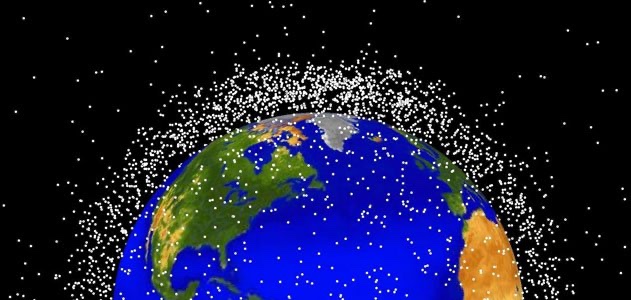
The tragedy of the outer space commons

Below is an another extended excerpt from my work-in-progress “Outer Space Auctions“; I have placed my scholarly citations below the fold:

The main sources of law that govern human activities in outer space include the 1967 Outer Space Treaty,[1] the 1972 Liability Convention,[2] and the 1979 Moon Treaty.[3] These treaties were originally drafted during the height of the Cold War and the space race between Russia and the United States. Among other things, Article II of the Outer Space Treaty prohibits “the national appropriation of outer space by claim of sovereignty, by means of use or occupation, or by any other means.”[4] As a result of this legal framework, outer space is governed as an open-access commons or res communis under international law.[5]

What does it mean to declare that outer space is not subject to national appropriation by any means?[6] Although the precise meaning of this provision has been discussed for decades,[7] it can be read as requiring outer space, including Low Earth Orbit, to be treated as an open-access commons. Broadly speaking, a “commons” refers to a public resource that is owned or used collectively by a group of individuals or firms. Traditional examples include public parks, fisheries, and grazing lands, but a commons can include any shared resource, including a public road, Wikipedia, or outer space (e.g. Low Earth orbit or LEO). Roman law, for example, distinguishes between res communis, property that cannot be used by all but cannot appropriated by anyone, such as the air and bodies of water, and res nullius, “property of no one” that can be appropriated through capture or use.[8] Likewise, international law recognizes two categories of open-access areas: terra nullius and res communis omnium.[9] Resources classified as terra nullius may be acquired by first possession.[10] By contrast, resources classified as res communis omnium, such as the high seas,[11] the deep seabed, and outer space,[12] are open for access and use to all.[13]

Given this legal framework, the increase in space congestion in Low Earth Orbit should come as no surprise, for in the absence of effective methods of shared governance open-access commons are often overused and overexploitated.

The “tragedy of the commons” refers to a situation where private individuals and firms over-exploit or overuse a shared resource.[14] Perhaps the most well-known example of a tragedy of the commons is overfishing.[15] If every fisherman in a community is free to catch as many fish as they want, they will likely continue to fish until the fish population is depleted, even if it means that they will no longer be able to fish in the future. Each fisherman only considers his own short-term gain, rather than the long-term sustainability of the fishery as a whole. As a result, the fishery may collapse, leading to a loss of income for fishermen and an ecological disaster.

In an open-access commons, each individual user obtains all the benefits from their own use of the shared resource but does not bear the full cost of the damage caused to the resource. Without some ground rules to limit the use of the resource, open-access commons can produce perverse overuse incentives, leading to its eventual destruction. As it happens, this same logic also applies to outer space today. Access to and use of Low Earth Orbit is not subject to strict regulation or coordination. Private companies and governments are launching more and more satellites for commercial, military, and scientific purposes, without necessarily considering the impact on others or the sustainability of the Low Earth Orbit region. There is also a lack of effective mechanisms for removing space debris from orbit, which further exacerbates the problem.[16]

The tragedy of the commons in outer space poses a significant threat to our increasingly interconnected world, as satellite systems are crucial for communication, navigation, weather forecasting, and other applications. To avoid this tragedy, experts are calling for greater international cooperation, better regulations, and the development of new technologies to remove debris from orbit. None of these proposed solutions, however, are likely to produce positive results in the short term. Greater international cooperation appears to be a non-starter given the increasing hostility among the world’s leading powers: China, Russia, and the United States. “Better regulations” at the national level are likely to work in the absence of greater international cooperation. And last but not least, a technological solution to the space congestion/space debris problem does not yet appear to be feasible.[17]

The traditional solution to negative externalities involves either command-and-control or Pigovian taxes. Adilov et al. (2013), for example, model the problem of space debris as a negative externality. In summary, their model predicts that, relative to the social optimum, firms will launch too many satellites and will under-invest in debris mitigation technologies. In addition, they identify some remediation policies and calculate a socially optimal Pigovian tax. The main problem with the Pigovian approach is that the government must have sufficient knowledge of the externality problem it is trying to solve to set the Pigovian tax at the optimal amount.[18] This crucial information, however, is usually lacking.[19]

So, what is to be done? Because Low Earth Orbit must be treated as an open-access commons under the Outer Space Treaty of 1967, is there any viable solution to the tragedy of the outer space commons short of amending the treaty or replacing it with a new one? More to the point, what is the most cost-effective way of responding to the problem of space congestion and space debris without jeopardizing the benefits of innovation, new technologies, and space exploration?
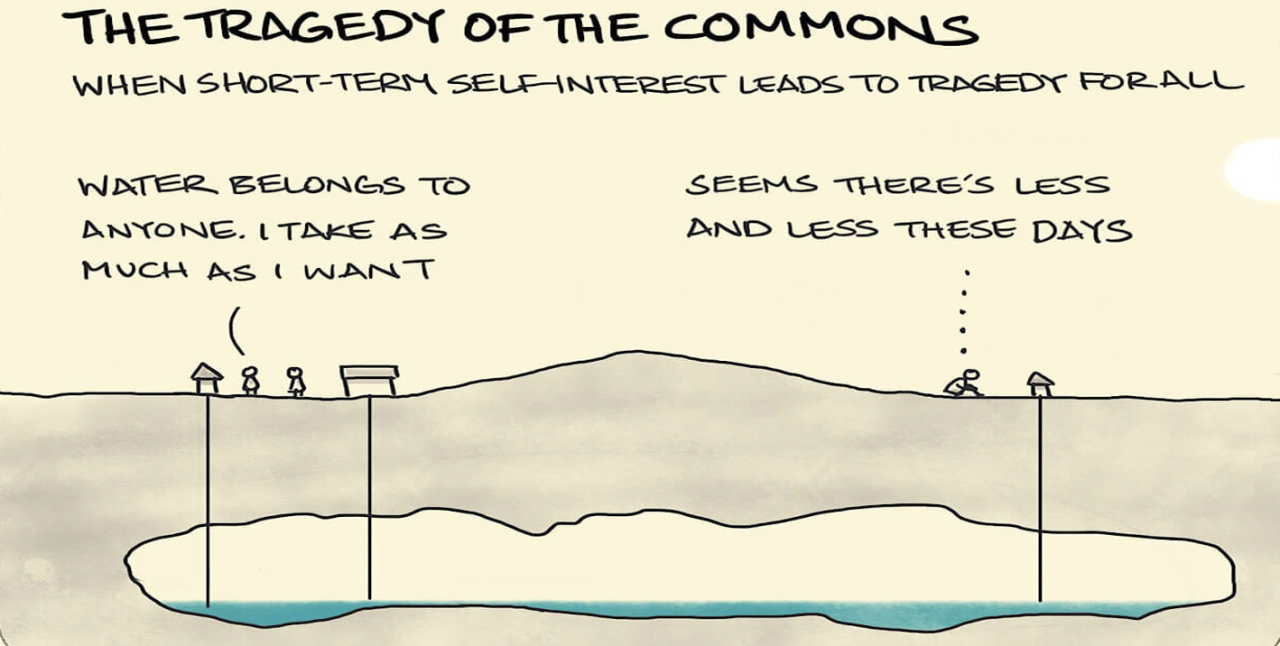
Tragedy of the Commons - how every man for himself can leave the world in ruins.
Image credit: Jono Hey, via sketchplanations.com
Continue reading →
Posted in Uncategorized | 1 Comment

Taxonomy of legal failures

Below is an excerpt from my work-in-progress “Outer Space Auctions“; I have lightly edited this extended excerpt for clarity and have placed the footnotes and scholarly citations below the fold:

It is tempting to see space congestion as a form of market failure or as what economists call an “externality”. In reality, however, the tragedy of the outer space commons–the increase in space congestion and the risks posed by orbital debris–is the result of legal failure: the longstanding treatment of outer space as a commons and the resulting lack of well-defined property rights in outer space. Broadly speaking, there are three types of legal failure or regulatory impediments to trade: (i) uncertainty about the legality of a transaction or activity, (ii) the prohibition of a purely voluntary transactions or activities, and (iii) lack of property rights. Why do I label these three types of legal barriers to trade as “legal failures”? Simply put, because these legal impediments prevent mutually beneficial and voluntary agreements from taking place.[1] Below is a brief survey of each type of legal failure:

First off is legal uncertainty: when the law itself is either uncertain or unclear about what transactions or activities are legal.[2] A textbook example of this type of legal failure (i.e. legal uncertainty) is the longstanding uncertainty regarding the legality of the purchase and sale of blood.[3] From a purely economic perspective, legal uncertainty is suboptimal because it makes the outcomes of legal cases difficult to predict and prevents would-be buyers and sellers from planning their transactions in the shadow of the law or settling their disputes peacefully out of court.

Next is prohibition: when the law criminalizes, prohibits, or otherwise impedes trade altogether in a given good or service. Textbook examples of this type of legal failure (i.e. prohibition) include draconian drug laws that make it illegal to buy or sell certain drugs and laws prohibiting adult prostitution.[4]

The last type of legal failure is the lack of well-defined property rights: when the law fails to define or enforce property rights in a contested resource. Textbook examples of this type of legal failure (i.e. lack of property rights) include common-pool resources such as ocean fisheries, public roads, and waterways.[5] Many economists, however, often confuse this legal failure with so-called “market failures,” or situations where markets on their own are unable to produce efficient outcomes.[6] Air pollution, traffic congestion, and now orbital debris are often listed as textbook examples of market failures. But in reality these bad outcomes are often the result of the law’s failure to define property rights in resources such as air, roads, or orbits. By failing to define such rights, a market for clean air or for uncongested roads or for safe space orbits is unable to exist in the first place. Simply put, without property rights, mutually beneficial and voluntary agreements won’t be able to occur in the first instance.

This third type of legal failure is the one most relevant to the subject matter of this paper: the increase in space congestion and orbital space debris. Simply put, because international space law defines outer space as a commons, the tragedy of the outer space commons we are now witnessing should come as no surprise.

Continue reading →
Posted in Uncategorized | Leave a comment

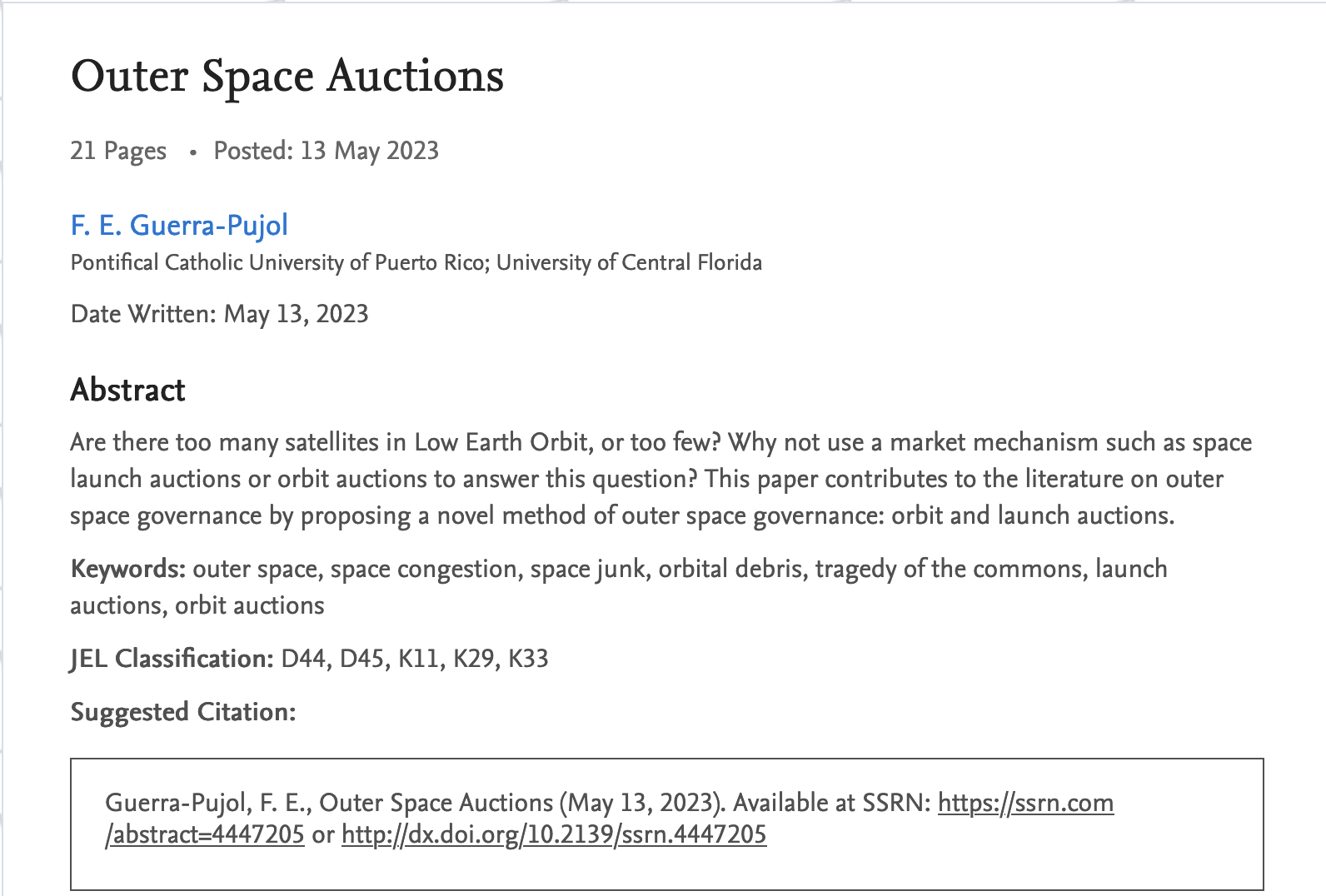
Outer Space Auctions

That is the title of my latest work-in-progress, which I posted to SSRN over the weekend (see here). Below is the Introduction to my paper (footnotes omitted):

“Are there too many or too few satellites and spacecraft in outer space? What is the optimal number of spacecraft in Low Earth Orbit, for example? Currently, the number of satellites in orbit is 9,000. This number is likely to increase to more than 60,000 by 2030. This increase in space congestion is a cause for concern for three reasons: (i) greater space congestion can interfere with ground-based observations, (ii) space congestion can also generates greater amounts of orbital debris, and last but not least, (ii) an increase in orbital debris can increase the risk of a catastrophic collision in outer space. Some estimates show that there are already more than 100 trillion untracked pieces of old satellites circling the planet, so space congestion is a real problem.

“Space congestion thus threatens the sustainability of the commercial space industry in Low Earth Orbit, but in the absence of an effective method of shared governance, what is to prevent this domain from becoming another “tragedy of the commons,” to borrow Garrett Hardin’s haunting phrase? This paper contributes to the literature on outer space governance by presenting a Coasian solution to the problem of space congestion: orbit auctions. The remainder of this paper is thus organized as follows: Parts I and II will provide some relevant background information: Part I contains a taxonomy of spacecraft in orbit today, while Part II surveys the nature of the outer space problem: space congestion. Next, Part III compares and contrasts legal failure and market failure and identifies the main cause of the space congestion problem: the fact that outer space is an open-access commons under existing international law. Last, Part IV concludes by presenting a simple Coasian solution: space launch auctions or property rights in space orbits.”

I will be travelling to Santiago de Chile next week to meet some of my fellow Adam Smith scholars from South America and attend some workshops; in the meantime, I will have more to say about my proposed outer space auctions in the days ahead.

Posted in Uncategorized | Leave a comment

In memoriam: Ian Hacking

Ian Hacking was an intellectual giant in the philosophy of science and in other fields. Among other things, Professor Hacking wrote an influential work on the history of probability (see here). Here is his Wikipedia page, and here is a memorial notice from the University of Toronto, where Hacking was professor emeritus.

Posted in Uncategorized | Leave a comment

Sunday salsa: San Juan sin ti

Happy Mother’s Day! I am including two versions of this beautiful ballad by Luis Enrique: an acoustic guitar version from 2017 and the original 1989 version from the album Mi Mundo:

Posted in Uncategorized | Leave a comment

Star Trek Saturday

The eight-minute video below takes the viewer on a tour of all the different bridges of the USS Enterprise:

hat tip: kottke
Posted in Uncategorized | Leave a comment

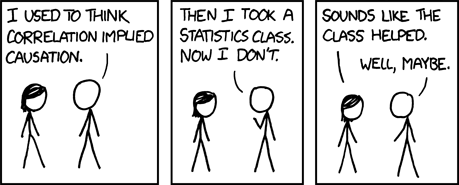
Friday funnies: correlation

Posted in Uncategorized | Leave a comment

Summer break reading, part 1

In addition to a plethora of scholarly papers and sundry blog posts, I am reading the following three books:

1. Parfit: A Philosopher and His Mission to Save Morality by David Edmonds. (I am not a big fan of Derek Parfit or his work, but I just ordered a copy of this book on the strength of this book review.)

2. Adam Smith as Student and Professor by W. R. Scott. (This tome was published in 1937 and is the best book on Adam Smith that I have read thus far.)

3. The Physiocrats and the World of the Enlightenment by Liana Vardi. (I am reading this work to learn more about François Quesnay; the book cover is pictured below).

Posted in Uncategorized | Leave a comment

Adam Smith updates

While I was out of town I proofread and made substantial revisions to both of my Adam Smith works-in-progress: Die Adam Smith Probleme and The Balliol College Conspiracy. Enjoy!

Posted in Uncategorized | Leave a comment

Twitter Tuesday: The Art of PowerPoint

What is the opposite of Death by PowerPoint? The tweet pictured below by Gokul Rajaram, which is worth clicking on and reading in full, describes former Google CEO Eric Schmidt’s unconventional but thought-provoking approach to PowerPoint: eliminate the use of words!

Hat tip: the Amazing Tyler Cowen (here)
Posted in Uncategorized | Leave a comment