
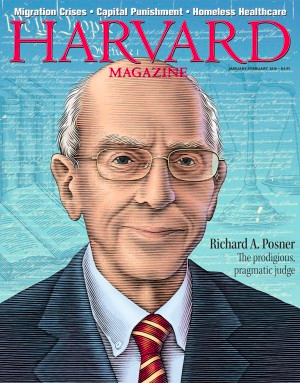
Note: This is the second in a series of blog posts in honor of Richard Posner
In a previous post, I described Richard Posner as “one of the greatest legal theorists and thinkers in history, on a par with such historical figures as the great dissenter Oliver Wendell Holmes, the natural law scholar St Thomas Aquinas, and the classical Roman law jurist Gaius“. Really? How did I come to that conclusion? In this post (and the next one), I will describe my “first contact” with Judge Posner, the moment when I first began to realize that Posner was not just a leading legal light, but a once-in-a-generation original thinker.
My first exposure to Judge Posner occurred in law school. But I have to tell you up front, my professors at Yale did not think very highly of the great Richard Posner. In fact, it would be no exaggeration to say that they totally disdained Posner and everything he stood for, which back in those days (the early 1990s) meant the economic analysis of legal rules or “law & economics” for short. Whether it was out of pure professional jealousy (my professors were by-and-large the same age as Posner) or outright envy (their accomplishments paled in comparison to Posner’s) or just plain spite, these Yale law professors would mention Judge Posner or cite one of his judicial opinions for the sole purpose of criticizing the man and his ideas, to offer an example of what not to think or write.
Alas, this dismissive and sneering attitude toward Judge Posner at first rubbed off on me. As a result, I did not begin to take Posner seriously until after I became a law professor in 1998, when I joined the faculty of the Pontifical Catholic University of Puerto Rico. At first, though, I have to confess that I actually refused to read anything by Richard Posner. As a recent graduate of the Yale Law School and full-time faculty member of a faith-based law school, I already “knew” that Posner’s works were stale and simple-minded. Why? Because the economic analysis of legal rules — especially the version of law & economics most closely tied to Posner, the version called the “Chicago school” — was too conservative, unoriginal, and morally suspect.
Given these negative priors, several more years would pass by before I actually started studying some of Judge Posner’s many multifaceted works on my own initiative, and when I finally did — in December of 2000 — my intellectual life would never be the same again. So, what was my first Posnerian foray, the piece of Posner’s writing that had such a momentous effect on me? As it happens, it was a book, and it had nothing to do with economics. I will identify Posner’s book and explain its effect on me in my next post in this series.















 prior probability