
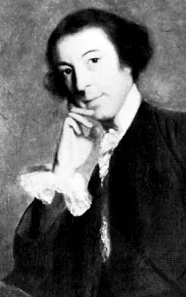
Hello, fellow nerds! I posed the following key question in my previous blog post: How likely is it that the price of any given belief contract on my truth market will eventually converge on the truth value of the conspiracy theory or fake news story being bet on? I will respond to this query by reviewing an influential paper titled “The use of knowledge in society” by F. A. Hayek (pictured below), the classic work that inspired me to propose “truth markets” to begin with.
Hayek’s paper, which was published in the September 1945 issue of the American Economic Review (AER), has seven parts. In Part 1, Hayek poses the following research question: “What is the problem we wish to solve when we try to construct a rational economic order?” (Hayek 1945, p. 519.) But why is constructing a “rational economic order” a problem in the first place? Because our knowledge about supply and demand is often fragmentary and dispersed among many different economic actors, or in the immortal works of Hayek:
“The peculiar character of the problem of a rational economic order is determined precisely by the fact that the knowledge of the circumstances of which we must make use never exists in concentrated or integrated form, but solely as the dispersed bits of incomplete and frequently contradictory knowledge which all the separate individuals possess. The economic problem of society is thus **** a problem of how to secure the best use of resources known to any of the members of society, for ends whose relative importance only these individuals know. Or, to put it briefly, it is a problem of the utilization of knowledge not given to anyone in its totality.” (Ibid., pp. 519-520.)
Hayek then identifies three major methods of knowledge organization in Part 2 of his paper: 1. central planning, e.g. a board consisting of experts; 2. markets or decentralized decision-making, and 3. monopoly, e.g. planning by a mega-firm like Google or Facebook. (Ibid., p. 521.) Which of these methods is the best? According to Hayek, the answer “depends on whether we are more likely to succeed in putting at the disposal of a single central authority all the knowledge which ought to be used but which is initially dispersed among many different individuals, or in conveying to the individuals such additional knowledge as they need in order to enable them to fit their plans in with those of others.” (Ibid.)
In Part III his paper, Hayek identifies two different kinds of knowledge: local knowledge (i.e. information that is “more likely to be at the disposal of particular individuals”) and scientific or technical knowledge (i.e. information “which we should with greater confidence expect to find in the possession of an authority made up of suitably chosen experts”). (Both quotes are in Hayek 1945, p. 521.) After making this distinction, Hayek emphasizes the importance of local knowledge:
“… a little reflection will show that there is beyond question a body of very important but unorganized knowledge which cannot possibly be called scientific in the sense of knowledge of general rules: the knowledge of the particular circumstances of time and place. It is with respect to this that practically every individual has some advantage over all others in that he possesses unique information of which beneficial use might be made, but of which use can be made only if the decisions depending on it are left to him or are made with his active coöperation.” (Ibid., pp. 521-522)
Hayek makes two further points about local knowledge in Parts 4 and 5 of his paper. First off, he emphasizes the temporal problem of change–how conditions can change rapidly or slowly over time, or in Hayek’s own words: “… the economic problem of society is mainly one of rapid adaptation to changes in the particular circumstances of time and place …” (Ibid., p. 524.) Next (in Part 5), Hayek identifies a second-order problem about local knowledge: how is this knowledge transferred among the members of society. As Hayek notes, “… the ‘man on the spot’ cannot decide solely on the basis of his limited but intimate knowledge of the facts of his immediate surroundings. There still remains the problem of communicating to him such further information as he needs to fit his decisions into the whole pattern of changes of the larger economic system.” (Ibid., pp. 524-525, emphasis added. In addition, Hayek identifies a third-order problem: “How much knowledge does he [the ‘man on the spot’] need to [make decisions] successfully?” Ibid., p. 525, emphasis added.)
Hayek then devotes the last half of his paper answering these key questions. According to Hayek, the movement of prices determined via decentralized markets–what Hayek calls “the price system”–conveys the optimal amount of knowledge to the right people at the right time. Because Hayek’s explanation of the price mechanism is so crucial–not just to our understanding of economics but to other domains of life as well–I will review the second half of Hayek’s 1945 paper in my next post.





















 prior probability