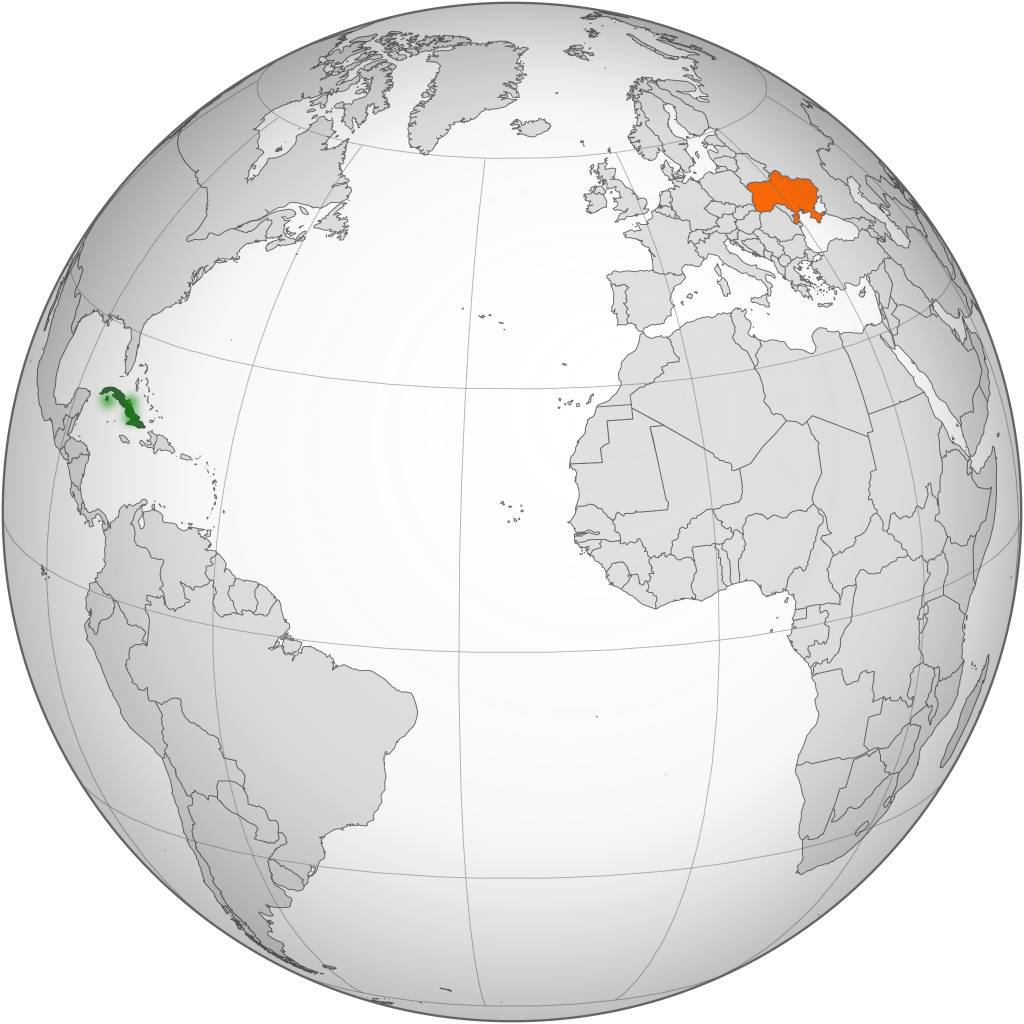
Ukraine for Cuba? Why not? I’m just thinking out loud here, but if the Russians were to launch an invasion of Ukraine (even a “minor” one), then the United States should invoke the Monroe Doctrine (look it up!) and invade Cuba. #LiberateCuba #TitForTat
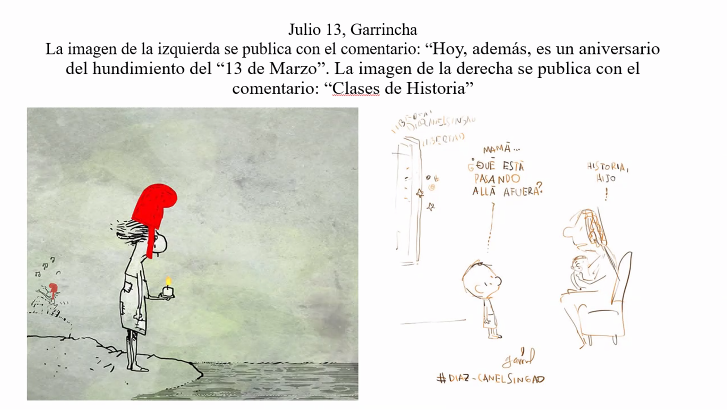
During the Thirteenth Conference on Cuban and Cuban-American Studies at FIU this past week, I discovered the work of Garrincha, which is the pen name of Gustavo Rodriguez, a Cuban-born artist who now resides in the USA. Both of his cartoons pictured below were published on 13 July 2021, two days after the unprecedented July 11 populist revolt in Cuba, which was brutally repressed by the Cuban military. The cartoon to the left refers to the 37 men, women, and children who drowned at sea when their vessel — the tugboat “13 de marzo” — was deliberately fired upon and destroyed by the Cuban Coast Guard on 13 July 1994, a crime that will live infamy. In the cartoon to the right, a child asks his mother what is going on outside. Her reply: “History, my son.”
where c is the universal constant for the speed of light.
In words, the speed of light traveling through a vacuum is about 186,282 miles per second, or exactly 299,792,458 meters per second (hat tip: @pickover).
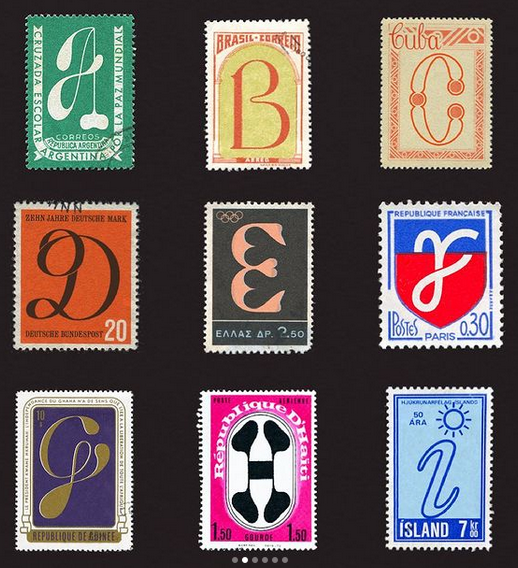
Via Kottke: “artist and type designer Marie Boulanger selected 26 postage stamps from around the world with letters on them (C for Cuba, F for France, K for Kenya, etc.) and 10 stamps with the numerals 0-9 on them.” Nine of her postage stamps are pictured below. Check out her Instagram here.
I have just posted to SSRN a revised and corrected version of my forthcoming chapter “Breaking Bad Promises” — to be published in Joshua Heter & Brett Coppenger, editors, Better Call Saul and Philosophy (Open Universe), which is now in press. (You may pre-order a copy of the book here.)
I am interrupting my multi-part series on “Coase and the Constitution” to let everyone know that I have posted to SSRN a revised version of my latest paper, which is titled “The Leibniz Conspiracy” and which will be published in the Journal of Law & Public Policy in the spring. In summary, I retell the story of Godel’s belief in a worldwide, centuries-long conspiracy to suppress the work of Gottfreid Leibniz (pictured below, left), showing how even the greatest logician since Aristotle could engage in conspiracy thinking, and I propose a solution for dealing with conspiracy theories today: a retrodiction conspiracy theory market. But at the suggestion of Professor Steven J. Brams, I made one significant revision to my paper: I replaced my proposed “conspiracy theory court” with a more simple and elegant solution. Specifically, instead of appointing an external arbiter to resolve the truth or falsity of any given conspiracy theory, let’s just keep the conspiracy theory market open indefinitely. That way, any bettor can opt out at any time, pocketing his winnings if the current price is above what he paid for his bet (either for or against the conspiracy) or taking a loss at the current price. In summary, the logic of keeping the market open indefinitely, instead of appointing an arbiter, is that bettors will presumably stay in if they think the price of their bets will increase, or they can opt out if they think the price will fall. The price will therefore track aggregate belief or non-belief in any given conspiracy theory, with no necessary final resolution, and as Professor Brams pointed out to me, bettors would still have an incentive to seek new information, information that not only supports their choice but that is also likely to persuade other bettors, thereby advancing the search for the truth.
Trent J. MacDonald, a research fellow at RMIT University, cites “Coase and the Constitution” on page 86 of The Political Economy of Non-Territorial Exit(Elgar, 2019), a beautiful book that “explores the theoretical possibility of ‘unbundling’ government functions and decentralising territorial governance.” Below is a screenshot of the relevant passage (just click on the passage to see it in its entirety), along with a picture of the book’s cover:
Alas, although MacDonald is correct to note “the transferability of legal rights” and the possibility of transfers of authority between different governmental units, his focus is on the ability of people to “vote with their feet” (so to speak) by moving to those cities and states whose public policies they prefer. The fatal flaw with this observation, however, is that it ignores what Coase’s disciples like to call “transaction costs.” To the point: moving from one place to another is not costless, so many people will, in fact, stay put even if they don’t like the government policies of the place where they live.
Moreover, putting the transacation-cost problem aside, MacDonald — like Sundquist; see my previous post — is talking about markets in a metaphorical sense, whereas my Coase paper proposes an actual “federalism market” in which various governmental units and private firms would compete with each otherto purchase the right to provide a particular public good or for the right to enact their own preferred policies and legal rules for a specific sector of the economy. I explain how this market would work in my Coase paper, but so far, it looks like I don’t have any takers …
Christian B. Sundquist, a law professor at the University of Pittsburgh, cites “Coase and the Constitution” as part of his discussion of “competitive federalism” in his 2017 law review article “Positive Education Federalism.” To the point, Professor Sundquist writes (p. 359):
“The model of competitive federalism … seeks to promote a deregulated ‘free market’ at both the state and federal level through incorporation of the economic principles of consumer choice and competition.” (Here, Sundquist drops a footnote, #44, and cites several scholars, including yours truly.)
Although Sundquist’s one-sentence description of “competitive federalism” — an ideal world in which national and state governments compete with each other to win over the hearts and souls of the people — is no doubt an attractive one, this vision is too watered-down compared to what I specifically propose in my Coase paper. What I propose is an actual “federalism market” in which various governmental units and private firms would have to compete with each other for the right to enact rules for a specific domain.


















 prior probability