
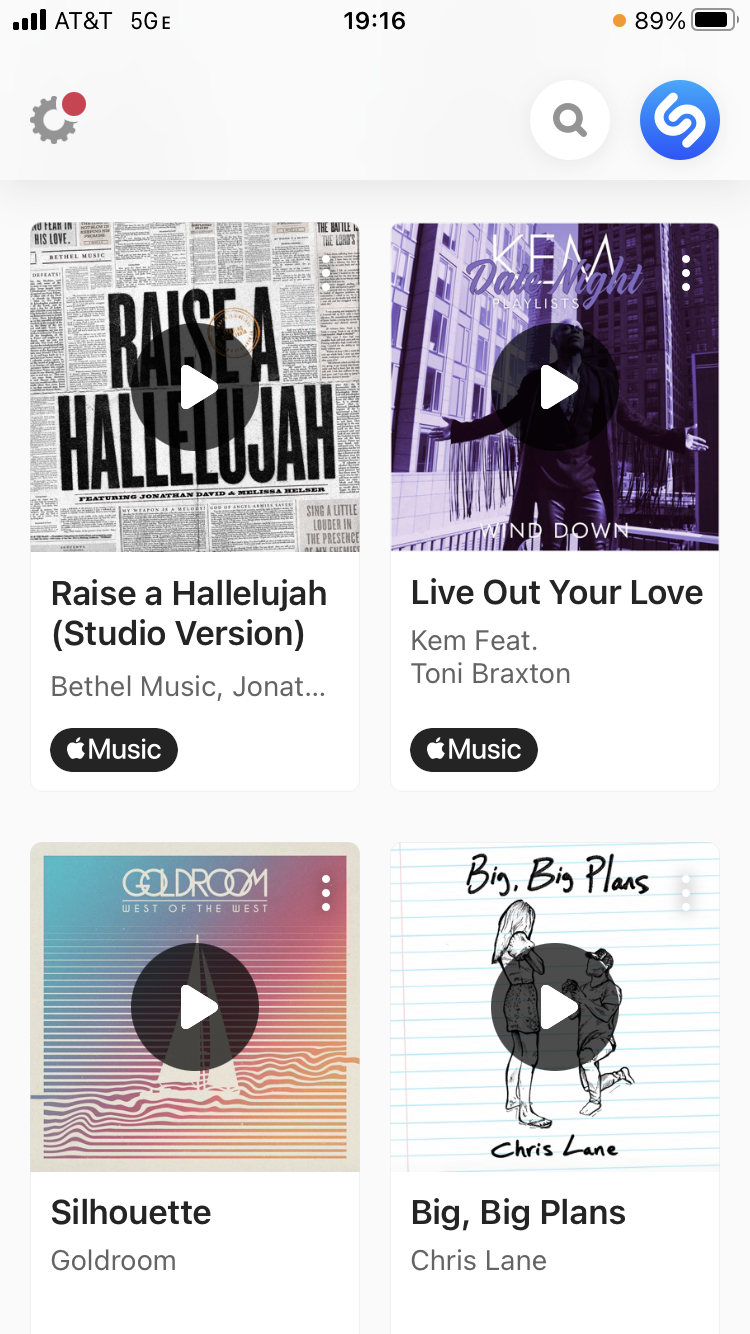
We will jump into Chapter 1 of “Anarchy, State, and Utopia” in the next day or two; in the meantime, below are screenshots of my most recent “Shazams”:

Creative Commons
Blogs I Follow








We will jump into Chapter 1 of “Anarchy, State, and Utopia” in the next day or two; in the meantime, below are screenshots of my most recent “Shazams”:


I am reblogging part 2 (see below) of my in-depth review of Robert Nozick’s “Anarchy, State, and Utopia.” Among other things, the post below explores the problem of coercion and asks, when is collective coercion against an individual ever justified? (John Stuart Mill, for example, famously argued that coercion is only justified to prevent harm, but how should we define the concept of “harm”?) Also, looking back on my original post from four years ago, I would pose several additional questions to my fellow readers of Nozick. Specifically, how should we define such key terms as “fraud” and “theft” and “contract”? (Under our Anglo-American common law tradition, for example, not all promises are legally-enforceable and not all acts of deceit are “torts” or civil wrongs.) Also, however those key terms are defined, the moral or legal “badness” of fraud or theft implies that people have a right to private property and a right to “truth”, so to speak–i.e. a right not to be lied to. But why is telling a lie wrong, i.e. a violation of one’s rights? More fundamentally, doesn’t my right to private property in X, by definition, deprive you of the right to X, especially if you haven’t consented to this arrangement? These are some of the questions that Nozick will have to answer as we proceed …
Nozick’s preface sets forth his main conclusion: only a “minimal state”–i.e. a collective “limited to the narrow functions of protection against force, theft, fraud, enforcement of contracts, and so on”–is consistent with the principle of individual rights. Nozick further concludes that a collective may not use coercion to promote distributive justice (reduction of income inequality) without violating individual rights, and he also tells us that he arrived at these libertarian conclusions “with reluctance.” Be that as it may, these conclusions raise a new set of difficult (and perhaps unanswerable) questions. At what point, for example, does a state stop being “minimal”, and further, what rights do people have? Yet, as we mentioned in our previous post, Nozick’s makes no attempt (so far) to identify what these sacrosanct individual rights consist of. By all accounts, it looks like Nozick is against coercion and that respect for individual rights must entail…
View original post 52 more words
Back in the fall of 2017 and extending off-and-on into the summer of 2018, I wrote up and posted to this blog a page-by-page, chapter-by-chapter review of Robert Nozick’s work “Anarchy, State, and Utopia,” one of the all-time most influential books of political philosophy–and deservedly so! In honor of Nozick’s birthday (16 November 1938), and to commemorate the upcoming 20th anniversary of his death (23 January 2002), I will be re-posting in the days and weeks ahead my in-depth review of Nozick’s classic work. Here is a revised version of Part 1 of my 2017/18 review, “Nozick’s Premise“:
Nozick’s preface in “Anarchy, State, and Utopia” begins with this famous sentence: “Individuals have rights and there are things no person or group may do to them (without violating their rights).” This Kantian premise is an attractive and appealing one, but is Nozick’s opening gambit simply a sophisticated case of circular reasoning or question begging? At a minimum, Nozick will have to answer the following questions: (1) What do these rights consist of? (2) What remedies are we entitled to when our rights are violated? (3) Who decides when our rights have been violated? (4) Why are violations of our rights, however such rights are defined or enforced, wrong? And (5) are there any exceptions to Nozick’s premise; i.e. when, if ever, can we violate someone else’s rights? In short, Nozick has a lot of explaining to do!
I will further explore Nozick’s thought-provoking preface in my next post …

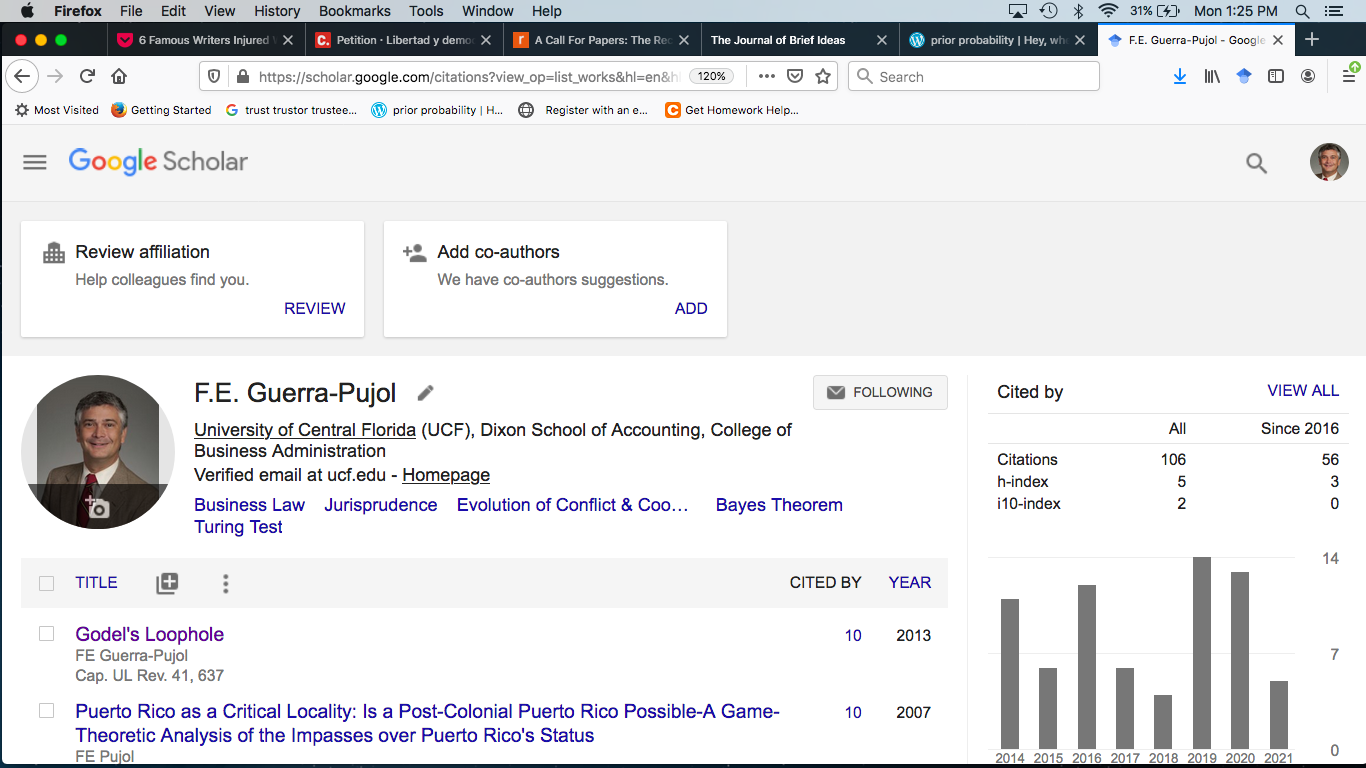
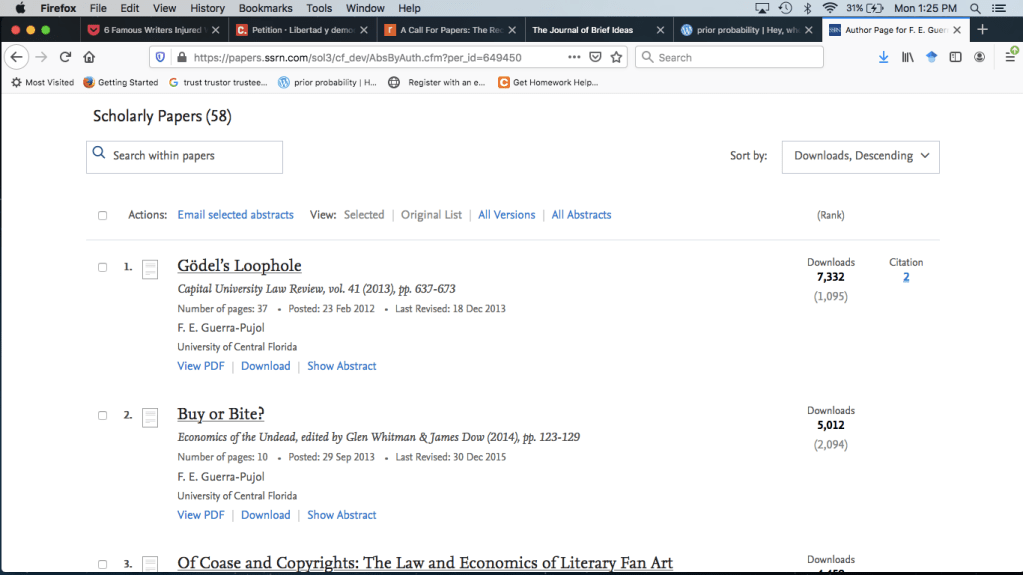
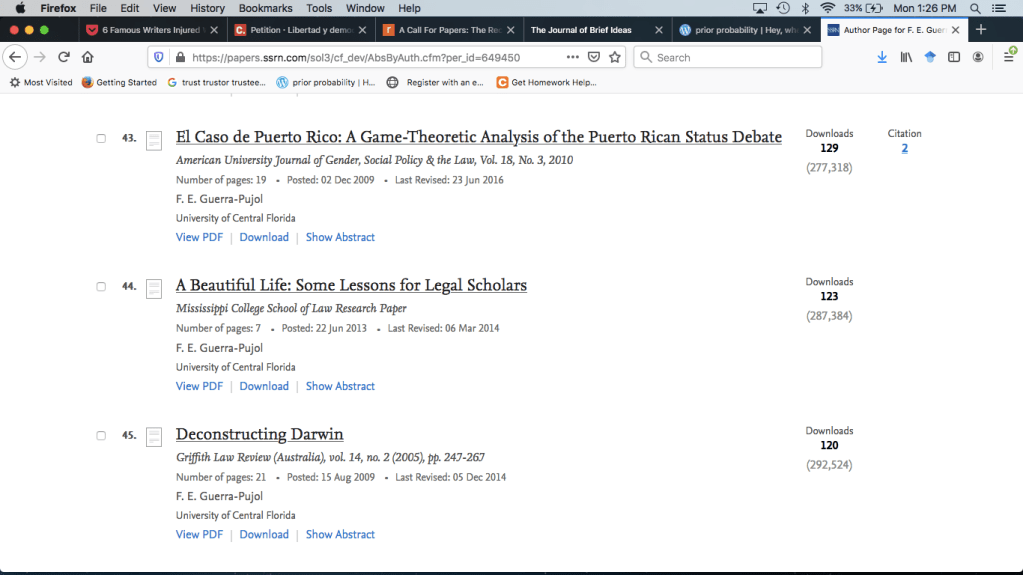
According to Google Scholar, two of my papers have been cited 10 times by other scholars (my 2014 paper “Goedel’s Loophole” and my 2010 paper “A Game-Theoretic Analysis of the Puerto Rico Status Debate“; see screenshot immediately below this paragraph), but according to SSRN (a popular platform scholars use to post ungated versions of their work), those same two papers have only been cited twice (see the other two screenshots on the bottom of this post). I love SSRN, but what is the source of this discrepancy?
You may have already heard that Netflix will be releasing Season 2 of “Tiger King” on November 17, 2021. (See here, for example.)
In related news, my July 2020 law review article, “Teaching Tiger King“, was recently published in final form in Volume 65 of the Saint Louis University Law Journal. (Shout out to Michael McMahon, the managing editor of the special teaching issue in which my paper was published, for his helpful comments, suggestions, and edits.) You’re welcome!

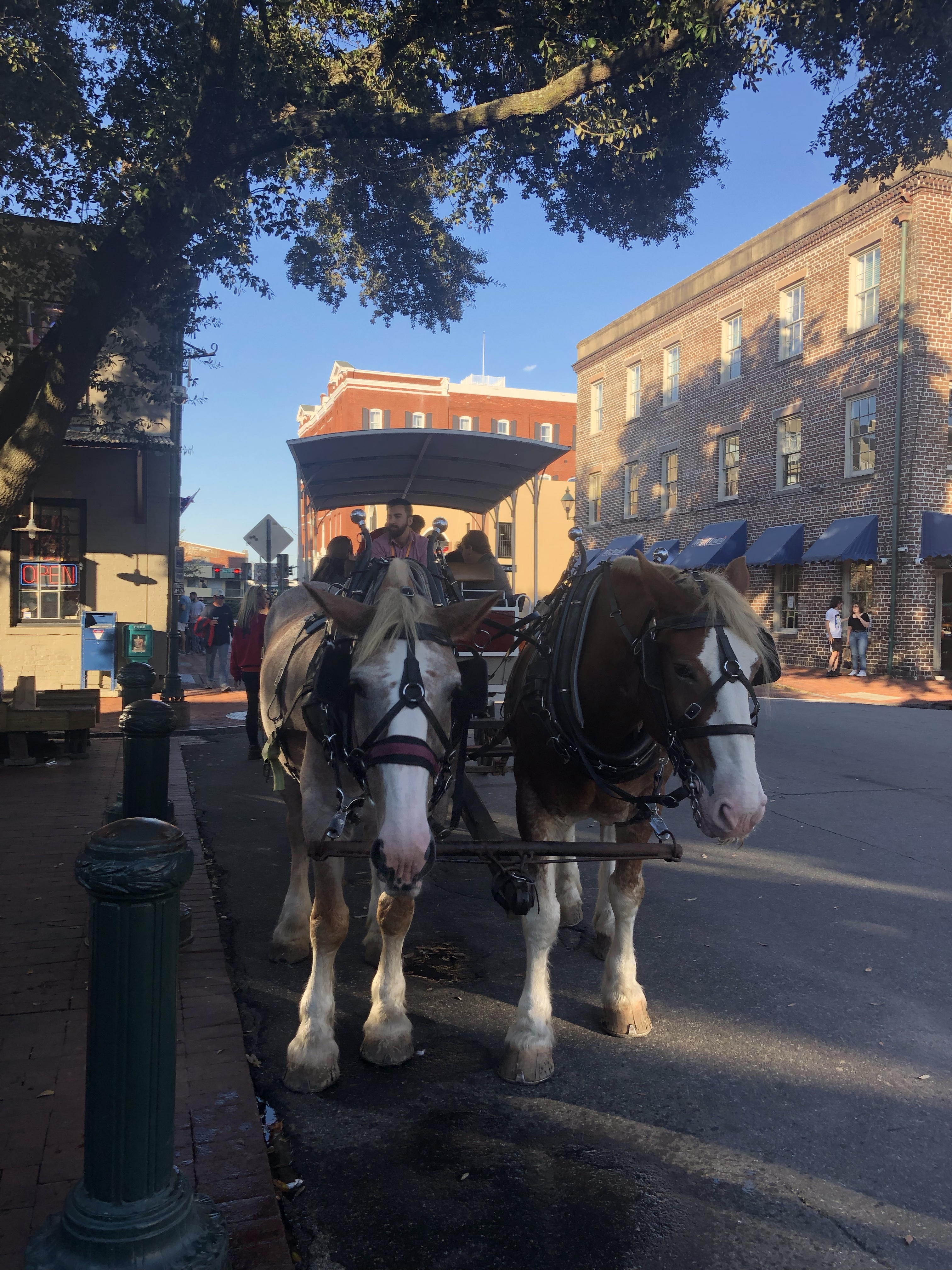
I attended my fifth and final scholarly conference of the fall semester: two via Zoom (the Central States Law School Association and LatCrit); one in the hybrid format, which I attended in person (the International Adam Smith Society in Madison, Wisconsin); and most recently, two in person (the Florida Statewide Undergraduate Research Symposium in Gainesville, Florida and the Southeastern Academy of Legal Studies in Business or “SEALSB” in Savannah, Georgia). Below are some pictures from my time in Savannah this weekend during the SEALSB conference:







You can find many more mathematical LEGO sculptures here.

The first I ever heard about Chegg was in the spring of 2021, when I discovered that some students were posting the answers to my quiz questions on the Chegg platform — quiz questions that I had created myself, by the way. At that time, Chegg was a $12 billion company, and Chegg’s stock was trading at over $100 per share.
Instead of punishing my students, however, I decided to go after Chegg itself and its corrupt management team. I filed a complaint with the Federal Trade Commission (FTC), and I wrote a paper called “The Chegg Conspiracy” explaining why Chegg’s officers should be criminally prosecuted for wire fraud. As it happens, I will be presenting my paper this weekend at the annual meeting of the Southeastern Academy of Legal Studies in Savannah, Georgia (#SEALSB2021). But this update doesn’t have to do with my paper; instead, it’s about Chegg itself.
When I first posted the original draft of my Chegg paper to SSRN on August 25, 2021, Chegg’s stock price had gone down to $80. A few weeks later (September 13, 2021), a major multinational publishing company called Pearson initiated a copyright infringement lawsuit against Chegg in the U.S. District Court for the District of New Jersey, and since then, Chegg’s shares have steadily declined in value. But on November 1st of this year, Chegg’s stock price took a dramatic plunge — it went from $62 to $32 in a single day!
So, what happened on Nov. 1st? That was the day Chegg released its quarterly financial report. (See here for a summary.). Among other things, Chegg announced that its paid subscribers fell to 4.4 million, an unexpected decline from 4.86 million in the previous quarter and a small fraction of the almost 20 million college and university students overall. (See here, for example.) Is this the beginning of the end for Chegg? Let’s hope so …

Below the fold is a small sample of English-language dailies marking the end of “the war to end all wars” — the original Armistice Day (11 November 1919).
Continue reading


Hopefully It’s Interesting.
In Conversation with Legal and Moral Philosophers
PhD, Jagiellonian University
Books, papers, and other jurisprudential things
Ramblings of a retiree in France
BY GRACE THROUGH FAITH
Natalia's space
hoping we know we're living the dream
Lover of math. Bad at drawing.
We hike, bike, and discover Central Florida and beyond
Making it big in business after age 40
Reasoning about reasoning, mathematically.
I don't mean to sound critical, but I am; so that's how it comes across
remember the good old days...
"Let me live, love and say it well in good sentences." - Sylvia Plath
a personal view of the theory of computation
Logic at Columbia University
Just like the Thesis Whisperer - but with more money
the sky is no longer the limit
Technology, Culture, and Ethics
Just like the horse whisperer - but with more pages
Poetry, Other Words, and Cats

 prior probability