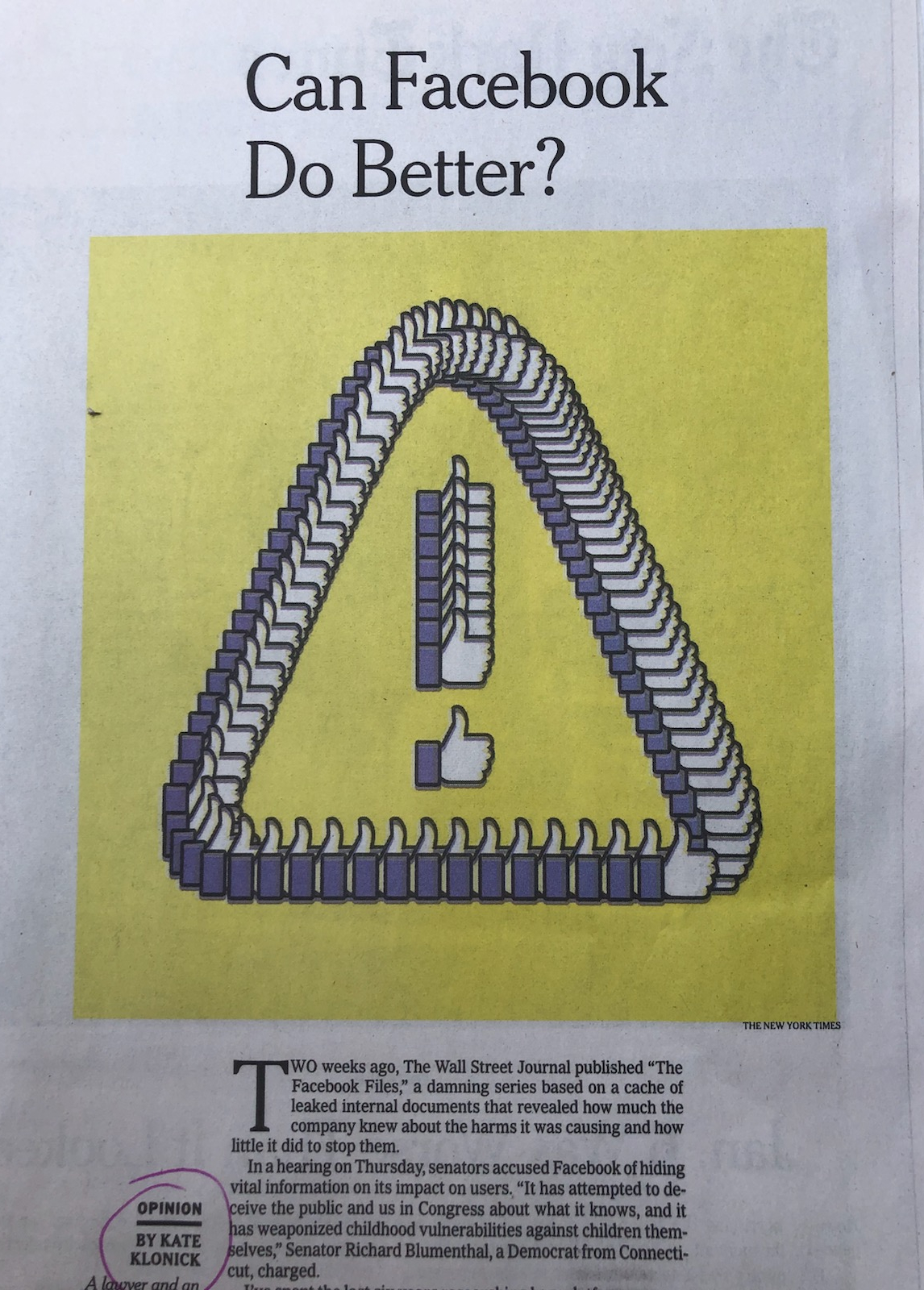
Can Facebook do better? Compared to what?

The first question forms the title of this recent op-ed in the New York Times by Kate Klonick, a social media expert who is a law professor at St John’s University Law School as well as a fellow at the Yale Law School and the Brookings Institution. Professor Klonick’s question also provides me a golden opportunity to conclude my review of Mark Lemley’s paper “The Contradictions of Platform Regulation“.

For starters, how are we supposed to answer Professor Klonick’s rhetorical question? To the point: “Compared to what?”

Alas, although Prof Klonick makes a number of good points, her op-ed contains no comparative analysis whatsoever. Instead, she criticizes the way Facebook measures “user engagement” and then recommends “laws demanding transparency from platforms, a new agency to specialize in online issues, and more science.”

For my part, although I agree with Klonick’s call for “more science”– i.e. more independent studies about the harmful and beneficial effects of social media — I caution against her call for more laws and a new public Internet agency for the reasons Mark Lemley gives in Part 2 of his excellent paper. In summary, Professor Lemley gives two-and-a-half slam-dunk reasons why calls for regulation of tech platforms are likely to backfire:

1. Trade-offs are unavoidable (p. 324): “Real regulation of technology platforms is likely to require difficult tradeoffs, giving some people what they want but making things worse in other respects.”

2a. Perverse effects on new entrants: Regulations often make it difficult for new entrants to compete with existing big players, or in Lemley’s own words (p. 332): “… once government creates a comprehensive set of regulations for an industry, it makes it harder for others to break into that industry, since they don’t have the experience dealing with those complex regulations.”

2b. Entrenchment effects (p. 335, footnote omitted): “… in the long run, regulatory choices that impose obligations on incumbents to do the things we want them to do as a matter of social policy are likely to entrench those incumbents, making it harder and more costly for someone to compete with them and eliminating the possibility of competing by offering a different set of policies.”

Notice that I say “two-and-a-half reasons” because the last two points are really two sides of the same coin, but be that as it may, the larger point that Lemley (and I) want to make is that bottom-up competition, not top-down regulation, is the way to go. If you don’t like Facebook, there is always Twitter and TikTok! And if you don’t like Twitter or TikTok, why not start your own social network? My motto, then, is let a thousand social media sites bloom! Yes, all of these platforms are going to be imperfect, but I want to live in a world where users have choices, where it is easy for new platforms to enter the Internet market.
IMG_4196

Posted in Uncategorized | Leave a comment

Twitter Tuesday: The Parable of the Spoons

Here is a link to the Tweet thread by @balajis posted below, and here is a link to Alex Tabarrok’s blog post titled “The Lesson of the Spoons” referenced in the Tweet thread. I cannot, however, find any source authored by the great Milton Friedman himself — or by his co-author and wife Rose Friedman — retelling this modern-day parable.

Screen Shot 2021-10-05 at 3.20.37 AM

Posted in Uncategorized | Leave a comment

Blessing of the Animals

Today is the Feast Day of Saint Francis of Assisi. In his honor, pictured below is “The Blessing of the Animals” (1974-1978), a mural by Leo Politi, located on 125 Paseo de la Plaza in my hometown of Los Angeles, California. More details about this wonderful tradition and mural are available here.

Posted in Uncategorized | Leave a comment

IASS Madison 2021 Final Schedule Announced!

The final conference program of the annual meeting of the International Adam Smith Society (IASS), to be held in Madison, Wisconsin from Oct. 15 to Oct. 17, has now been posted on the IASS website. (See below.) I will be presenting my work on “The Lost History of Adam Smith’s Private Life” — with a focus on Smith’s eventful year abroad in Paris (1766) — on Friday morning, October 15. In the meantime, feel free to read my March 2021 refereed paper “Adam Smith in Love.”

adamsmithsociety's avatarInternational Adam Smith Society

The final schedule for our upcoming 2021 conference in beautiful Madison, Wisconsin has been posted to the website. You can find it here. Please be sure to check your presentation dates, times, and roles as some have changed.

See you soon!

View original post

Posted in Uncategorized | 3 Comments

Happy Birthday, Charlie Brown

According to this entry in Wikipedia, the first Peanuts cartoon was published on this day (October 2) in 1950.

Posted in Uncategorized | Leave a comment

Friday flowers

One of the advantages of walking versus cycling or driving is that one often finds little surprises that one might otherwise have missed. Pictured below, for example, are some of the flowers I encountered during my previous walk.

(Weather permitting, on my non-teaching days I like to ditch my car after dropping my daughter off at her school; walk home via Dubstread, Orlando’s oldest golf course; shower and then make myself a Cuban-style cafe con leche; devote the rest of my morning to reading or writing, or both; prepare brunch for my wife and me around Noon; clean out my inbox and respond to emails; and then walk back to my daughter’s school when it’s time to pick her up at 3. The rest of my day is devoted to office hours via Zoom and then to my family, i.e. dinner and a movie.)

Posted in Uncategorized | 1 Comment

The Peoples of Iran

Posted in Uncategorized | Leave a comment

PSA: Beware Big Tech

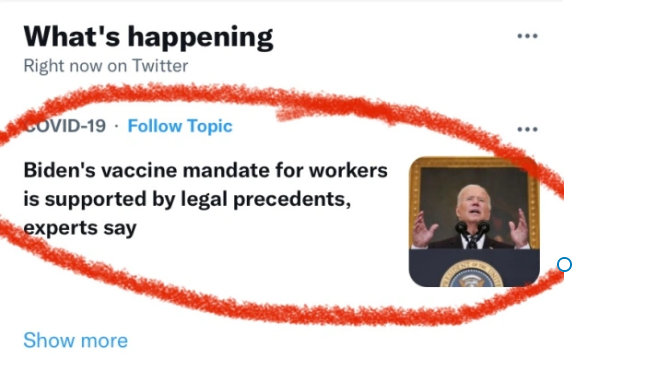
The notification pictured below popped up in my Twitter feed yesterday:

Screen Shot 2021-09-30 at 8.33.10 AM

Really? Who the Hell are these “experts”? Alas, the claim contained in this notification is false! While some liberal legal scholars might agree with this claim, conservative legal scholars, like my colleague and friend Jonathan Adler (see here, for example), are far more skeptical of OSHA’s authority to impose a vaccine mandate in the absence of federal legislation delegating such a power to that agency. (For the record, it would be more correct to say that Congress has the power under the Commerce Clause to enact a nationwide mask or vaccine mandate, but Congress has yet to enact such a law.)

On a related note, this piece of big tech misinformation takes me to the recent news that YouTube has now decided to block all videos with anti-vaccine content, even though the effectiveness of the Wuhan-virus vaccines, especially when compared with natural immunity, has been called into question by many reputable sources. (See here, for instance. Also, as an aside, I am now referring to COVID-19 as the “Wuhan virus” as it is more likely than not that the virus originated in the now-infamous Wuhan Institute of Virology via an accidental lab-leak.) Say what you will about the latest round of Big Tech censorship, I will concede that YouTube is responding to a legitimate problem: the spread of misinformation and fake news on the Internet. But as the egregious example above shows, we must also ask, Who guards the big tech guardians? What happens when Big Tech itself is the source of misinformation?

Although I am generally skeptical of regulation (see by way of example my recent 12-part review of Balkin’s social media paper or the ongoing and in-depth series of this excellent blogger on “Baptists and bootleggers”), I am also highly distrustful of Big Tech. So, what is to be done? This difficult dilemma, however, nicely sets the stage for my review of Part 2 of Mark Lemley’s platform paper next week!

Posted in Uncategorized | Leave a comment

Merry Michaelmas!

Yes, today (9/29) is the Catholic feast day of Michaelmas! More details about the meaning and history of Michaelmas can be found here and here.

F. E. Guerra-Pujol's avatarprior probability

View original post

Posted in Uncategorized | Leave a comment

Lemley on data security and hacker threats

Note: this is post #4 of a multi-part series.

Thus far, we have seen how proposals to reform “Section 230 Immunity” or to regulate the Internet advertising market are either contradictory or likely to backfire (see here re: § 230 and here re: ads). What about the problem of black hat hackers and data breaches? Why can’t we use the law to protect or at least enhance user privacy and the security of user data from external hacking threats? Alas, here is another area where our lofty legal rhetoric and growing calls for regulation fail to match up to our technological reality. If anything, as I shall explain below, it is the government who represents the greatest threat to our data privacy!

As Lemley notes in Part 1 of his paper (p. 318), “we want to stop [black hat] hacks and data breaches.” By way of example, in July of 2019 Facebook agreed to pay a $5 Billion fine to the Federal Trade Commission for allowing private user data to be exposed (see here, for instance), and numerous States have enacted local laws imposing legal liability on companies with insecure data- and information-protection systems. (On this note, see the sources in footnote 63 of Lemley’s paper.) But here’s the rub: when tech companies respond to our demand for privacy by providing strong end-to-end encryption platforms like WhatsApp or secure devices like the Apple iPhone, it is the government — specifically, law enforcement agencies — who ends up objecting to and thwarting these technological privacy protections!

Once again, Professor Lemley is worth quoting in full (p. 319, footnotes omitted, emphasis added): “Law enforcement, it turns out, wants to make sure it has a back door into our phones and our text messages, and if there isn’t one it has even tried to force tech companies to build it. This is a battle that has been continuing for a quarter century, since the government tried to build a backdoor into digital phone technology in the 1990s. The issue then was secret communications supporting terrorism, while more recently it tends to be child sexual abuse or, even more recently, white supremacy. But the claim is the same: People will use encryption to hide the bad things they are doing, so law enforcement must have the power to break encryption.”

I will sum up by restating the irony of this perverse state of affairs: (a) Hackers are a threat, and people want to protect their communications and their devices; (b) private tech companies build end-to-end encrypted systems to thwart hackers and meet this legitimate demand for privacy; (c) government agencies, however, insist on a “back door” to maintain their snooping powers, making it easier for hackers to access our data. But we can’t have it both ways. As Professor Lemley correctly points out toward the end of Part 1 of his paper, when we use law to require encrypted platforms and devices to have “backdoors” for law enforcement agencies, we are also inevitably making those same systems more vulnerable to black hat hackers!

I will proceed to Part 2 of Lemley’s two-part paper next week, beginning on Monday, Oct. 4.

Backdoor To WhatsApp End-To-End Encryption | by d'wise one | Chip-Monks |  Medium
* except, of course, the government.

Posted in Uncategorized | Leave a comment