
Check out this beautiful collage of the Moon in 48 different hues. This original work of “Moon art” was created by Marcella Giulia Pace. (More details about her project are available here; hat tip: Kottke.)

Check out this beautiful collage of the Moon in 48 different hues. This original work of “Moon art” was created by Marcella Giulia Pace. (More details about her project are available here; hat tip: Kottke.)
I recently reviewed Jack Balkin’s paper on social media regulation and ended up giving it a mere “D minus” (see here, for example). But what would an “A plus” platform regulation paper look like? In a word, it would look like this. To the point, in the same volume in which Balkin’s sub-par paper appears, Stanford law professor Mark Lemley has published an excellent essay titled “The Contradictions of Platform Regulation“, which is, simply put, one of the best papers on Internet regulation that I have read thus far. Lemley’s work is deserving of more attention, so I will begin writing up a multi-part review of Professor Lemley’s new paper starting on Monday of next week …

Imagine an alternative social network, one without like buttons or noisy notifications — an anti-Facebook where the feed is reverse chronological, not algorithmic, and where nothing is monetized. Imagine no more …
In particular, check out Minus — https://minus.social/ — a “finite” social network in which each user gets 100 posts, period. According to Minus’s website: “The site’s only visible metric counts down, showing how many posts each user has remaining.” Although users may reply to a post as often as they like, each user is allotted a maximum of 100 posts for life. Check it out for yourself and tell me what you think …
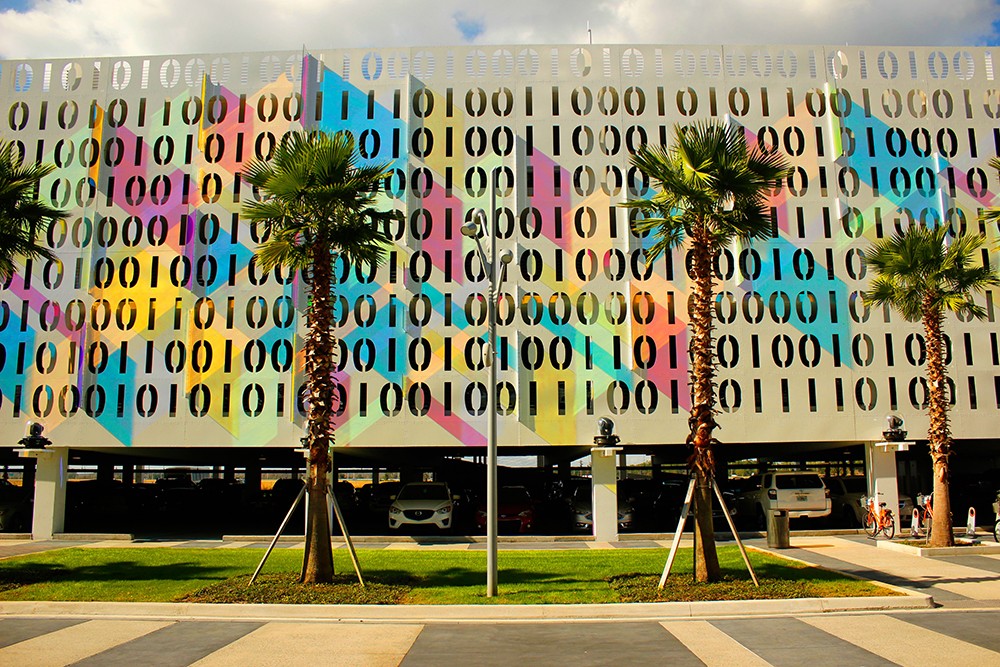
The “code wall” parking garage at the Lake Nona Town Center in Orlando, Florida has to be one of the most beautiful and creative parking structures in the world. For additional details, check out this short entry from the London International Creative Competition (LICC) and this more detailed report by Eva Recinos (via Vice).

Those are the opening words of the 1978 song “September” by one of the greatest North American bands of all time: Earth, Wind & Fire. For me, this song brings back so many beautiful memories from my childhood in Los Angeles, California. (Hat tip: Kottke.)
In addition to my regular teaching duties and service commitments, this fall I will be presenting some of my ongoing research projects (in bold) at the following upcoming conferences:

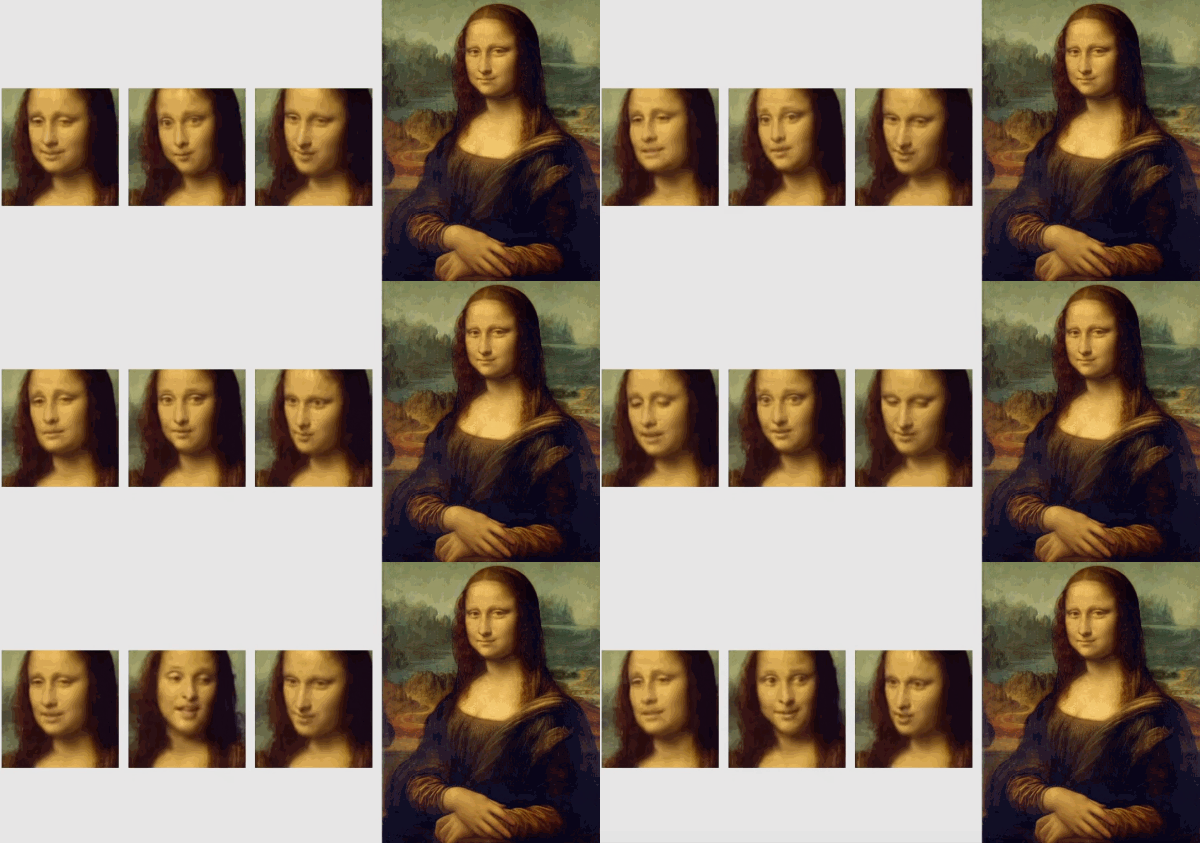
Check out this fascinating report in Tech Crunch by Devin Coldeway, who explains how computer scientists used “machine learning” and AI techniques to bring Leonardo da Vinci’s famous portrait of the Mona Lisa to life.
For your reference, below is a compilation in chronological order of my 12-part critique of Yale law professor Jack Balkin’s call for regulation of social media platforms:
This is my last post in this series.
Yale Law School Professor Jack Balkin concludes his social media regulation paper with the following paragraph, which I will quote in full below:
“We should regulate social media because we care about the digital public sphere. Social media have already constructed a digital public sphere in which they are the most important players. Our goal should be to make that digital public sphere vibrant and healthy, so that it furthers the goals of the free speech principle—political democracy, cultural democracy, and the growth and spread of knowledge. To achieve those ends, we need trustworthy intermediate institutions with the right kinds of norms. The goal of regulation should be to give social media companies incentives to take on their appropriate responsibilities in the digital public sphere.”
Before proceeding, notice that Prof Balkin’s conclusion consists of five separate sentences. The ideas expressed in all of these concluding sentences, however, are either vacuous or tautological. For starters, consider Sentence #1 (emphasis added): “We should regulate social media because we care about the digital public sphere.” Bullshit! We could just as well argue that we should leave social media alone for the same reason: precisely because “we care” about the digital public square.
Similarly, Sentence #2 is just as vacuous as #1, setting forth the following non-sequitur (emphasis added): “Social media have already constructed a digital public sphere in which they are the most important players.” Sigh. Of course social media platforms are “the most important players” in this space; without these platforms, there would be no digital public square to speak of. So what?
Sentence #3, however, is the most vacuous sentence of them all (emphasis added): “Our goal should be to make that digital public sphere vibrant and healthy, so that it furthers … political democracy, cultural democracy, and the growth and spread of knowledge.” Alas, as I mentioned previously, Balkin doesn’t bother to define what he means by “vibrant” and “healthy”; nor does he make a persuasive case that regulation would achieve these lofty but undefined goals instead of making matters worse.
Next, Sentence #4 contains this brilliant piece of circular reasoning (emphasis added), “To achieve those ends [i.e. a healthy and vibrant digital public square], we need trustworthy intermediate institutions with the right kinds of norms.” Again, however, Balkin does not spell out what these “norms” are; nor does he explain how regulation would generate these optimal social media norms. Worse yet, when it comes to Internet governance, Balkin simply assumes that governments are more trustworthy than private companies, an assumption that is dubious at best.
Finally, Sentence #5 concludes with this vacuous and empty observation (emphasis added), “The goal of regulation should be to give social media companies incentives to take on their appropriate responsibilities in the digital public sphere.” But above and beyond the formulation and even-handed enforcement of their content moderation policies (and, I might add, the reduction of enforcement errors), what are these “appropriate responsibilities”?
This omission on Prof Balkin’s part shows us the overall problem with his call for social media regulation. To the point, Balkin never provides us with a well-defined yardstick for deciding whether social media policies are furthering or hindering the goals of a “healthy and vibrant” digital public square. By contrast, I would argue that our digital public square has never been healthier or more vibrant (defined in terms of the number of social media options we have and the general level of freedom we have on each platform), I would further argue that social media regulation, by increasing compliance costs and liability risks, would very likely make matters worse by discouraging new entrants from entering the social media market.
It’s time to bring this review to a close by assigning Professor Balkin’s work a letter grade. Although I am generally an easy grader, Balkin is a law professor at Yale, so I will grade him on a curve. In particular, given his susceptibility to the Nirvana Fallacy (a rookie mistake), his vacuous and woefully inadequate reasoning (see above), and his utter inability to define key terms, Balkin’s work merits a “D minus” at best.

This is the next-to-last post of a multi-part series.
Jack Balkin concludes his social media regulation paper by taking a closer look at “intermediary liability” — i.e. the idea that social media platforms should be legally liable for unlawful content posted by end-users.
In brief, Professor Balkin’s position is that the government should start operating more like a social media Mob boss: it should offer complete intermediary immunity to social media companies in exchange for substantial concessions from them. (“Nice social media platform you got here; it would be a pity if anything happened to it.”) To the point, Prof Balkin states (p. 93) that the law “should use intermediary immunity as a lever to get social media companies to accept fiduciary obligations toward their users” and to get these firms “to invest in increasing the number of [content] moderators they employ as well as providing more due process for end users.” Alas, Prof Balkin does not bother to tell us what the “optimal” number of content moderators is or how much due process users should be entitled to when their posts are taken down. (Can you blame him? After all, Balkin is a “serious academic”, not a fussy bureaucrat, so he simply can’t be bothered with the niggling details of his call for social media regulation.)
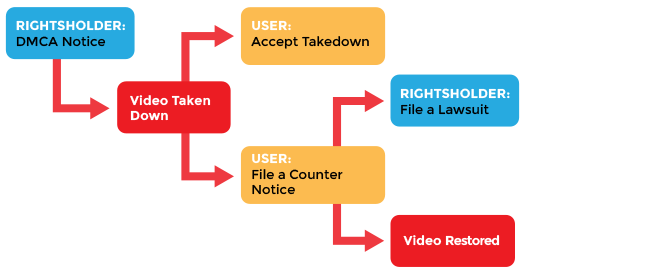
Additionally, Balkin toys with the more promising idea of “distributor liability” (p. 94) by extending the existing costly and cumbersome “notice and take down” system for online copyright infringement, which is pictured below, to all social media content across the board. (The U.S. Congress created the current decentralized system of online copyright enforcement in 1998 when it enacted the Digital Millennium Copyright Act or “DMCA”. For more details, see here, for example.) In summary, under this decentralized system of distributor liability, companies are generally immune from legal liability unless they receive a take-down notice that specific content on their platforms is unlawful; once they receive such a take-down notice, however, social media companies would be required to remove the flagged content within a particular period of time, or else they themselves would be potentially liable for the content.
For my part, I wonder whether extending this “notice and take down” system to social media platforms would be a panacea for all the supposed social media ills that Balkin has been complaining about in his paper, but I will go ahead and give Prof Balkin the benefit of the doubt on this one. Why? Because if we are going to regulate the Internet, the “notice and take down” system is literally “the lesser evil” (the least bad choice among a bevy of bad regulatory alternatives), one with three advantages. First and foremost, the “notice and take down” system would represent a mere modest or incremental change to the existing laissez faire landscape. Secondly, there already is a well-developed body of “notice and take down” law developed by the courts under the DMCA. And lastly, Balkin’s modest proposal presents a decentralized alternative to Internet regulation. (It does not require a government agency to figure out what the optimal number of content moderators is, for example.)
Note: I will conclude my review of Balkin’s social media regulation paper in my next post.










Welcome to the online home of the IASS
Hopefully It’s Interesting.
In Conversation with Legal and Moral Philosophers
PhD, Jagiellonian University
Books, papers, and other jurisprudential things
Ramblings of a retiree in France
BY GRACE THROUGH FAITH
Natalia's space
hoping we know we're living the dream
Lover of math. Bad at drawing.
We hike, bike, and discover Central Florida and beyond
Making it big in business after age 40
Reasoning about reasoning, mathematically.
I don't mean to sound critical, but I am; so that's how it comes across
remember the good old days...
"Let me live, love and say it well in good sentences." - Sylvia Plath
a personal view of the theory of computation
Logic at Columbia University
Just like the Thesis Whisperer - but with more money
the sky is no longer the limit
Technology, Culture, and Ethics
Just like the horse whisperer - but with more pages
Poetry, Other Words, and Cats


