Some open questions about Adam Smith’s Glasgow period

The celebrated Scottish moral economist Adam Smith was a professor at the University of Glasgow (then known as the College of Glasgow, pictured below) from 1751 until early January 1764, when he abruptly left the college in the middle of the 1763-64 academic year to accompany the young 3rd Duke of Buccleuch on his grand tour. Below are some excerpts from Chapter 7 (“Glasgow Enigmas”) of my forthcoming survey of open Adam Smith problems with Salim Rashid (footnotes are below the fold):


Das Freihandelsproblem (the free trade problem). The Act of Union in 1707 not only united Scotland and England into Great Britain; it also lifted oppressive trade restrictions and opened new markets and trading opportunities for Scottish merchants. Glasgow experienced a significant period of prosperity due to its thriving trade with the North American colonies and became a bustling port city, surpassing other British ports like London and Bristol.[1] This prosperity led to the rise of powerful merchants, collectively known as the Tobacco Lords.[2] By 1770, on the eve of the American Revolution, Glasgow was the primary entrepot for Virginian tobacco, much of which was then re-exported to Europe. But did Smith become a free trader during his Glasgow period? Did he ever lecture on the doctrine of free trade, either at the University of Glasgow (1751-1764) or at one of the several private clubs that he was a member of, such as the storied Anderston Club of Glasgow or the Select Society of Edinburgh?[3] Or did Smith first embrace free trade during his extended visit to France (1764-66) or during the time he spent writing and revising The Wealth of Nations (1767-1776)?[4] 

Das Shelburne-Problem. In addition to his regular teaching and administrative duties at the University of Glasgow, why did Adam Smith also agree to take into his home and personally tutor Thomas Fitzmaurice from 1759 to 1761? During this time, Smith corresponded with Fitzmaurice’s older brother, Lord Shelburne, over a dozen times.[5] Considering that Smith was a rather stingy correspondent (he wrote less than 200 of his letters during his entire lifetime!), his correspondence with Lord Shelburne and the responsibility of tutoring his son must have consumed a lot of Smith’s time. Why on Earth did Smith accept this responsibility? Was it to ingratiate himself with Fitzmaurice’s father: John Petty Fitzmaurice, 1st Earl of Shelburne? Was it on account of Lord Shelburne’s wealth and position as a member of the British aristocracy? Did he owe him a favor, perhaps? Also, how many other students, if any, did Smith tutor or take at his home during his Glasgow period, and how much time and effort did this take?

Das Snell-Problem. According to John Rae (1965/1895, pp. 152-153), in June of 1761 the faculty senate of Glasgow University authorized Adam Smith to conduct some business in London on behalf of the university regarding a pending lawsuit involving the Snell Exhibition. In addition, Rae mentions that “on the 15th of October [1761], after his return [from London], he [Smith] reported what he had done [to the faculty senate], and produced a certificate, signed by the Secretary to the Treasury.”[6] Where is that certificate? How long did Smith stay in London, and what other business, if any, did he conduct during this trip? In addition, what was the outcome of this new round of litigation, and why didn’t the previous round of litigation bring the perennial legal controversies surrounding the Snell Exhibition to an end? (In legal speak, why wasn’t the court’s previous decision from the 1740s res judicata?) Are there any additional extant documents (correspondence, receipts, etc.) from Smith’s 1761 trip to London?

Das Hochschulabschluss Problem: Why was Smith awarded an LL.D. degree in October 1762? The University of Glasgow decided to confer on Adam Smith the degree of Doctor of Laws (LL.D.) in October of 1762.[7] Why? In the minutes of the meeting in which the award of Smith’s degree was formally approved, it is reported that Smith’s degree was awarded in recognition of his “universally acknowledged reputation in letters” as well as his success in teaching jurisprudence at the university for many years with “great applause and advantages to the Society.”[8] But given that Smith had already been teaching for over ten years and given that The Theory of Moral Sentiments had been published in 1759, why was the degree not awarded earlier? Also, regardless of the timing of this decision, whose idea was it that Smith should be awarded a degree? Was it Smith himself who asked to be awarded a degree? Or was it the University of Glasgow’s regular policy to award honorary degrees to its own faculty members after, say, 10 years of service or after the publication of an important work?

571 years since The University of Glasgow was founded : r/glasgow
Continue reading
Posted in Uncategorized | Leave a comment

The Lost Year

Below is an excerpt from Chapter 6 (“Adam Smith’s Lost Year: 1747”) of my forthcoming survey of open Adam Smith problems with Salim Rashid (footnotes are below the fold):


“There is a small but significant gap in Adam Smith’s biography: the lost year of 1747, the year of Smith’s 24th birthday. We know that Smith left Oxford ‘for good’ in August of 1746,[1] and we also know that he eventually ‘fixed his residence at Edinburgh’,[2] where he began to deliver a series of ‘freelance lectures on English composition and literary criticism’ somewhere in Edinburgh beginning in 1748,[3] but what was the college dropout doing during the span of time between his departure from Oxford and his move to Edinburgh, i.e. late 1746 to 1748? Alas, no one knows for sure.

“E. G. West (1969, p. 44) claims that Adam Smith spent this lost year writing some of the essays that would later be published posthumously in Smith’s Essays on Philosophical Subjects: West, without a shred of evidence, writes: ‘Much of these two years [i.e. 1746 to 1748] he spent writing. It is probable that in this period he wrote some of the belles-lettres and the essays on astronomy, ancient physics, logic and metaphysics.’[4] Smith’s other biographers, however, are of no help.

“To begin with, all we are told in Dugald Stewart’s Account of the Life and Writings of Adam Smith (1980/1811, p. 272; EPS, I.11) is that, ‘[a]fter a residence at Oxford of seven years’ (i.e. July 1740 to August 1746), the young Smith ‘returned to Kirkcaldy, and lived two years with his mother; engaged in study, but without any fixed plan for his future life’ and that ‘he resolved to return to his own country, and to limit his ambition to the uncertain prospect of obtaining, in time, some one of those moderate preferments, to which literary attainments lead in Scotland.’

“For his part, John Rae adds one extra detail to Stewart’s account. Rae (1965/1895, p. 110, our emphasis) reports that ‘Smith returned to Scotland in August 1746, but his name remained on the Oxford books for some months after his departure, showing apparently that he had not on leaving come to a final determination against going back.’ So, was the young Smith planning on possibly returning to his formal studies at Balliol College at some point? If he was, he must have changed his mind, for according to Rae, ‘Smith concluded that the best prospect for him was after all the road back to Scotland. And he never appears to have set foot in Oxford again.’[5]

“Alas, neither Nicholas Phillipson (2010) nor Ian Simpson Ross (2010) have anything to say about this chapter of Smith’s life. Both biographers skip the year 1747 altogether. The only thing Ross (2010, p. 74) has to say is that Smith ‘went back to Kirkcaldy’ in 1746 and then ‘went off to do the work that led to his world fame as a man of letters.’[6]   Nicholas Phillipson (2010, p. 72), moreover, is even more terse. He simply tells us that ‘Smith left Oxford in late August 1746 and returned to Scotland’ before changing the subject to the Jacobite rebellion of 1745-46 and proceeding to describe Henry Home’s ‘instrumental [role] in launching Smith’s career in 1748 by means of an invitation to deliver two series of lectures in the capital [Edinburgh], on rhetoric and on jurisprudence.’[7]  

“In short, to quote our colleague and friend Glory Liu (2022, p. xvii): ‘Smith left Oxford for Scotland in 1746. We know next to nothing of what happened between then and 1748 ….’ Most of Smith’s biographers simply leapfrog from Smith’s decision to ditch Oxford in August of 1746 directly into Smith’s fateful move to Edinburgh in 1748. But what happened in 1747? How did an Oxford dropout with no prospects become a leading light of the Scottish Enlightenment, the man who would change the world by bringing down mercantilism and championing free trade?”

File:Map of the Royal Burgh of Kirkcaldy 1824.jpg
Map of the Royal Burgh of Kirkcaldy 1824 (Wikimedia Commons)
Continue reading
Posted in Uncategorized | Tagged , , , | Leave a comment

Paris Liberation Day

Today (25 August) is the 81st anniversary of the liberation of Paris from German occupation (see here and here) as well as my first day back in the classroom after the summer break and my 57th birthday!

Posted in Uncategorized | 1 Comment

Sunday song: My boo

I will resume my survey of “Adam Smith problems” in the next day or two; in the meantime, check out the hit song “My boo” by Ghostown DJs from the 1990s:

Footnote: for me, “My boo” is the Tom Brady of music: just as the future hall of fame quarterback was selected as the 199th overall pick in the 6th round of the 2000 NFL draft, according to Wikipedia, this all-time classic peaked at number 31 on the Billboard “Hot 100” on its initial release in 1996. 

Posted in Uncategorized | Leave a comment

Adam Smith and John Wesley’s Final Sermon at Oxford

Below is an excerpt from Chapter 5 (“Das Oxford Problem”) of my forthcoming survey of open Adam Smith problems with Salim Rashid:


“Why did Smith ditch Oxford in 1746? Did this decision have anything to do with John Wesley’s final sermon at Oxford, which he gave two years earlier on 24 August 1744? It was at this sermon that Wesley condemns Oxford University for its failure to live according to the teachings of Scripture, [1] and according to one Smith scholar (our colleague and friend, Ryan Griffiths), ‘Smith would have been expected to be in the audience for the sermon in which Wesley broke from Oxford.’[2] But was the young Adam Smith in attendance when Wesley delivered his last sermon at Oxford on 24 August 1744?[3]

“Even if Smith wasn’t in attendance, he must have heard about this dramatic event and discussed it with others, right? Wesley’s sermon was a famous and consequential event at the time, and it was also a university sermon, which, as far as we can tell, meant that a student like Smith was required to attend.[4] After all, wasn’t Smith required to study theology as part of his Snell Exhibition? And either way, did Smith attend any of Wesley’s other Oxford sermons, and if so, what did he make of Wesley and his ministry? More to the point, did Wesley’s brand of “Scriptural Christianity” (the title of his last sermon at Oxford) influence Smith’s religious views or his subsequent decision to ditch Oxford in 1746?”

Bonus links: for reference, here is the text of John Wesley’s final sermon at Oxford, and here is a summary. Also, check out this excellent lecture on the life of John Wesley by Ryan Reeves (PhD, Cambridge):

[1] See, e.g., Watson 2020. The complete text of Wesley’s last sermon at Oxford is available online: https://wesley.nnu.edu/john-wesley/the-sermons-of-john-wesley-1872-edition/sermon-4-scriptural-christianity/ [https://archive.ph/CLSp0].

[2] Griffiths 2023.

[3] For further details about Wesley’s final Oxford sermon, see Coleman 2017.

[4] Griffiths 2024. Cf. Coleman 2017, p. 2: “As an Oxford fellow, Wesley’s name was placed in the regular rotation of chapel preaching, and he was scheduled for the St. Mary’s canopied pulpit on August 24, 1744, overlooking the dozens of pews designated properly according to the roles of their occupants.”

Posted in Uncategorized | Leave a comment

Adam Smith’s anvil

Below is an excerpt from Chapter 4 (“Das Ambossproblem”) of my forthcoming survey of open Adam Smith problems with Salim Rashid (again, footnotes are below the fold):


“… The Wealth of Nations and Theory of Moral Sentiments were not the only books Adam Smith was working on during his lifetime. The Scottish philosopher also had ‘two other great works upon the anvil’ at the time of his death. (See Corr. No. 248 in Mossner and Ross’s edition of The Correspondence of Adam Smith.) By Smith’s own account, one work was ‘a philosophical history of literature, philosophy, poetry, and eloquence’ and was thus most likely based on a series of lectures that Smith gave when he was a professor at Glasgow (1751-63).[1] Although Smith never published this work, two centuries later two volumes of a handwritten manuscript titled ‘Notes of Dr. Smith’s Rhetorick Lectures’ were discovered by a professor of English literature, John M. Lothian, who published an edition of these lecture notes under the title we know them by today, Lectures on Rhetoric and Belles Lettres Delivered in the University of Glasgow by Adam Smith, Reported by a Student in 1762-63, or ‘LRBL’ for short.[2]

“The other great work that Smith was working on during his lifetime was ‘a book on the theory and history of law and government.’ Although this second book never saw the light of day, it was most likely based on a series of lectures on jurisprudence that Smith gave when he was a professor at Glasgow. Eventually, two sets of jurisprudence lecture notes, now referred to as LJ(A) and LJ(B), were discovered by subsequent generations of Smith scholars. Most scholars now agree that LJ(A) corresponds to Smith’s law lectures during the 1762-63 academic year, while LJ(B) relates to law lectures that were delivered—either by Smith himself, or his hand-picked substitute Thomas Young—during the 1763-64 academic year.[3]

“Before proceeding, one also wonders about Smith’s original lectures on logic, which he had delivered at the University of Glasgow during the 1751-52 academic term, his first year as a professor at Glasgow. What happened to those lecture notes? Curiously, as far as we can tell, Smith makes no further reference to his logic lectures. Was logic the one subject that failed to capture Smith’s boundless curiosity? Either way, the remaining sets of his surviving lecture notes—LRBL, LJ(A), and LJ(B)—may shed some light on Smith’s ‘two other great works on the anvil’, but at the same time serious pesky questions persist about the provenance and accuracy of these student notes. We still don’t know, for example, who wrote them,[4] and we also have no way knowing for sure just how accurate those notes are. After all, Smith’s theory of jurisprudence or his views on rhetoric may have changed over time. But the most important question is this: why did Smith destroy the manuscripts of his two other great works?”

Amazon.com: Colonial Blacksmith 18Th C Na Colonial American Blacksmith Line  Engraving Late 18Th Century Poster Print by (18 x 24): Posters & Prints
Continue reading
Posted in Uncategorized | Leave a comment

The sleepy sentinel problem

Below is an excerpt from Chapter 3 (“TMS Problems”) of my forthcoming survey of open Adam Smith problems with Salim Rashid (footnotes are below the fold):


“Was Smith a closet consequentialist? Next, we want to share our favorite open problem from the pages of Smith’s Theory of Moral Sentiments (TMS). To the point, one of the most controversial—as well as memorable—passages in TMS occurs when Smith is explaining why crimes must be punished: ‘All men, even the most stupid and unthinking, abhor fraud, perfidy, and injustice, and delight to see them punished. But few men have reflected upon the necessity of justice to the existence of society, how obvious soever that necessity may appear to be.’ (TMS, II.ii.3.9) It is here, in Book II of TMS,[1] that Smith introduces the sleepy sentinel:

A centinel … who falls asleep upon his watch, suffers death by the laws of war, because such carelessness might endanger the whole army. This severity may, upon many occasions, appear necessary, and, for that reason, just and proper. When the preservation of an individual is inconsistent with the safety of a multitude, nothing can be more just than that the many should be preferred to the one. (TMS, II.ii.3.11)

“There are many competing interpretations of this passage (see, e.g., Paganelli and Simon 2022; pp. 281-282; Ueno 2021, pp. 306-307), for at the same time, immediately after writing that ‘the preservation of an individual is inconsistent with the safety of a multitude, nothing can be more just than that the many should be preferred to the one’, Smith then explains why condemning the sleepy sentinel to death would be deemed to be too harsh a penalty by most people:

Yet this punishment, how necessary soever, always appears to be excessively severe. The natural atrocity of the crime seems to be so little, and the punishment so great, that it is with great difficulty that our heart can reconcile itself to it. Though such carelessness appears very blamable, yet the thought of this crime does not naturally excite any such resentment, as would prompt us to take such dreadful revenge. A man of humanity must recollect himself, must make an effort, and exert his whole firmness and resolution, before he can bring himself either to inflict it, or to go along with it when it is inflicted by others. (Ibid.)

“Was this a mere hypothetical example, or was Smith thinking of an actual historical precedent? The Articles of War of the Royal Navy, which were originally enacted in the 1650s and amended by acts of Parliament in 1749 and in 1757, make sleeping during one’s watch an offense punishable by death.[2] Specifically, Section XXVII of the Royal Navy Articles of War of 1757 states:

Sleeping, negligence, and forsaking a station. No person in or belonging to the fleet shall sleep upon his watch, or negligently perform the duty imposed on him, or forsake his station, upon pain of death, or such other punishment as a court martial shall think fit to impose, and as the circumstances of the case shall require.

“By the same token, Article VI of Section XIV of the Articles of War of the British Army,[3] which was first enacted in 1663 (Childs 1994, p. 53), also make sleeping during one’s watch an offense punishable by death:

Of Duties in Quarters, in Garrison, or in the Field. Whatever Centinel shall be found sleeping upon his Post, or shall leave it before he shall be regularly relieved, shall suffer Death, or such other Punishment as shall be inflicted by the Sentence of a Court-martial.

“Furthermore, one British military historian, writing three decades after Smith’s death, refers to an anecdote involving Epaminondas, a Greek general and statesman of the 4th century BC: ‘Epaminondas, in making the circuit of his camp, slew a sentinel whom he found sleeping, using this memorable saying, “that he did him no harm, leaving him only as he found him”.’[4] Although we can find no other reference to this anecdote, did Smith have this example in mind?”

Continue reading
Posted in Uncategorized | Leave a comment

Another Adam Smith problem: Arthur Cole’s puzzle

The Harvard Research Center in Entrepreneurial History and the Daimonic  Entrepreneur

What is “Arthur Cole’s puzzle”? This enigma refers to an obscure but curious Adam Smith problem identified by Arthur H. Cole (pictured here), an economic historian at Harvard and the head librarian of the Harvard Business School back in the day. For further reference, below is an excerpt from Chapter 2 of my forthcoming survey of Adam Smith problems with Salim Rashid:

“Arthur H. Cole (1889–1974) …. published a paper titled ‘Puzzles of the “Wealth of Nations”.’ (Cole 1958) Although the title of Cole’s paper refers to puzzles (plural), in reality Cole identifies just one puzzle, but it is a big one. To begin, Cole (1958, p. 3) shows how ‘Smith gives much evidence of a pretty low opinion of mankind in general.’ Among others, Smith calls out ‘the usual idleness’ of apprentices (WN, I.x.a.8) and the ‘sneaking arts’ of underling tradesmen (IV.iii.b.8). The Scottish philosopher also castigates ‘weak and wondering travelers’ and ‘stupid and lying missionaries’; he rebukes ‘the absurd prescriptions’ of doctors (II.iii.31) as well as ‘[l]uxury in the fair sex’ (I.viii.37); and he is unable to ‘reckon our soldiers the most industrious set of people among us’ (I.viii.44). But Smith reserves his greatest invective for politicians, i.e. ‘that insidious and crafty animal’ (IV.ii.39), and for merchants and manufacturers, whose ‘avidity’ (IV.viii.4), ‘clamour and sophistry’ (I.x.b.25), and ‘mean rapacity’ (IV.iii.c.9) impede the progress of commerce.

“In short, Cole’s conclusion is that Smith had bad things to say about almost everyone … Well, almost everyone. By comparison, Smith has good things to say about the ‘judicious operations’ of English bankers and the ‘delightful art’ of gardening. He commends ‘the wholesome and invigorating liquors of beer and ale.’ And he also praises the ‘chairmen, porters, and coalheavers in London’ as well as ‘those unfortunate women who live by prostitution’ as ‘the strongest men and the most beautiful women perhaps in the British dominions ….’ (WN, I.xi.b.41)

“Cole’s puzzle is therefore this: what are we to make of this Smithian pattern of general condemnation sprinkled with such limited praise? Or in the words of Arthur Cole: ‘One lesson seems sufficient: when some specially vigorous judgment is quoted from the great Scotsman—that a politician is an “insidious and crafty animal,” or tradesmen are capable of “sneaking arts”—it will be appropriate to reflect that this thorn came from a bouquet full of rather thorny roses. Whether Adam Smith deliberately put such prickly blossoms there—for literary effect—or in his premature cantankerousness didn’t realize that such barbs were being placed all through the book—this question each admirer of the Scotsman may answer for himself’.” (Cole 1958, p. 8)

Posted in Uncategorized | Tagged , , | Leave a comment

Das Problem des Reichtums: What does Adam Smith mean by *wealth* in The Wealth of Nations?

Below is an excerpt from Chapter 1 of my forthcoming survey of Adam Smith problems with Salim Rashid:

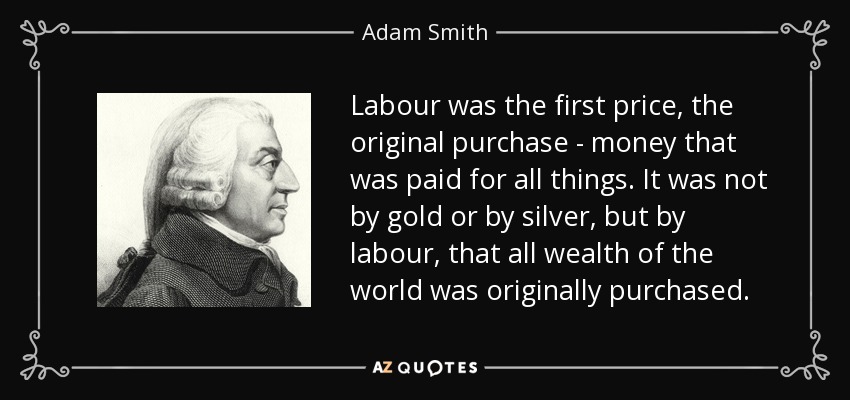
“’Wealth’, in the words of Robert L. Heilbroner, ‘is a fundamental concept in economics—indeed, perhaps the conceptual starting point for the discipline.’ (See Heilbroner’s entry for ‘Wealth’ in The New Palgrave Dictionary of Economics.) But what does the putative father of economics himself, Adam Smith, mean by ‘wealth’ or ‘opulence’ in his second magnum opus, The Wealth of Nations? Smith famously wrote, ‘It would be too ridiculous to go about seriously to prove, that wealth does not consist in money, or in gold and silver; but in what money purchases, and is valuable only for purchasing.’ (WN, IV.i.17)

“A literal reading of Smith’s purchasing-power approach to wealth might favor an objective definition of opulence, but such a reading runs into an immediate difficulty: what yardstick or objective standard does Smith use for measuring wealth, since Smith himself correctly rules out money or precious metals as measures of wealth? In Book I of The Wealth of Nations, for example, Smith tells us that labour is the yardstick by which wealth should be measured: ‘It was not by gold or silver, but by labour that all the wealth of the world was originally purchased; and its value, to those who possess it and who want to exchange it for some new productions, is precisely equal to the quantity of labour which it can enable them to purchase or command.’ (WN, I.v.2) But at the same time, at various places in Book II of The Wealth of Nations, Smith defines wealth as the annual produce of both ‘land and labour.’ (See, e.g., WN, II.ii.2, our emphasis.) Either way, even if we were to ignore land and limit our objective analysis of wealth to just labour, there are additional ‘troublesome questions’ and difficulties to be surmounted. (Again, see Heilbroner, op. cit.) Chief among these are Smith’s distinction between ‘productive’ and ‘unproductive’ labor towards the end of Book II of The Wealth of Nations. That is, how can labour be a reliable yardstick if labour itself is a heterogeneous entity?

“At the same time, Smith can also be read as adopting a subjective or psychological definition of wealth, for in the very same chapter in which Smith says that ‘[i]t was not by gold or silver, but by labour that all the wealth of the world was originally purchased,’ he also writes: ‘Every man is rich or poor according to the degree in which he can afford to enjoy the necessaries, conveniences, and amusements of human life.’ (WN, I.v.1) On this view, wealth is measured not in terms of the objective value of labour used to produce tangible goods (what Smith refers to as ‘productive labour’) but in terms of the subjective enjoyment or utilities generated by those goods. Alas, it was David Ricardo (1951/1821, ch. 20) who first pointed out this inconsistency in Smith’s approach to wealth, since ‘the subjective enjoyments yielded by wealth—its “riches’—were not the same as the expenditure of labour power required for its creation—its “value”.’ Moreover, this internal tension in Smith’s thought—and in economics as discipline more generally—is still unresolved to this day.”

Adam Smith quote: Labour was the first price, the original purchase - money ...

Posted in Uncategorized | Tagged , , , | Leave a comment

Abstract of *Adam Smith Problems*

My colleague and friend Salim Rashid and I have been working on a new book-length manuscript tentatively titled Adam Smith Problems. (Here is our first draft.) In summary, we survey a wide variety of open problems and unsolved mysteries regarding Adam Smith the political economist (Chapters 1 & 2), Adam Smith the moral philosopher (Chapter 3), Adam Smith the rhetorician and law scholar (Chapter 4), Adam Smith the disenchanted student (Chapter 5) and the college dropout (Chapter 6), Adam Smith the professor (Chapter 7), Adam Smith the tourist and tutor (Chapter 8), Adam Smith the devotee of Voltaire (Chapter 9), Adam Smith the beloved (Chapters 10 & 11), and Adam Smith the customs commissioner (Chapter 12), just to name a few. Starting tomorrow, we will explore some open questions about Smith’s most famous work, The Wealth of Nations.

10 Major Achievements of Scottish Economist Adam Smith | Learnodo Newtonic
Posted in Uncategorized | Leave a comment