
Alternative title: That was then, this is now
I confess I really love (pun intended) the melody and rhythm of the new Ariana remix, but don’t the lyrics violate YouTube’s “community standards”? Yes, they probably do …
Alternative title: That was then, this is now
I confess I really love (pun intended) the melody and rhythm of the new Ariana remix, but don’t the lyrics violate YouTube’s “community standards”? Yes, they probably do …
With apologies to German dadaist/surrealist Max Ernst. Hat tip: Craig Collins. (Also, check out Craig’s blog The 100 Billionth Person; you will be amply rewarded.)

Today (February 2nd) is Candlemas, commemorating the Presentation of Our Lord Jesus Christ at the Temple, and the Purification of the Blessed Virgin Mary. More details about the meaning and history Candlemas are available here.

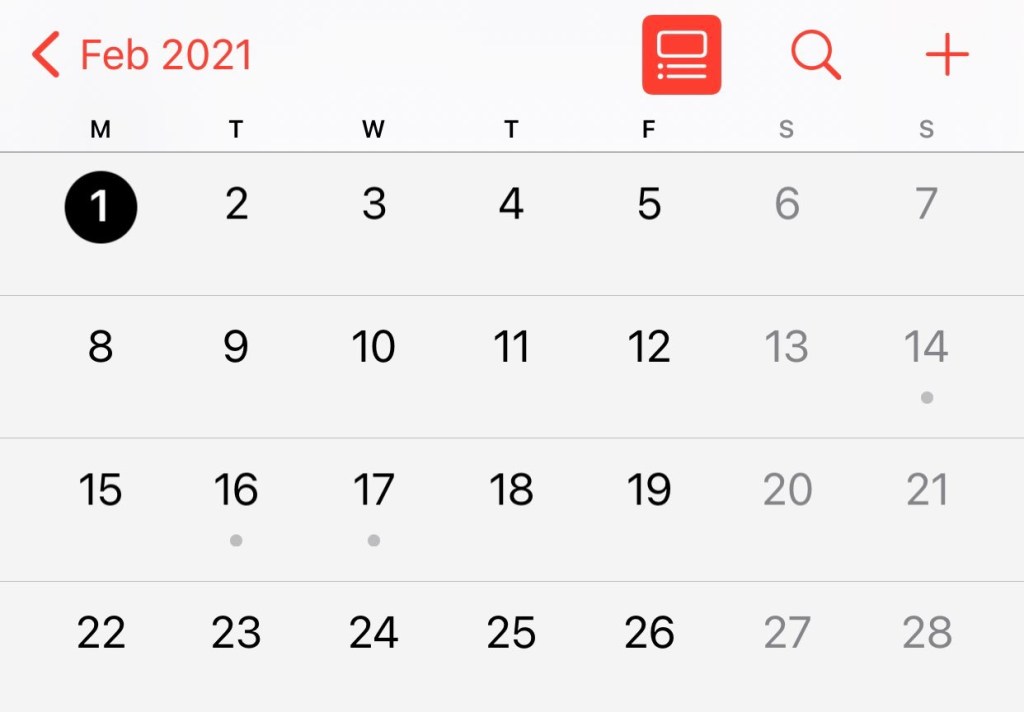
Today is not only the “1st of tha month“; today also marks the start of a “perfectly rectangular” February. More details about this occurrence are available here, via Vox (Yuri Victor).

Also, check out this essay by Fahad Muhammad on the psychology of colors. Meanwhile, chemists at Oregon State University have created a new shade of blue! Hat tips: Brian Leiter and @pickover.
Note: this is probably my last blog post on Orin Kerr’s essay “Line-Drawing and Legal Education.”
Thus far we have been exploring the technique of line-drawing from the perspective of lawyers, moral philosophers, and scholars generally: (a) the ubiquity of line-drawing in law and ethics (why all hard cases in law boil down to line-drawing), (b) the politics of drawing lines (who decides who gets to draw the line?), and (c) philosophical objections to line-drawing (small-mindedness and moral relativism). What about the perspective of students? To his credit, Professor Kerr concludes his beautiful paper on line-drawing by providing three practical pointers for his law students, which I will distill as follows:
In other words, when your professor asks you, “Where do you draw the line?,” what he is really asking is for you to do is to somehow translate your moral values into a workable legal rule–a rule that is clear enough for any person to understand and that is fair enough to harmonize whatever conflicting values are at play. In other words, the professor is asking you to perform a difficult, if not impossible, task. That is why whatever rule you propose or whatever line you draw should be considered a mere starting point in an intellectual contest with no end point or finish line: because no rule will be perfect or even close to perfect; because all rules require difficult tradeoffs. That is also why you should listen very closely to what your classmates have to say: to figure out what their deeper values are, to understand what is really at stake whenever we have to draw lines, and to update your Bayesian priors …
Note: this is the fifth of six blog posts on Orin Kerr’s essay “Line-Drawing and Legal Education.”
Thus far in this series of blog posts, we have explored the reasons why we must draw lines whenever we must formulate a new rule (“rule choice”) or apply an existing rule to new facts (“rule application”), and we have also explored the politics of line-drawing, since oftentimes the way in which a particular legal line is drawn depends on who has the power to draw that line. Here, by contrast, we will explore some “meta” objections to the standard legal and moral question, “Where would you draw the line?” Specifically, the last part of Professor Kerr’s excellent essay on line-drawing (Part V) identifies two related objections to the line-drawing metaphor. One objection is “small-mindedness” (his words, not mine); the other is moral relativism. Let’s consider the “small-mindedness” objection first. Professor Kerr puts it this way:
“[The line-drawing metaphor] frames legal decision making as a technocratic exercise. The options are reduced to various lines. A debate over values is presented as merely a choice as to which line to draw. No matter the real-world stakes of the question, reducing the search for an answer to mere line-drawing makes the issues seem technical and small. It’s as if one were at a restaurant choosing an entrée. Would you like the chicken or the fish?When you put it that way, can the choice really matter?“
In other words, instead of inviting us to ask the big questions–like is this rule consistent with justice?; is this rule consistent with our moral duties?–the line-drawing metaphor reduces difficult legal and moral questions into a purely technical or formulaic enterprise. In reply, I would ask the critics of line-drawing to consider the following possibility: maybe “small-mindedness” and “technicality” are features, not bugs? That is, by breaking down a difficult question, such as how much power should the police have to make a traffic stop, into a standard-form line-drawing exercise, we are able to make the problem more tractable and manageable–more “soluble” to borrow Sir Peter Medawar’s beautiful concept.
My reply, however, takes us to the second objection to line-drawing: moral relativism. Simply put, the line-drawing metaphor not only invites us as a technical or practical matter to draw any number of possible lines; this approach also “relativizes” each of these possible lines, or in the eloquent words of Professor Kerr:
“When professors [ask their students where would they draw the line?], they seek to accommodate different perspectives without saying which are right and which are wrong. A wide range of perspectives is deemed legitimate, and choices among them are merely a matter of perspective.”
How can we respond to this moral relativism objection? Alas, there is no all-wise, all-powerful Solomonic judge or supreme court of pedagogy who can resolve this fundamental philosophical impasse for us. Either you are moral pluralist or “pragmatist”–i.e. you acknowledge that our moral values will often collide, or you believe a wide range of answers are possible to the question, What is justice?–in which case the small-mindedness and moral relativism of line-drawing are features, not bugs, or you are a moral realist or “dogmatist”–i.e. you believe in an all-encompassing hierarchy of values, that there is a single right answer to the justice question–in which case line-drawing is a misguided, if not dangerous, approach.
Whatever your views are about this larger philosophical impasse, this discussion invites us to weigh the pros and cons of line-drawing and to consider alternatives to drawing lines, to ask whether law professors should be analyzing the problems of “rule choice” and “rule application” in in a different way. If so, how? If not, how can we resolve this impasse between classical liberal pragmatism and Platonic dogmatism? Professor Kerr concludes his paper by describing the task of line-drawing as a “platform,” a springboard for students “to debate what matters and how the law should address it.” Kerr then concludes his paper as follows:
“By offering the platform [i.e., by asking you where you would draw a particular legal or moral line], your professor may be opening the door to a wide range of perspectives. But an open door doesn’t require you to accept everything that comes through it.”
In other words, Professor Kerr, perhaps wisely, does not attempt the impossible task of reconciling or harmonizing these opposing philosophical views–pragmatism/moral relativism versus Platonic dogmatism/moral realism. Instead, he concludes his paper down to Earth, so to speak, by providing three practical pointers for law students. I will restate these tips and wrap up my review of Kerr’s essay on Monday …







Welcome to the online home of the IASS
Hopefully It’s Interesting.
In Conversation with Legal and Moral Philosophers
Relitigating Our Favorite Disputes
PhD, Jagiellonian University
Inquiry and opinion
Life is all about being curious, asking questions, and discovering your passion. And it can be fun!
Books, papers, and other jurisprudential things
Ramblings of a retiree in France
BY GRACE THROUGH FAITH
Natalia's space
hoping we know we're living the dream
Lover of math. Bad at drawing.
We hike, bike, and discover Central Florida and beyond
Making it big in business after age 40
Reasoning about reasoning, mathematically.
I don't mean to sound critical, but I am; so that's how it comes across
remember the good old days...
"Let me live, love and say it well in good sentences." - Sylvia Plath
a personal view of the theory of computation
Submitted For Your Perusal is a weblog wherein Matt Thomas shares and writes about things he thinks are interesting.
Logic at Columbia University
Just like the Thesis Whisperer - but with more money
the sky is no longer the limit
Technology, Culture, and Ethics
Just like the horse whisperer - but with more pages
Poetry, Other Words, and Cats



 prior probability