I want to conclude my series on “Kurt Gödel and the Leibniz Conspiracy” with the following observation about Franz Neumann’s influential 1957 essay on conspiracy theories[1]: Neumann, with his focus on “anxiety” and “politics”, has opened up a veritable Pandora’s box of competing psychological and social explanations to explain away the popularity of conspiracy theories.[2] (See, for example, the book pictured below.) But by painting conspiracy theorists with such a wide brush, these scholarly “explanations” are too comprehensive to be of any value. Let me explain:
A recent comprehensive survey of the literature concludes that conspiracy beliefs are due to “a range of psychological, political, and social factors.”[3] Similarly, another study examines the link between “societal crisis situations” and “belief in conspiracy theories” and blames “fear, uncertainty, and the feeling of being out of control” for “increasing the likelihood of perceiving conspiracies in social situations.”[4] Yet another study highlights the role the epistemic, existential, and social motives play in driving the popularity of conspiracy theories.[5] Is this why Michael Kempe makes no mention of Gödel’s conspiracy theory in his otherwise excellent intellectual biography of Leibniz, The Best of all Possible Worlds: A Life of Leibniz in Seven Pivotal Days?
However my question about Kempe’s omission is answered, the problem with all these dime-a-dozen psychological and social explanations of conspiracy theories, beginning with Franz Neumann’s classic work on conspiracy theories on “Anxiety and Politics”, is that they are ad hoc. Simply put, by blaming conspiracy thinking on such a wide variety of social and psychological factors and motives, these explanations prove too much. Worse yet, some commentators, in their zeal to blame conspiracy theories on “bad thinking”[6] or “cognitive quirks,”[7] come perilously close to committing the ad hominem fallacy.[8] In any case, the argument that “only bad thinkers believe in conspiracies” is not only tautological; it is also overinclusive, as the Leibniz Conspiracy itself demonstrates. After all, the proponent of this particular conspiracy theory, Kurt Gödel, is considered to be the greatest logician since Aristotle!
To conclude: Kurt Gödel may have been paranoid about many things (see here or here, for example), including about Leibniz’s missing works, but my larger point is simply this: Gödel’s paranoia, by itself, has no bearing on whether “The Leibniz Conspiracy” really occurred or not. (Footnotes are below the fold.)
Yesterday, we turned to Franz L. Neumann’s influential 1957 essay on “Anxiety and Politics” to explore the inner logic of Kurt Gödel’s conspiracy theory, or what I like to call “The Leibniz Conspiracy”. In brief, according to Neumann (1957, p. 283), conspiracy theories have following three features in common: “intensification of anxiety through manipulation, identification, [and] false concreteness.” We already examined the “concreteness” of Gödel’s conspiracy theory in my previous post. Today, we will explore what Neumann refers to as “identification”.
First off, what does Neumann mean by identification? Simply put, he means that the alleged conspirators must belong to a specific and identifiable target or enemy group. For his part, Neumann identifies five such common targets or enemy groups in his classic 1957 essay: Jesuits, Freemasons, Communists, Capitalists, and Jews. But regardless of whether the conspirators are Jesuits or Jews, Communists or Capitalists, Freemasons or Illuminati, etc., etc. Neumann’s larger point is that the conspiracy in question must be orchestrated by members of an identifiable group.
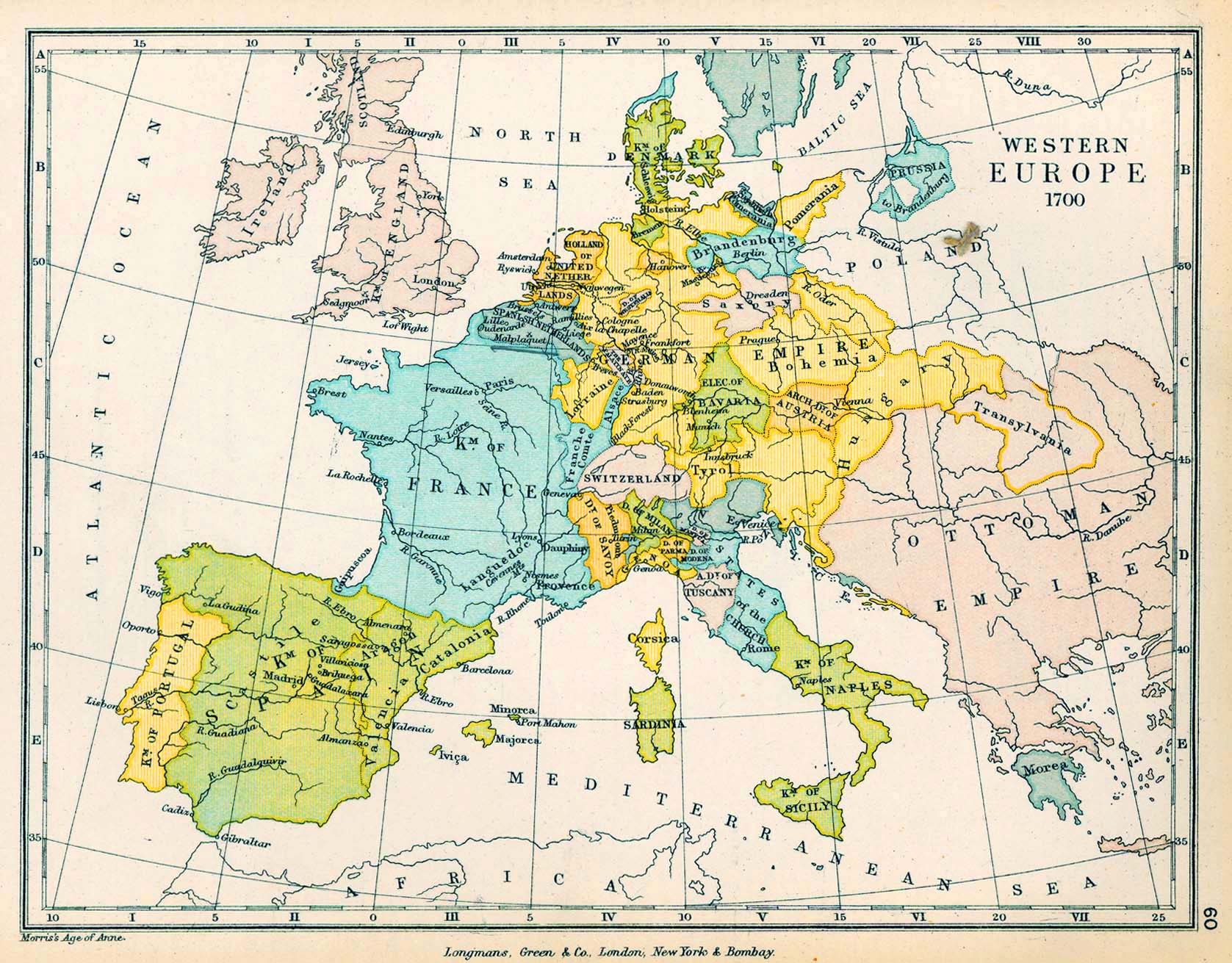
In Gödel’s case, however, who were the members of the alleged conspiracy to suppress Leibniz’s works? Once again (see my previous post), Karl Menger provides a possible clue as to the identity of Gödel’s shadowy conspirators: the House of Hapsburg in Austria, which at one point was the most powerful dynasty in the world (see map pictured below). And this time, Menger’s report does not consist of second-hand hearsay; it is a first-hand account of a personal conversation he had with Gödel himself:
“Meanwhile, Gödel was more and more preoccupied with Leibniz. He was now completely convinced that important writings of this philosopher had not only failed to be published, but were destroyed in manuscript. Once I said to him teasingly, ‘You have a vicarious persecution complex on Leibniz’ behalf.’ Soon afterwards he said, ‘There is something I have wanted to ask you for quite a while. When was the Viennese (now Austrian) Academy of Sciences founded?’ I immediately suspected what Gödel was after. It is a historical fact that Leibniz negotiated for a time with the Emperor and his government about the founding of an Academy in Vienna, but that the negotiations came to nothing.”[1]
According to Menger’s account, Kurt Gödel believed as a matter of “historical fact” that Leibniz was negotiating directly with the House of Habsburg for the creation of a special academic institution to be located in the imperial city of Vienna, the implication being that Leibniz’s works would have been stored in this place. Apparently, however, Gödel had further reason to believe that these talks between Leibniz and the Habsburgs became acrimonious and that—when these contentious negotiations fell through—someone, perhaps acting under the direct orders of the Emperor of Austria-Hungary himself, must have acted in retaliation by destroying some of Leibniz’s writings.
Last of all, Neumann also refers to “anxiety” or to the psychological aspect of conspiracy theories. But is it helpful to think of conspiracy theories as a kind of mental disorder or mental ailment? After all, some conspiracies are real![2] Rest assured, I will consider this key question and conclude my survey of “The Leibniz Conspiracy” in my next post.
In my previous posts (see here, here, and here), I provided some historical background regarding Gottfried Leibniz’s efforts to develop a universal symbolic language (characteristica universalis) and universal thinking machine (calculus ratiocinator), and I also mentioned how one of Leibniz’s greatest admirers, Kurt Gödel, postulated the existence of a hostile centuries-old conspiracy to conceal Leibniz’s ambitious project. But how plausible is this conspiracy theory? Today, I will explore the inner logic of Gödel’s conspiracy theory, what I like to call “The Leibniz Conspiracy“, using Franz L. Neumann’s influential and oft-cited essay on “Anxiety and Politics” as my point of departure.
In summary, Neumann (pictured below) identifies three features that all conspiracy theories or alternate realities have in common: “intensification of anxiety through manipulation, identification, [and] false concreteness. (See Franz Neumann, “Anxiety and Politics”, page 283, in Herbert Marcuse, editor, The Democratic and Authoritarian State: Essays in Political and Legal Theory, The Free Press (1957), pp. 270–300.) The first of these elements—anxiety—refers to the psychological aspect of alternate realities: who is most likely to fall for a conspiracy theory? The last two elements—identification and false concreteness—refer to the content or internal logic of any given conspiracy theory: the identity of the conspirators and their nefarious goals.
With this theoretical background in mind, let us return to Kurt Gödel to illustrate the internal logic of his conspiracy theory, and let’s start with the element of false concreteness. According to Neumann, there must be an element of truth to some aspect of the conspiracy; i.e. the conspiracy must be plausible. (Ibid., pp. 283-287.) In Gödel’s case, his conspiracy theory, although unlikely, was not entirely far-fetched, for some of Leibniz’s writings—specific passages that Leibniz himself had referred to in some of his works—had apparently gone missing. Karl Menger, for example, reports at length the following conversation between Oskar Morgenstern and Gödel:
“Later, I once discussed Gödel’s ideas on Leibniz with a common friend, the economist Oskar Morgenstern. He described to me how Gödel one day took him into the Princeton University Library and piled up two stacks of publications: on one side, books and articles that appeared during or shortly after Leibniz’ lifetime and contained exact references to writings of the philosopher published in collections or series (with places and years of publication, volume and page numbers, etc.); on the other side, those very collections or series. But in some cases, neither on the cited page nor elsewhere was there any writing by Leibniz; in other cases, the series broke off just before the cited volume or the volume ended before the cited page; in still other cases, the volumes containing the cited writings never appeared. ‘The material was really highly astonishing,’ Morgenstern said.”[1]
Although Menger’s statement is hearsay, since he is reporting what a third party (Morgenstern) told him, his hearsay testimony, if true, presents a genuine mystery about the whereabouts of some of Leibniz’s writings. After all, it was not just one obscure reference or a few isolated passages of Leibniz’s that went missing; it was a large collection of them consisting of “two stacks”!
Moreover, Gödel did not simply imagine or conjure up the existence of some long-lost Leibnizian manuscript, a mythical Holy Grail of philosophical legend. Instead, Gödel had done a meticulous amount of research, assembling two stacks’ worth of seventeenth- and eighteenth-century materials with “exact references” to specific writings and passages of Leibniz—passages that had disappeared completely, despite the existence of such precise references to those writings.
Perhaps one or two lost references would be just a coincidence, works lost to the ceaseless march of time (to paraphrase The Great Gatsby), but how do we explain the disappearance of such a large collection of Leibniz’s writings? Next, I will explore Neumann’s remaining features of conspiracy theories and their relation to the Leibniz Conspiracy in my next post.
N.B.: I will resume my series on “Kurt Gödel and the Leibniz Conspiracy” in my next post.
Building on my previous blog posts on this subject (see here, here, here, and here), I have just posted this short paper to SSRN. To the point, my plea to my fellow Adam Smith scholars is to stop citing the Scottish philosopher’s Lectures on Jurisprudence without proper qualification. Although this compilation of lecture notes purports to be a primary source–a transcription of Smith’s law lectures at the University of Glasgow–these student notes pose two practical problems. One is that we have no idea how faithful or accurate this transcription of Smith’s law lectures is. The other problem is that Smith himself may have repudiated the ideas contained in those early law lectures.
I will resume my series on “The Leibniz Conspiracy” in the next day or two; in the meantime, here is some melancholic music by North American country artist Morgan Wallen from his 2021 studio album, Dangerous: The Double Album:
Fun fact: According to Wikipedia (see here), “Wallen did not originally intend to include the song on the album, but following a demo version of the song gaining popularity on social media, he decided on its inclusion.”
As I mentioned in my previous two posts (see here and here), it was Kurt Gödel who posited the existence of a centuries-long conspiracy to conceal Leibniz’s efforts to develop a universal symbolic language (characteristica universalis) and universal thinking machine (calculus ratiocinator). And yet, there is no reference to this conspiracy theory in Michael Kempe’s intellectual biography of Leibniz, The Best of all Possible Worlds: A Life of Leibniz in Seven Pivotal Days. Why this omission? How seriously should we take Gödel’s conjecture? And what evidence, if any, did Gödel have for reaching this remarkable conclusion? At the very least, for the reasons I provide below (and in my 2022 paper “The Leibniz Conspiracy“), Gödel’s conjecture deserves a fair hearing:
To begin (sorry, Richard!), Gödel is best known for his landmark contributions to logic and mathematics, especially his first and second incompleteness theorems,[1] as well as for reportedly discovering a logical contradiction in the U.S. Constitution.[2] In addition, during his years at the Institute for Advanced Studies (IAS) in Princeton, New Jersey, Gödel’s interests also turned to philosophy and physics. Among other things, Gödel admired the works of Gottfried Leibniz and studied them closely, “devoting endless hours to the study of Leibniz.”[3] At some point during his studies, Gödel postulated the existence of a hostile conspiracy that had caused some of Leibniz’s works to be concealed or destroyed.[4] In the words of one of Gödel’s biographers, Rebecca Goldstein, Gödel “came to believe that there was a vast conspiracy, apparently in place for centuries, to suppress the truth [about Leibniz’s writings] and make men stupid.”[5]
That Gödel, one of the most logical and rigorous thinkers of all time, was himself a proponent of such a far-fetched conspiracy theory shows us how compelling and pervasive conspiracy thinking can be. Gödel’s biographers, however, have generally dismissed Gödel’s conspiracy theory out of hand, attributing this episode to Gödel’s “paranoia” or to his many mental delusions.[6] By way of example, one scholar states: “He [Gödel] suffered delusions and personality disturbances. He became excessively paranoid, the paranoia deriving, some have conjectured, from his super-logicality and overly intense introspection. He tended to believe in secret intrigues and conspiracies.”[7] Another scholar speculates that it was Gödel’s intellectual isolation, especially after the death in 1955 of his best friend Albert Einstein, that “provided fertile sole for that rationality run amuck which is paranoia.”[8]
While it is tempting to dismiss this conspiracy theory as the product of a paranoid mind, such an ad hominem psychological explanation is too easy. After all, Gödel was not only a world-renowned logician; he had also devoted “endless hours” of study to Leibniz’s works.[9] In fact, Gödel may have first encountered the works of Leibniz as early as 1926, while he was still a student at the University of Vienna.[10] According to Karl Menger, a credible source who knew Kurt Gödel personally from their days together in Vienna, Gödel “had been most intensely interested in Leibniz”[11] and “he keenly desired to inspect Leibniz’ unpublished manuscripts and not only out of historical interest ….”[12] But to fully appreciate and assess the plausibility of this alleged conspiracy, we must revisit one of Leibniz’s most ambitious and revolutionary ideas and the supposed target of this secret cover-up, an idea that must have captured Gödel’s imagination, for in the words of one scholar:
“Gödel was fascinated by Leibniz’s ideas, to the point that others felt he was obsessed: he checked out every book on Leibniz from his university library. He believed (correctly, I would say) that Leibniz’s most important ideas (the characteristica universalis) had been nearly forgotten by society; but he also believed that this was due to a shadowy conspiracy meant to prevent the intellectual advancement of mankind.”[13]
In brief, Gottfried Wilhelm Leibniz was one of the most important logicians, mathematicians, and natural philosophers of his time. Although his most well-known contributions to the world of ideas include his discovery of differential and integral calculus, he also attempted to develop a universal logic of science and human reasoning. Specifically, Leibniz wanted to “reduce everything from imagination to analysis,”[14] or in the words of one Leibniz scholar: “Leibniz dreamt all his life of developing a ‘characteristica universalis’—a kind of ‘algebra of thought’ that would mechanize any form of factual reasoning as algebra had mechanized geometrical thought.”[15]
To the point, Leibniz was convinced that all human ideas could be reduced to a few primitive thoughts, or in the words of another Leibniz scholar, “If it were possible to map these primitive thoughts unambiguously to a list of characters, then either no one using these characters in reasoning and writing would ever err, or he or she would recognize these errors with the help of [the] most simple checks.”[16] To accomplish this ambitious project, Leibniz developed the concept of a characteristica universalis, the foundation of his general model for logical reasoning.[17]Or in the immortal words of Leibniz himself:
“We will present here, thus, a new and marvelous calculus, which occurs in all our reasonings and which is not less rigorous than arithmetic or algebra. Through this calculus, it is always possible to terminate that part of a controversy that can be determined from the data, by simply taking a pen, so that it will suffice for two debaters (leaving aside issues of agreement about words) to say to each other: Let us calculate!”[18]
Alas, as I mentioned in my previous post, one possibility is that Leibniz never described the characteristica universalis in operational detail. (Indeed, some scholars have dismissed Leibniz’s project as an absurd fantasy.[19]) Gödel, however, may have believed that Leibniz’s project was feasible. In a systematic and methodical fashion, Gödel had assembled all the relevant works of Leibniz and that is when the Austrian-American logician noticed a striking anomaly: a detailed treatment of the characteristica universalis was conspicuously absent from Leibniz’s surviving works. Was this omission a mere coincidence, or was something more nefarious at work?
That is one of the chapter headings of Michael Kempe’s intellectual biography of G. W. Leibniz: The Best of all Possible Worlds: A Life of Leibniz in Seven Pivotal Days (see p. 96 of Kempe’s book). To the point, as I mentioned yesterday, this “global formula” refers to the great German polymath’s Heraclean efforts to develop a working blueprint for a universal thinking machine as well as a “universal symbolic language” (p. 37) to express mathematical, scientific, and metaphysical concepts in order to automate the process of knowledge production and scientific discovery.
But as Michael Kempe notes in Chapter 4 of his beautiful new book (from which the chapter heading quoted above is taken), Leibniz was unable to complete this ambitious project during his lifetime. This observation, however, begs the key question: how much was Leibniz able to accomplish? After all, Leibniz began to work on this project as early as 1666, when he published his Art of Combinations (Dissertatio de arte combinatoria), and he presumably continued to work on his universal thinking machine until his death many decades later in 1716.
There are two possibilities. One is a conspiracy, as no less an authority than Kurt Gödel conjectured. Although this sounds like a rather remote, if not far-fetched, possibility, as I mentioned in my previous post it was Gödel who posited the existence of a centuries-long conspiracy to conceal Leibniz’s efforts to develop his universal thinking machine. On this view, Leibniz was able to carry out, if only partially, his ambitious project, but it was subsequently suppressed by a group of his shadowy enemies.
The other possibility, however, is more benign and thus more plausible. According to Kempe, for example, Leibniz’s decades-long efforts simply stalled out, so to speak, for the main stumbling block for the German polymath was this: how to reduce ideas into formal symbols? For reference, below are three of the most relevant passages from the English-language translation of Kempe’s book:
“But what’s still largely missing [from Leibniz’s efforts to develop a universal thinking machine] are concepts and methods for converting nonnumerical information into numerical values. Words have meanings, refer to things or facts, express a sense. Numbers are meaning-neutral.” (p. 111)
“[Leibniz] is looking for clues to the problem of how to connect nonnumerical and purely numerical information.” (p. 119)
“What is crucial for Leibniz is … the formalization of reality by means of symbols.” (Ibid.)
As a result, Kempe presents the following alternative conjecture: “… Leibniz should be associated not only with the programmatic idea of a universal method for answering all manner of questions by means of formulas, but also with the suspicion that this might not be possible to an unlimited extent.” (Kempe 2024, p. 121) In other words, Leibniz just gave up! Why? Because he was unable to find a way of “formaliz[ing] reality by means of symbols” (p. 119), i.e. he was unable to convert ordinary human language into well-defined symbols.
But what if Kempe’s conjecture, however plausible and reasonable-sounding, is wrong, and what if Gödel’s more malevolent and crazy conjecture of a conspiracy is closer to the truth? I will explore this possibility in my next few posts …
I just finished reading Michael Kempe’s beautiful intellectual biography of G. W. Leibniz: The Best of all Possible Worlds: A Life of Leibniz in Seven Pivotal Days. Among other things, Kempe explores one of the many ways that the great German polymath was centuries ahead of his times: Leibniz’s decades-long effort to develop a blueprint for a universal thinking machine, a kind of proto-A.I. for the nascent Age of Enlightenment.
The ultimate goal of this Quixotic project was nothing less than breathtaking: Leibniz wanted to automate the laborious and time-consuming process of knowledge production and scientific discovery in order to resolve deep epistemological disagreements in all fields of study. For reference, here is how one respected Leibniz scholar, Brandon C. Look (University of Kentucky) via the Stanford Encyclopedia of Philosophy, describes the origins of Leibniz’s ambitious and awe-inspiring intellectual project:
“While there [at the University of Altdorf (Universität Altdorf), a university in Altdorf bei Nürnberg, a small town outside the Free Imperial City of Nuremberg] Leibniz published in 1666 the remarkably original Dissertation on the Art of Combinations (Dissertatio de arte combinatoria), a work that sketched a plan for a “universal characteristic” and logical calculus, a subject that would occupy him for much of the rest of his life.”
But what did Leibniz’s characteristica universalis and calculus ratiocinator consist of? (Although these mysterious-sounding Leibnizian terms of art are often used interchangeably, they refer to two different aspects of Leibniz’s proposed universal thinking machine.) For his part, although the English-language translation of Kempe’s new book does not refer to the characteristica universalis or calculus ratiocinator by name (you will not find any references to these terms in the index), Kempe’s work does contain many tantalizing references to Leibniz’s dream of developing a “universal symbolic language” (p. 37) to express mathematical, scientific, and metaphysical concepts. (See especially pages 109-111 and 121-122 of Kempe’s book.)
As it happens, no less a first-rate thinker than Kurt Gödel, considered to be the greatest logician since Aristotle, was intrigued by Leibniz’s dream. By all accounts (see here, for example), Gödel was not only fascinated by Leibniz’s ideas, especially the possibility of a universal symbolic language or characteristica universalis; the great Austrian logician also further believed that Leibniz’s dream “had been nearly forgotten by society” and “that this was due to a shadowy conspiracy meant to prevent the intellectual advancement of mankind”. Wait, what?! Was this episode in Gödel’s intellectual life just another example of his lifelong “paranoia”, as many of his biographers have claimed? (At the very least, that one of the most logical and rigorous thinkers of all time was himself a proponent of such a far-fetched conspiracy theory shows us just how compelling and pervasive conspiracy thinking can be!)
Although the great Kurt Gödel makes a lone, solitary appearance in the erudite pages of Kempe’s beautiful new Leibniz book (the reference to the Austrian logician appears on p. 121), Kempe makes no reference at all to the possibility of a worldwide conspiracy to suppress Leibniz’s ideas. But what if Gödel’s “Leibniz Conspiracy” were true? Stay tuned, I will consider this possibility in my next two posts …
Earlier this month (1-6 July), I blogged about James Buchanan and Warren Samuels’s disagreement over Miller et al. v. Schoene (the infamous red cedar rust case), a landmark legal precedent that dramatically expanded the power of State and local governments to curtail private property rights without having to pay any compensation, let alone “just compensation” as required by the U.S. Constitution. For reference, below are the links to my relevant blog posts:
As it happens, both economists not only presented their competing views of this controversial case on the erudite pages of the Journal of Law & Economics (see here, here, and here); they also corresponded with each other at length from May of 1972 until January of 1974, and for me, their private correspondence is even more fascinating and more compelling to read than their formal papers because it is here, behind the scenes, so to speak, where they are each trying to piece together and figure out the true sources of their disagreement.
In all, they exchanged 13 letters, which were subsequently edited and published in 1975. (See James M. Buchanan & Warren J. Samuels, On Some Fundamental Issues in Political Economy: An Exchange of Correspondence, Journal of Economic Issues, Vol. 9, No. 1 (1975), pp. 15-38.) Therefore, to conclude my review of the Buchanan-Samuels exchange, I am including below the fold my favorite excerpts from each of their letters in chronological order; page numbers refer to the published version of their exchange, cited above:
I have been highly critical of the late Alasdair MacIntyre’s 2023 essay On Having Survived the Academic Moral Philosophy of the 20th Century. (See here, here, here, and here.) Today, however, I was going to conclude my review of his essay on a somewhat positive note, for as I mentioned in my opening salvo in this series, I totally agree with Professor MacIntyre’s diagnosis regarding the pervasiveness of disagreement among philosophers. Nevertheless, that said, I find it hard to say anything positive about MacIntyre’s essay. Let me explain:
First off, my main reply to scholars like MacIntyre is this: the optimal level of disagreement in any field is not zero. Secondly and more importantly, I seriously doubt whether MacIntyre’s proposed remedy would have any impact one way or another on the level of disagreement in philosophy. In brief, MacIntyre proposes two cures. One is to expand the list of required courses to obtain a degree in moral philosophy. Specifically, MacIntyre recommends in paragraph 33 of his essay that “courses in social and cultural anthropology and in certain areas of sociology and psychology should be a prerequisite for graduate work in moral philosophy.” Alas, I would prefer just one course on Homer or in 19th-century Russian literature over three dozen anthropology, sociology, or psychology courses!
MacIntyre’s other proposed remedy, which appears in paragraph 34 of his essay, consists of, and I quote, “requir[ing] on the CVs of those who aspire to teaching or research appointments in moral philosophy accounts of their relevant experiences on farms and construction sites, in laboratories and studios, in soccer teams and string quartets, in political struggles and military engagements.” Alas, although MacIntyre’s life-experience requirement is an excellent idea in theory, how would farmers, construction workers, lab scientists, artists, soccer players and coaches, musicians, politicians, and soldiers ever be persuaded to study moral philosophy? And even if we could persuade such a potpourri of “village people” to become academic philosophers, it is not really obvious what impact, if any, such a diverse range of life experiences would have on any of the ongoing substantive debates among, say, Kantians and and consequentialists.
On the other hand, perhaps the main problem with MacIntyre’s proposed reform is that it is not ambitious enough. Why not expand the life-experience requirement to include all PhD candidates in all fields?