My summer 2025 readings

  1. Jaime Bayly, Los genios, Galaxia Gutenberg (2023). What caused the legendary quarrel between the Latin American literary giants Mario Vargas Llosa and Gabriel García Márquez? I picked up a copy of this wonderful work of historical fiction at a bookstore in Mexico City, and I was spellbound by every page! (in Spanish)
  2. Randall Berry, et al., Spectrum Rights in Outer Space: Interference Management for Mega-Constellations, NSF White Paper (2022). As a follow-up to my 2023 paper Outer Space Auctions?, I am currently doing further research on the feasibility of orbit and spectrum markets in outer space, and this paper, in particular, is especially informative.
  3. Arthur A. Goldsmith, Power Grabs from the Top: A Database of Self-Coups, International Studies Quarterly, Vol. 68, No. 4 (2024), https://doi.org/10.1093/isq/sqae147. At the beginning of my summer break (back in late April!), I began doing further research on “self-coups” to prepare for a talk I was invited to give in Mexico City as part of my series of papers on Gödel’s Loophole (see here, here, and here).
  4. Geoffrey Hindley, A Brief History of the Magna Carta: The Story of the Origins of Liberty, Running Press (2008). I wanted to learn more about the “Great Charter” of 1215, so I picked up a copy of the first edition of this not-so-brief history (the book is 302 pp. long, excluding end notes and the index!) at my favorite bookstore in Los Angeles, Lost Books. (Here is a link to the second edition of this book.)
  5. Michael Kempe, The Best of all Possible Worlds: A Life of Leibniz in Seven Pivotal Days, W. W. Norton (2024). I just ordered this work about the great Baroque polymath Gottfried Wilhelm Leibniz, one of the most creative, original, and prolific men of letters of all time, on the strength of Tyler Cowen’s mini-review.
  6. Werner Troesken, The Pox of Liberty: How the Constitution Left Americans Rich, Free, and Prone to Infection, University of Chicago Press (2015). There is no way I’m going to pay $120.00 for a book published by an extortionate academic press (see here), but fortunately for me, I was able to pick up a free examination copy of this excellent tome last weekend at the annual meeting of the History of Economics Society. Among other things, Professor Troesken’s review of Jacobsen v. Massachusetts on pp. 83-88 of his book is highly illuminating.
  7. Rob Wesson, Darwin’s First Theory: Exploring Darwin’s Quest for a Theory of Earth, Pegasus Books (2017). The title of this book refers to Darwin’s theory of plate tectonics, a theory he developed years before he published his famous work on evolution in 1859. (For the record, I should disclose that Charles Darwin is one of my intellectual role models, and one of my first published papers was about Darwin’s travels through Tierra del Fuego; see here.)

In addition to the above works, I also want to single out an essay by the late Alasdair MacIntyre, On Having Survived the Academic Moral Philosophy of the 20th Century, that I had read soon after the death of the Scottish-American philosopher on 21 May 2025. As it happens, although this essay is directed mainly to moral philosophers, it is highly relevant to my field as well (law). I will therefore have more to say about MacIntyre’s essay in my next post …

Posted in Uncategorized | Leave a comment

Monday music: Entre dos Aguas

Preview: I will revisit the late Alasdair MacIntyre’s stinging critique of academic philosophers, “On Having Survived the Academic Moral Philosophy of the 20th Century,” in the next day or two; in the meantime, below is one of my favorite flamencos of all time … ¡Olé!

Posted in Uncategorized | 2 Comments

Coase’s blind spot?

James Buchanan versus Warren Samuels, last round: Buchanan’s devastating critique of Samuels’s analysis of Miller et al. v. Schoene

Thus far, we have outlined Miller et al. v. Schoene (the red cedar tree rust case), explained why economists like James Buchanan and Warren Samuels took an interest in this old case (see here), and then compared and contrasted Samuels’s 1971 paper with Buchanan’s 1972 reply paper (see here and here). Today, I will conclude my series on the Buchanan-Samuels exchange by pinpointing the main source of their disagreement over how the cedar tree case was decided.

As I see it, it’s not so much what Samuels says that bothers Buchanan; it’s what he doesn’t say, for there is a big blind spot in Samuels’s economic analysis — and in Coase’s theorem as well, for that matter. Simply put, both Samuels and Coase are ignoring a critical distinction: the distinction between (a) lower-level, day-to-day law and politics on the one hand and (b) higher-level constitutional rules on the other. Although Buchanan does not express his objection to Samuels or to Coase in this way, this objection is implicit in the logic of Buchanan’s overall worldview as expressed in many of his other writings. (See, for example, this 2003 paper describing Buchanan’s “public choice” approach to politics; James Buchanan, Politics without romance, Policy, Vol. 19, No. 3 (2003), pp. 13-18.)

To the point, while Samuels’s focus is on how law can impact economics (e.g. how the allocation of property rights affects costs), Buchanan’s focus, by contrast, is on how economics can impact law. For Buchanan, government officials (including legislators and judges) are not benevolent do-gooders; they are self-interested actors who respond to incentives the same way everyone else does. This is why the distinction between lower-level, day-to-day law and politics and higher-level constitutional rules is so crucial for Buchanan. On the one hand, constitutional-level rules are designed to limit government power, such as the rules under which the government itself may confiscate property — e.g. the Takings Clause of the Constitution. On the other hand, the ordinary rules of law and politics refer to the rough-and-tumble world of law courts and legislatures — e.g. a specific law or government order taking someone’s property, such as the Cedar Rust Act of Virginia or Fred Schoene’s order in in Miller et al. v. Schoene.

For Buchanan, our ordinary political-level rules are always up for grabs; that is why higher-level constitutional-level rules need to be established ahead of time in order to bind the players of the day-to-day law and politics game. More to the point, this distinction between constitutional rules and ordinary law and politics is especially relevant to a case like Miller et al. v. Schoene. In that case, the State of Virginia enacted a takings law (the Cedar Rust Act) that required the owners of red cedars to cut down their infected trees, but at the same time, a strong argument can be made that this law violated the Takings Clause in the Constitution because the law did not require the payment of compensation to the cedar tree owners for the fair market value of their fallen trees. And that is why the main lesson to be learned from the cedar tree case is not how law can shape economic activity (Samuels’s main point in his 1971 paper). The main lesson to be learned for someone like Buchanan is how economics can shape — and distort — law!

In other words, Buchanan is not so much objecting to the substantive choice that was made in the cedar tree case. That is, his objection is not that the legislature and the courts favored the interests of the apple growers at the expense of the cedar tree owners; after all, their dispute is a reciprocal one, so one of the parties is going to be harmed no matter how the case is decided. Instead, what Buchanan is really objecting to is the legislature’s and the courts’ ex post disregard of an important ex ante constitutional-level rule: the Takings Clause, which is supposed to protect existing property owners by providing them compensation whenever their property is taken by the government.

For my part, Buchanan’s critique of Samuels (and Coase) is a devastating one. Why? Because Buchanan’s critique is not that one side or another should have won the cedar tree case; rather, his critique is that neither the legislature nor the courts in this case abided by the constitutional-level rules that apply to takings. Instead, they flouted those constitutional-level rules and literally changed the rules of the law-and-politics game in the middle of the game!

Macro-pru, regulation, rule of law and public choice theory | Spontaneous  Finance
Happy Birthday, Adela!
Posted in Uncategorized | 1 Comment

Buchanan versus Samuels, round 5

Nota bene: Today (5 July) marks the 12th anniversary of my blog!

In my previous post, we saw how one economist, Warren J. Samuels, painted a reciprocal picture of the conflict between the cedar tree owners and the apple growers in Miller et al. v. Schoene. Simply put, one of these two groups of landowners is going to harmed no matter how the case is decided. If, for example, the courts were to declare Schoene’s order under the Cedar Rust Act to be an unconstitutional taking of private property (recall that that the owners of red cedars were initially ordered by Schoene to cut down their trees without compensation), it is the apple growers who will be harmed, since their apple trees will be exposed to the risk of being infected by cedar rust. By contrast, if the courts were to affirm the legality of Schoene’s order, which is what the trial judge, the court of appeals, and a unanimous U.S. Supreme Court all did, then it is the owners of the cedar trees who will be harmed.

So, why did Samuels’s colleague and friend James Buchanan (see the infographic below) object to Samuels’s economic analysis of this case? As it happens, something rubbed Buchanan the wrong way when he studied Samuels’s analysis of the cedar rust case, so much so that Buchanan wrote a strongly-worded reply paper to Samuels’s 1971 paper. (See James M. Buchanan, Politics, property, and the law: an alternative interpretation of Miller et al. v. Schoene, Journal of Law and Economics, Vol. 15, no. 2 (1972), pp. 439-452.) What was that “something”?

Was it, for example, the tone of Samuels’s 1971 paper that offended Buchanan’s “public choice” sensibilities? In their subsequent correspondence (see Buchanan & Samuels, On some fundamental issues in political economy: an exchange of correspondence, Journal of Economic Issues, Vol. 9, No. 1 (1975), pp. 15-38), Samuels insists that he is engaging in “descriptive” or “positive” economics (as opposed to “normative” economics), while Buchanan suspects that Samuels is, in fact, smuggling in certain moral values between the lines or through the back door.

Yes, this normative versus descriptive debate does take up a large part of their exchange, but for me it’s not the whole story. Instead, what really bothered Buchanan the most was Samuels’s and the courts’ cavalier disregard of the primacy of property rights. Although Buchanan raises several subsidiary objections to the technical details of Samuels’s economic analysis (e.g. how do we know in the absence of Coasean bargaining which land use is the most highly-valued one in this case), his main objection is to the Virginia legislature’s total disregard of property rights when it first enacted the Cedar Rust Act and to the courts’ similar disregard of property rights when they adjudicated the dispute between the cedar tree owners and the apple growers in Miller et al. v. Schoene.

But that said, Buchanan’s objection begs the key question, “Why are property rights so important in the first place?” After all, one possible reading of the “Coase theorem” in economics and in law is a Panglossian one: property rights don’t matter so long as someone has them and the parties are free to bargain with each other. In brief, Coase’s so-called theorem not only posits that most conflicts are reciprocal in nature (Miller v. Schoene being a textbook illustration of the reciprocal nature of harms); it also predicts that private bargaining will produce an efficient outcome regardless of where or to whom those property rights are initially assigned when two conditions are met: (1) when property rights are well-defined, and (2) transaction costs — i.e. the costs of negotiating, monitoring, and enforcing agreements — are low.

Buchanan, for his part, was fully aware of Coase’s theorem. In fact, he devotes most of his 1972 reply paper to the problem of transaction costs and to the possibility of a negotiated settlement between the red cedar owners and the apple growers, and his treatment of both of these issues is a sophisticated one (see especially pp. 441-448 of Buchanan’s reply paper). Spoiler alert: Buchanan’s disagreement with Samuels goes way beyond the technical details of the Coase theorem. Their disagreement was much deeper and philosophical than that, for as I will explain in my next post, what Buchanan and Samuels really disagreed about was the proper relationship between economics and law …

James M. Buchanan: Early Life, Education, Works

Posted in Uncategorized | 2 Comments

The reciprocal nature of the dispute in Miller et al. v. Schoene

Buchanan versus Samuels, round 4

🇺🇸 Happy Independence Day! 🇺🇸 In my previous post, I explained why two great academic economists, James Buchanan and Warren Samuels, took an interest in Miller et al. v. Schoene (the cedar rust case). Simply put, this case illustrates a general problem in economics: the problem of harmful effects or negative externalities, when the activity of one firm creates spillover effects or imposes costs on third parties. But that said, why did they disagree so vehemently about how this old case was decided?

To appreciate the source of their disagreement, we must begin with Professor Samuels’s 1971 paper in the Journal of Law & Economics. (See Warren J. Samuels, Interrelations between Legal and Economic Processes, Journal of Law & Economics, Vol. 14, No. 2 (1971), pp. 435-450.) In that paper, Samuels (correctly, in my view) plays up “the ineluctable necessity of choice” whenever one party’s economic interests are harmed by another party’s conduct:

What Miller et al. v. Schoene illustrates first of all, indeed what the Court so clearly perceived, is the ineluctable necessity of choice on the part of government. The [legislature and the courts] had to make a choice as to which property owner was to be made not only formally secure but practically viable in his legal rights. The [Supreme] Court … had to make a judgment as to which owner would be visited with injury and which would be protected. (Samuels 1971, p. 438)

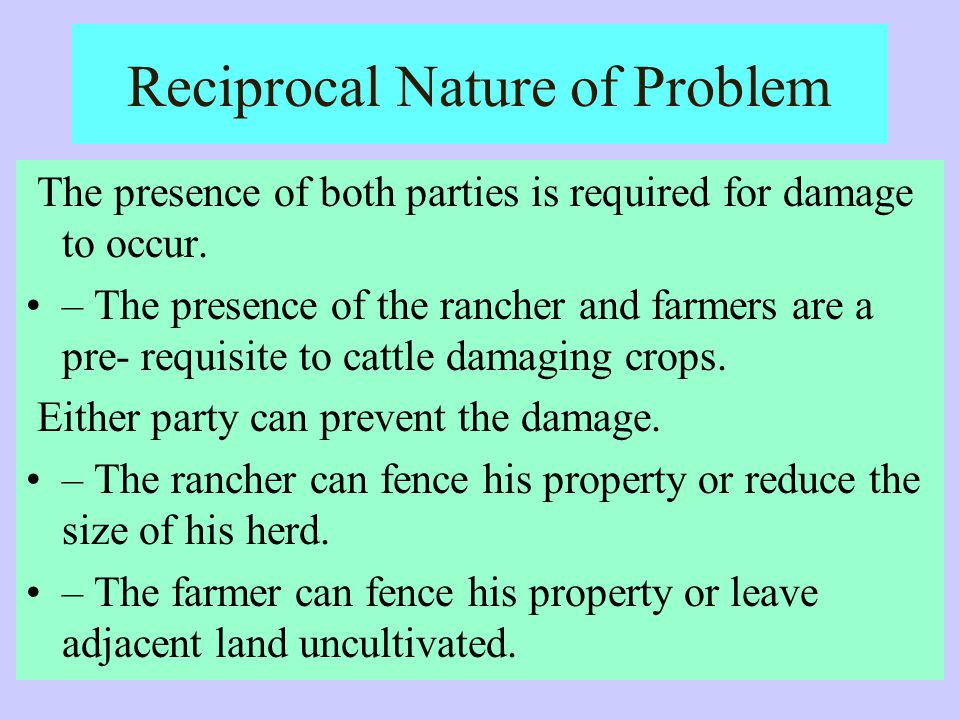
In other words, as the great Ronald Coase taught us long ago (see here or here, for example), the dispute between the owners of the red cedar trees and the owners of the apple orchids in Miller et al. v. Schoene is a “reciprocal” one for two reasons. First off, as Professor Samuels correctly notes in his 1971 paper, one of these two groups of owners is going to harmed no matter what action or inaction the State of Virginia takes or doesn’t take. Let me explain.

Recall that the law in dispute in Miller et al. v. Schoene was enacted to protect apple orchids from a plant disease known as cedar rust. Although cedar rust is harmless to most cedar trees, it can spread to apple orchids, cause the premature defoliation of apple trees, reduce their yield, and blemish their fruit. (See, for example, this summary by the U.S. Forest Service.) Now, imagine a world in which the State of Virginia does not enact the Cedar Rust Act. In that world, it is the owners of apple orchids who will be harmed, since they will be exposed to the risk of cedar rust if their orchids are located close enough to infected cedar trees. But at the same time, if the State of Virginia does enact a law like the Cedar Rust Act, it is the owners of red cedar trees who will be harmed, since they are exposed to risk of having to cut down their trees if their trees become infected with cedar rust. Either way, Professor Samuels’ main point is that one group or the other is going to be harmed.

(As an aside, the other reason why the dispute between the cedar tree owners and the apple growers is reciprocal is because either group of property owners could have taken pro-active steps to avoid the harm in the first place. Although Samuels omits this second reason from his paper, the simple truth is that the owners of the apple orchids could have cultivated a different type of fruit tree on their properties, one that is resistant to cedar rust, and likewise, the owners of the red cedar trees could have planted a different type of cedar tree on their properties, since not all cedar trees are susceptible to cedar rust. The Atlantic white cedar tree, for instance, is immune from cedar rust. Or in the alternative, fungicide sprays, if applied in a timely manner, are effective against cedar rust (see here), so either group could have applied fungicide treatments to their red cedars or to their apple orchids to reduce the risk of cedar rust.)

So, what is wrong with this Coasean picture of reciprocal harms? More specifically, what set James Buchanan off when he read Samuels’s 1971 paper, so much so that he wrote a strongly-worded reply paper? As it happens, Buchanan had a very good reason to object to Samuels’s analysis of the cedar rust case. I will explain why in my next post …

The Problem of Social Cost” of Ronald Coase William. - ppt download

Posted in Uncategorized | 2 Comments

Why Miller et al. v. Schoene?

Buchanan versus Samuels, round 3

In my previous post, we outlined the case of Miller et al. v. Schoene (the red cedar tree rust case) in which the Supreme Court created a “police power” exception to the Takings Clause. Today, I will address a different question: why did two great academic economists, James Buchanan and Warren Samuels, take an interest in this old case but disagree over how it was decided?

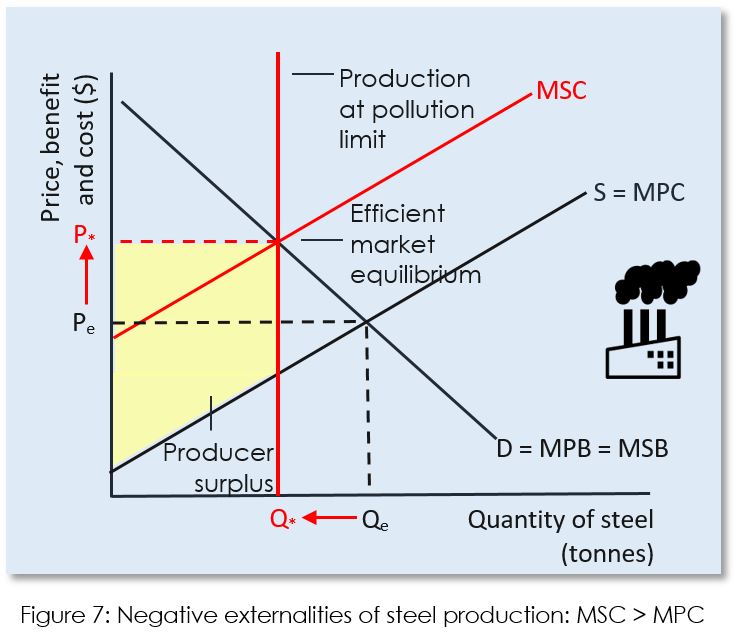
To begin (sorry, Richard!), it’s easy to see why two economists would take an interest in a case like Miller et al. v. Schoene, for this case illustrates what Ronald Coase calls the problem of harmful effects or what mainstream economists call “negative externalities.” But why did they chose the cedar tree case (Miller et al. v. Schoene) specifically, and why did they clash over its outcome? To answer these questions, we must first turn to Samuels’s 1971 paper in the Journal of Law & Economics. (See Warren J. Samuels, Interrelations between Legal and Economic Processes, Journal of Law & Economics, Vol. 14, No. 2 (1971), pp. 435-450.) It was this paper that fired up Buchanan and led to their exchange, and in the introduction to his 1971 paper, Samuels provides several general reasons why he decided to write about the cedar tree rust case.

For starters, for Samuels Miller et al. v. Schoene has all “the constituent elements of most if not all legal-economic problems, cases, or situations.” (Samuels 1971, p. 435) The second, somewhat redundant, reason Samuels gives is that this case is “beautifully illustrative of the interrelations of legal and economic processes.” (Ibid. In fact, Samuels’s paper is titled “Interrelations between legal and economic processes.”) And the third reason Samuels chose to write about this case was because it “is not a case with which one can get readily emotionally or ideologically involved thereby adversely affecting one’s powers of perception and analysis ….” (Ibid., pp. 435-436)

In short, Professor Samuels consciously chose a boring case in order to explore the relationship between law and economics. Like Ronald Coase (the editor of the Journal of Law & Economics from 1964 to 1982), he was specifically interested in the problem of “harmful effects” or negative externalities. In my next post, I will revisit Samuels’ economic analysis of the cedar tree case and explain why Buchanan took exception to Samuels’ analysis.

Externalities - AP Microeconomics - AP MICROECONOMICS

Posted in Uncategorized | 2 Comments

Miller et al. v. Schoene

Buchanan versus Samuels, round 2

I mentioned in my previous post that I would revisit the controversial case of Miller et al. v. Schoene, the case that sparked the legendary exchange between James Buchanan and Warren Samuels. (See Buchanan & Samuels, On some fundamental issues in political economy: an exchange of correspondence, Journal of Economic Issues, Vol. 9, No. 1 (1975), pp. 15-38.) In summary, this old case illustrates what Ronald Coase once called the problem of harmful effects in his much-cited social cost paper (see here) — or what mainstream economists refer to as negative externalities, i.e. when the activity of one firm creates spillover effects or imposes costs on third parties. For further reference, below I describe the parties to the case, the facts, the main legal issues, as well as the court’s holding and rationale:

Parties:

The plaintiffs (“Miller et al.“) were a group of landowners in Shenandoah County, Virginia, who were ordered by a government official representing the State of Virginia to cut down a large number of ornamental red cedar trees on their respective properties in Shenandoah County. The defendant, Fred P. Schoene, was the Virginia State Entomologist who had ordered the plaintiffs to cut down the red cedar trees on their land because those trees were infected with a plant disease (cedar rust) that could spread and harm neighboring apple orchards.

Facts:

The facts in this case were not in dispute. The State of Virginia had enacted a law in 1914 known as the Cedar Rust Act of Virginia. Here is how the Supreme Court of the United States described this law (emphasis added; ellipses in original):

The Virginia statute presents a comprehensive scheme for the condemnation and destruction of red cedar trees infected by cedar rust. By section 1 it is declared to be unlawful for any person to “own, plant or keep alive and standing” on his premises any red cedar tree which is or may be the source or “host plant” of the communicable plant disease known as cedar rust, and any such tree growing within a certain radius of any apple orchard is declared to be a public nuisance, subject to destruction. Section 2 makes it the duty of the state entomologist, “upon the request in writing of ten or more reputable freeholders of any county or magisterial district, to make a preliminary investigation of the locality … to ascertain if any cedar tree or trees … are the source of, harbor or constitute the host plant for the said disease … and constitute a menace to the health of any apple orchard in said locality, and that said cedar tree or trees exist within a radius of two miles of any apple orchard in said locality.” If affirmative findings are so made, he is required to direct the owner in writing to destroy the trees and, in his notice, to furnish a statement of the “fact found to exist whereby it is deemed necessary or proper to destroy” the trees and to call attention to the law under which it is proposed to destroy them. Section 5 authorizes the state entomologist to destroy the trees if the owner, after being notified, fails to do so. Section 7 furnishes a mode of appealing from the order of the entomologist to the circuit court of the county, which is authorized to “hear the objections” and “pass upon all questions involved,” the procedure followed in the present case.

The most important feature of this law, however, is what it did not do: it did not provide the owners of infected cedar trees any compensation for the value of their red cedar trees or for the decrease in the market value of their real properties caused by the destruction of their trees.

Issue:

Although the facts in this case (see above) were not in dispute, the law was. In brief, this case presented at least two legal issues. The main issue was whether Schoene’s order or the Cedar Rust Act itself constituted a “taking”. The other issue, which the Supreme Court decided to avoid, was whether the infected cedars constitute a common law nuisance.

Holding:

In a unanimous decision — an appalling and dangerous decision that deserves to live in infamy — the Supreme Court of the United States held that the State of Virginia had the constitutional authority to enact the Cedar Rust Act and to order the destruction of the infected cedar trees. In practical effect, the Supreme Court created a “police power” exception to the Constitution’s Takings Clause: when a State legislature enacts a law under the guise of protecting public health, public safety, or the general welfare (in other words, any time a State law is enacted!), that law is not a taking.

Rationale:

The Supreme Court invoked the doctrine of necessity in support of its decision:

On the evidence we may accept the conclusion of the Supreme Court of Appeals that the state was under the necessity of making a choice between the preservation of one class of property and that of the other wherever both existed in dangerous proximity. It would have been none the less a choice if, instead of enacting the present statute, the state, by doing nothing, had permitted serious injury to the apple orchards within its borders to go on unchecked. When forced to such a choice the state does not exceed its constitutional powers by deciding upon the destruction of one class of property in order to save another which, in the judgment of the legislature, is of greater value to the public. It will not do to say that the case is merely one of a conflict of two private interests and that the misfortune of apple growers may not be shifted to cedar owners by ordering the destruction of their property; for it is obvious that there may be, and that here there is, a preponderant public concern in the preservation of the one interest over the other.

In my next few posts, I will explain why Buchanan and Samuels took such a deep interest in this old case and pinpoint the underlying source of their disagreement over how this case was decided.

Posted in Uncategorized | 2 Comments

James Buchanan versus Warren Samuels

🇨🇦 Happy Canada Day! 🇨🇦 One of the most fascinating sessions at this year’s meeting of the History of Economics Society (HES) at the University of Richmond was the “Roundtable on the 50th anniversary of the Buchanan-Samuels Exchange.” (Their exchange was published in 1975 on pages 15-38 of Volume 9 of the Journal of Economic Issues.) During this roundtable, which took place yesterday (30 June) and featured my colleagues and friends Marianne Johnson (Wisconsin), M. Ali Khan (Johns Hopkins), David M. Levy (George Mason), Steven Medema (Duke), Gary Mongiovi (St. John’s), and Emily Skarbek (Brown), I learned that the wellspring of the original exchange between James Buchanan and Warren J. Samuels was an old law case: Miller et al. v. Schoene. I will revisit this controversial case and pinpoint the underlying source of Buchanan and Samuels’s disagreement over how the case was decided in my next few posts …

Posted in Uncategorized | 1 Comment

*Viele Adam Smith Probleme: Some Open Questions in Smith’s Two Great Works*

That is the title of my most recent work-in-progress (with Salim Rashid), which we are presenting today (30 June) at a joint session of the History of Economics Society and International Adam Smith Society at the University of Richmond. Below is our introduction:

What is the relationship between Adam Smith’s two great works, The Theory of Moral Sentiments and The Wealth of Nations? The so-called Das Adam Smith Problem refers to a possible internal contradiction between the invisible hand of The Wealth of Nations, where Adam Smith the political economist presents a descriptive theory of economics based on self-interest and self-regarding behavior, and the impartial spectator of The Theory of Moral Sentiments, where Smith the moral philosopher develops a normative, pro-social theory of ethics based on sympathy and other-regarding behavior. This supposed tension between ethics and economics–between Smith’s impartial spectator and his invisible hand–has generated an academic literature of Borgesian proportions, and scholars continue to debate whether the perennial Das Adam Smith Problem is really a genuine problem. This work, by contrast, will focus not on the relationship between Smith’s two great works but on the most salient open problems within each one.

The Betrayal of Adam Smith | The New Republic
Posted in Uncategorized | Leave a comment

Sunday song: loving u is harder

This weekend (29 & 30 June), I will be presenting two of my co-authored works at a joint session of the History of Economics Society (HES) and International Adam Smith Society (IASS) at the University of Richmond. (See here and here.) In the meantime, below is some music I Shazamed recently during my visit to Boulder:

Posted in Uncategorized | Leave a comment