Preview of Module 2 of Tiger King Law

Module 2 of my legal/ethical environment survey course is devoted to the main sources of law in the U.S. legal system–State, federal, and international law–and is divided into six parts as follows:

  • A. Introduction to the main sources of law
  • B. State law
  • C. Federal law
  • D. International law
  • E. The problem of legal interpretation
  • F. Quiz & Discussion Post

The first five parts of Module 2 contain videos and reading materials, while the last part contains a quiz and discussion post, but because of our Tiger King theme this semester, each part features problems, questions, and materials relating to some aspect of the animal kingdom or to the protection of animals. Part A, for example, includes theme songs by the popular singer Doja Cat and the reggae artist Super Cat. Next, Part B contains the case of Wilkerson v. Florida, a State case challenging the constitutionality of Florida’s animal cruelty law. Part C then features the federal Endangered Species Act of 1973 as well as the case of Lujan v. Defenders of Wildlife. Lastly, Part D contains a proposed international treaty, the International Convention for the Protection of Animals, while Part E features the case of Yates v. United States, a federal case involving a commercial fisherman. I will delve into the details of each of these parts of Module 2 in the next day or two. In the meantime, below the fold are some screenshots of the homepage of my course. (Note: these screenshots are from my Summer A class.)

Continue reading

Posted in Uncategorized | 2 Comments

Double Probability

The classic film noir “Double Indemnity” inspired the title of this pithy blog post; the nested dice pictured below are blowing my mind. (Also, imagine the look on the faces of your family or friends if you were to bust out a set of these “dice within dice” the next time y’all play a board game!) FYI: These double dice are available for purchase here, via Amazon.

Hat tip: Cliff Pickover (@pickover)

Posted in Uncategorized | Leave a comment

COVID-19 and Property Rights Panel

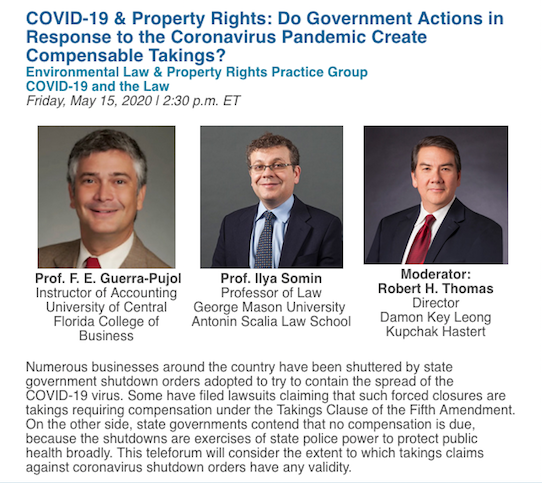
Yesterday (Friday, May 15), Ilya Somin and I debated whether the takings clause of the Constitution applies to coronavirus lockdown orders. (Because courts usually rule for the government, I championed a natural rights perspective to this question.) Our scholarly and spirited debate was hosted by the Federalist Society and moderated by Robert H. Thomas, who asked us a lot of great questions. I will share some of his questions, as well as a link to a recording of the event and my thoughts about the entire affair in the next day or two.

Posted in Uncategorized | Leave a comment

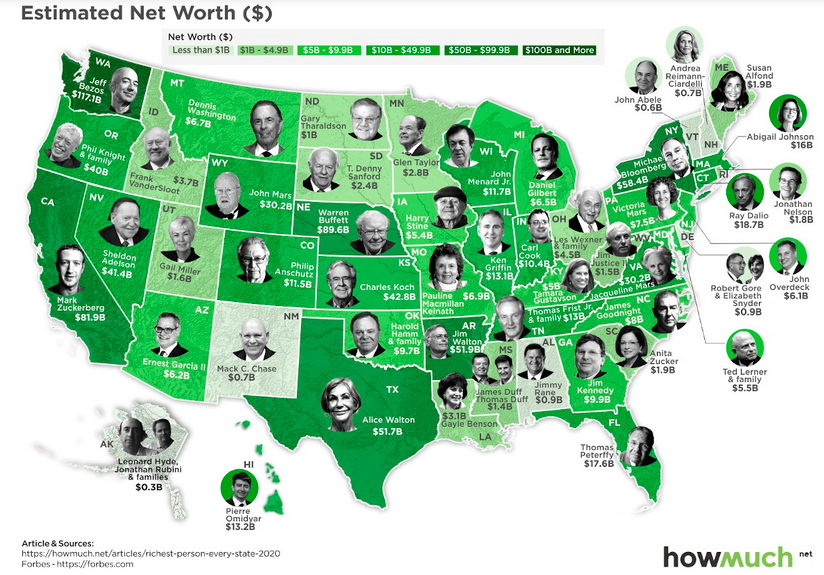
The wealthiest man or woman in every State

Screen Shot 2020-05-16 at 1.15.48 PM

More details here, via Visual Capitalist.

Posted in Uncategorized | Leave a comment

This Friday (5.15): a virtual panel on COVID-19 & property rights

I am reblogging this post as I will be participating in a virtual Federalist Society panel on the theme of “COVID-19 and Property Rights” this afternoon. Specifically, I will be debating my colleague and friend Ilya Somin on whether Government Actions in Response to the Coronavirus Pandemic Create Compensable Takings. (I will argue yes; Somin, no.) The panel is today, May 15, at 2:30 PM (Eastern). It is a teleconference, not a Zoom, so you can listen in by calling in at 888-752-3232. Prof. Somin and I have reserved most of the time to take questions from the audience! (Lastly, I apologize in advance if I do a terrible job at this panel. I am in the process of preparing for the debate, but the law is not on my side!)

F. E. Guerra-Pujol's avatarprior probability

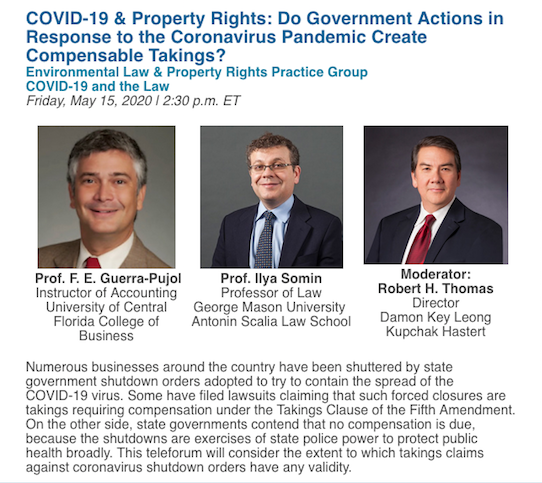
On Friday, May 15, at 2:30 PM Eastern (11:30 AM Pacific), Professor Ilya Somin and yours truly will be debating the following question: “Do Government Actions in Response to the Coronavirus Pandemic Create Compensable Takings?” This virtual panel is open to the public–just pick up a phone and dial 888-752-3232 to listen in. (Sorry, we won’t be using Zoom, but Ilya and I have agreed to field questions from the audience.) Via the Federalist Society, more details are available here.

Screen Shot 2020-05-12 at 3.36.12 PM Source: The Federalist Society

View original post

Posted in Uncategorized | Leave a comment

What would Nozick say?

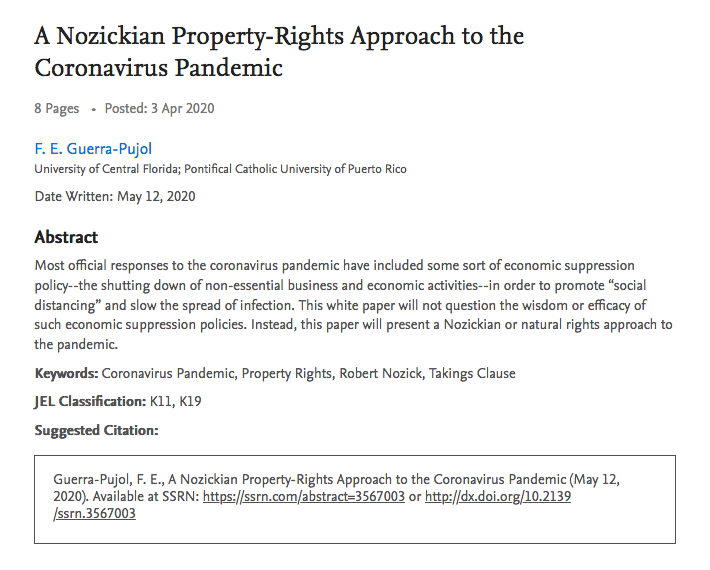
Updated on 5/15 (9:53 AM). How about: “Individuals (even ‘non-essential’ ones) have rights!” In preparation for my upcoming scholarly debate with my colleague and friend Ilya Somin, I have made significant revisions to my property-rights paper, available here (via SSRN), and which is now titled “A Nozickian or natural rights approach to the coronavirus pandemic.” Here is the introduction to my revised paper (references omitted):

In response to the current coronavirus pandemic, State governors all across the United States have issued a series of unprecedented and compulsory economic suppression orders, commonly referred to as “lockdown,” “stay-at-home,” or “shelter-in-place” orders. Broadly speaking, these orders require all “non-essential” businesses to close their doors and prohibit their employees from leaving their homes to work. But do these business lockdowns, however labelled, constitute constitutional “takings” under the Fifth Amendment to the U.S. Constitution?

This is not just a legal question, but also a moral and political one. Instead of waiting for the courts to decide whether shutdown orders are takings under the Constitution, this white paper will offer a Nozickian approach to the pandemic. Simply put, beginning today, local, State, and federal levels of government should start operating at once under the assumption that such orders are constitutional takings. The dire economic consequences resulting from the ad hoc patchwork of coronavirus shutdown orders are too severe and too urgent to leave to the courts.

Following this introduction, Part 2 of the paper will present a Nozickian or natural rights reading of the takings clause. Next, Part 3 will review existing case law and offer the best possible legal argument for why shutdown orders are constitutional takings, while Part 4 will discuss a recent takings case involving a shutdown order in Pennsylvania. Part 5 will then explore the public policy implications of lockdown orders from a Nozickian perspective. To do this, Part 5 will pose the following question: what is the morally optimal level of public theft in the coronavirus age? Lastly, Part 6, in the spirit of Robert Nozick, concludes with a simple thought experiment

Screen Shot 2020-05-13 at 5.59.15 PM

Two cheers for Robert Nozick!

Posted in Uncategorized | 7 Comments

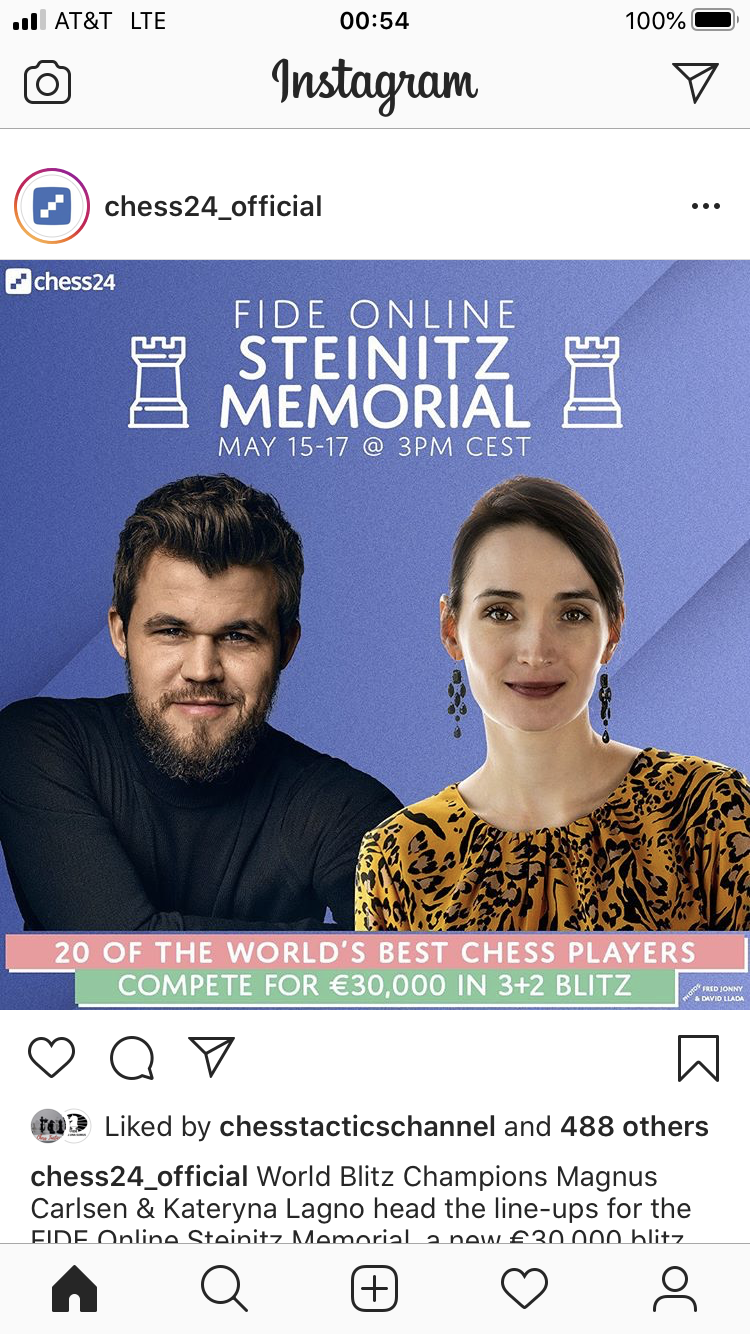
Battle of the sexes (chess edition)

The Steinitz Memorial Chess Tournament is this weekend! As an aside, one of the best things about Instagram are the various chess accounts, like the one below:

Posted in Uncategorized | Leave a comment

This Friday (5.15): a virtual panel on COVID-19 & property rights

On Friday, May 15, at 2:30 PM Eastern (11:30 AM Pacific), Professor Ilya Somin and yours truly will be debating the following question: “Do Government Actions in Response to the Coronavirus Pandemic Create Compensable Takings?” This virtual panel is open to the public–just pick up a phone and dial 888-752-3232 to listen in. (Sorry, we won’t be using Zoom, but Ilya and I have agreed to field questions from the audience.) Via the Federalist Society, more details are available here.

Screen Shot 2020-05-12 at 3.36.12 PM

Source: The Federalist Society

Posted in Uncategorized | 1 Comment

Module 1 of my tiger law survey course

Updated (May 17): I have already shared (in my previous two posts) my summer syllabus as well as the homepage of my new business law course–both the desktop and Canvas app versions. Next, I shall delve into the details of my course modules, beginning with Module 1 (“Introduction to the Course”). For your reference, screenshots of the desktop and Canvas app versions of Module 1 are pictured below the fold. In summary, since the Summer A session at my university has six weeks, I decided to divide my course into six modules (one per week). The first module has three parts: (1) Syllabus, Academic Activity, and Theme Song, (2) Videos, (3) and Tiger King Stuff. Here, I shall summarize the contents of each part and explain the logic of my design choices:

  1. Syllabus, Academic Activity, and Theme Song. The first few items students will see when they now open Module 1 are the syllabus, an academic activity, a theme song as well as some introductory videos. Links to the Syllabus, the Academic Activity, and the Videos are also prominently displayed on the homepage. The theme song and the section on “Tiger King Stuff” are little surprises or rewards for those students who actually bother to go into Module 1. I include a theme song (“Welcome to the Jungle” by Guns N’ Roses, one of my favorite rock songs from when I was in college) in order to stoke everyone’s “animal spirits” and keep up morale. (Also, I have been teaching at the university level for 20 years, and as two generations of students can attest to, I have always liked to begin my lectures with some music.)
  2. Videos. Because this is an online course, I created my own YouTube channel (it’s called “Tiger Law Prof”) in order to record and upload short videos for each module of the course. By posting these videos on YouTube, I can also keep track of how many students are actually watching my videos. I recorded my first set of videos in my home office, using my bookcase as a background. Alas, I will be the first to say that my videos are pretty boring, for I am still learning how to edit videos and sex them up with images and graphics. In the meantime, I will use other techniques to make my videos more engaging and entertaining, perhaps by filming some of them outdoors and in other unexpected locations.
  3. Tiger King Stuff. Because I am using the docuseries “Tiger King” to explore the legal and ethical environments of business, I devoted the third and last subsection of Module 1 to all things Tiger King, including a YouTube video (the official preview of the series), a beautifully-written magazine article (a critical review of Tiger King that was published in The New Yorker), as well as some Wikipedia entries, one for Joe Exotic’s “Greater Wynnewood Exotic Animal Park” and another for Carole Baskin’s “Big Cat Rescue.”

Continue reading

Posted in Uncategorized | 2 Comments

Tiger Law, Homepage for Week 1

As I may have mentioned in a previous post, I will be teaching an upper-level survey course on “The Legal & Ethical Environment of Business” during the Summer A session (May 11 to June 19, I believe) at my home institution. Because all Summer A courses at my university are going to be online this year (due to the pandemic), I decided to start from scratch and completely revamp my business law course to make it as relevant, timely, and engaging as possible. Specifically, during one of my bouts of insomnia, I decided to use the hit Netflix docuseries “Tiger King” to explore the legal and ethical environments of business with my undergraduate students.

If you are a fellow instructor and would like to look under the hood, so to speak, and see what my new course looks like, check out the two sets of screenshots that are below the fold. If you are a student and are just curious about the method behind my madness, also feel free to read on. The first two screenshots capture the desktop version of my course homepage (the first thing that enrolled students will see if they open the course on the Canvas platform on a laptop or desktop computer), while the second pair of screenshots show what my homepage looks like on the Canvas app.

In brief, the top of the homepage showcases a colorful collage of images relating to “Tiger King”–the idea here is to grab my students’ attention from the get-go with a beautiful visualization of the two main protagonists of the hit series, Carole Baskin and Joe Exotic. The rest of the homepage contains some announcements. Among other things, I welcome students to the course and provide them a link to a required academic activity. I also provide students a link to the syllabus (see my previous post to see what my syllabus looks like) and then include a few short introductory videos to personalize this online course as much as possible.

In addition to the homepage, which I will update weekly, I have also created six separate modules for this course (one module per week). Each module will cover a different area of law and will contain a theme song, a set of video lectures, and all of my assigned reading materials (cases, legislation, book chapters, and law review articles) for that week, so students won’t have to spend money on an expensive textbook. (I will delve into the details of Module 1, which is titled “Week 1: Introduction to the Course,” in my next blog post and then describe the contents of my remaining five modules in future posts.) Continue reading

Posted in Uncategorized | Leave a comment