
My most recent paper “Adam Smith in the City of Light” (with Alain Alcouffe) was recently published in volume 15 of the Adam Smith Review. (Here is a link to an ungated preprint of my paper.)
My most recent paper “Adam Smith in the City of Light” (with Alain Alcouffe) was recently published in volume 15 of the Adam Smith Review. (Here is a link to an ungated preprint of my paper.)
One (“The Social Reckoning“) is about Mark Zuckerberg’s response to a Wall Street Journal investigative report known as the Facebook files; the other (“You Can See Everything“) is about disgraced Theranos founder and convicted felon Elizabeth Holmes. The theatrical release dates of these productions are 9 and 16 October; teasers below:
PS: “Musk” does not make my short-list as that movie is almost four hours long!
File under: the history they did not teach me in school. The Stono Rebellion (also known as “Cato’s Conspiracy”) begins on this day (9 September) in 1739 in the colony of South Carolina. It is the largest and most violent uprising in Britain’s mainland North American colonies prior to 1776, and what is even more noteworthy is that it was a slave revolt! (Also on this day in 1850, California is admitted as the 31st U.S. State.)
As you probably have heard by now, last Friday (4 September) the judge presiding over the Lindsay Clancy case in Plymouth, Mass., declared a mistrial after a lone holdout juror had blocked a unanimous verdict after seven days of tense and arduous deliberations. (See here or here, for example.) Alas, I hate to be “that guy”, but this case would not have ended in a mistrial had the jury been allowed to use a simple weighted voting system known as “score voting” or “range voting“, which would have allowed the jurors to express how strong or weak they think the prosecution’s case is. For further reference, I explain in far more detail how this common-sense and intuitive voting procedure works in three of my previous papers:
I have also blogged about score/range voting (or what I now prefer to call Bayesian voting — “Bayesian” because this method of voting allows one to express degrees of belief) many times before:
For a technical explanation of how Bayesian systems of voting solve Arrow’s Paradox, see the video below:
If this haunting track sounds familiar, it’s because it was released by the Swedish artist Kasbo back in 2018.
I began this series of blog posts on 22 August by asking whether Adam Smith was a closet Bayesian. Today, I draw this series to a close by concluding that Adam Smith was a closet behavioral economist who made several significant contributions to what I like to call the “psychology of probability”. Although Smith’s insights are non-mathematical in nature, they are nevertheless important and original:
LOTTERY METAPHOR
To begin, Adam Smith can be considered the first out of a long line of future Anglo-American philosophers — Rawls 1971, Williams 1981, Taleb 2001, Hawthorne 2004, Binmore 2005, and Stone 2011, just to name a few — who have explored how chance applies to various domains of our lives! On this note, see my posts “Adam Smith’s allegory: the lottery of life” and “Adam Smith on self-deception“.
OPTIMISM BIAS
In addition to initiating an entirely new field of philosophy, the Scottish philosopher-economist made an important contribution to this new field, for he explains how optimism bias clouds and distorts our ability to rationally calculate the expected value of certain types of bets (e.g. choice of profession, lottery prizes, insurance risks). See my posts “Adam Smith: father of behavioral economics” and “Adam Smith on the paradox of insurance“.
RISK-TAKING, CRIME, AND AGE
Smith also identifies a direct connection between age and risk-seeking behavior and correctly concludes that risk-taking is most pronounced among young people, and he also extends his optimism bias model to criminal conduct. See my posts on “Adam Smith on the risks of youth” and “Adam Smith explains why crime does not pay“.
THE “WHO DECIDES?” QUESTION
Last but not least, Smith not only recognizes the role that chance can play in our lives and how our self-confidence can distort our perception of these probabilities; he also highlights (though only in passing) the importance of what I like to call the “who decides?” question. That is, in any given situation, Who is in the best position to calculate what the relevant probabilities are? Who decides? See my post “Politics and probability“.
To my North American readers, Happy Labor Day Weekend! Now, to the business at hand. This past week we have been surveying how Adam Smith uses lotteries in Book I, Chapter 10 of The Wealth of Nations — actual state-run lotteries and metaphorical ones — to describe our risk-taking behavior at an individual level, e.g. why we buy lottery tickets, why we neglect or under-insure against the occurrence of certain types of remote but real risks, and why we join certain trades and professions. But Smith saves the best for last. In Paragraph 33 of Book I, Ch. 10, Smith draws a direct connection between profits and risk:
“In all the different employments of stock, the ordinary rate of profit varies more or less with the certainty or uncertainty of the returns. These are in general less uncertain in the inland than in the foreign trade, and in some branches of foreign trade than in others; in the trade to North America, for example, than in that to Jamaica. The ordinary rate of profit always rises more or less with the risk.” (WN, I.x.33; my emphases)
But no sooner than making this observation about the direct relationship between profit and risk, Smith carves out an exception for people engaged in “the most hazardous of all trades”, i.e. smuggling:
“The ordinary rate of profit always rises more or less with the risk. It does not, however, seem to rise in proportion to it, or so as to compensate it completely. Bankruptcies are most frequent in the most hazardous trades. The most hazardous of all trades, that of a smuggler, though when the adventure succeeds it is likewise the most profitable, is the infallible road to bankruptcy. The presumptuous hope of success seems to act here as upon all other occasions, and to entice so many adventurers into those hazardous trades, that their competition reduces their profit below what is sufficient to compensate the risk.” (WN, I.x.33; my emphasis)
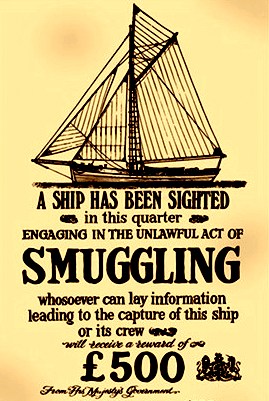
In other words, according to Adam Smith, illegal activities like smuggling, bank robbery, etc., etc. will attract a disproportionate number of profit-loving risk-seekers, and this excess number of law-breakers will put downward pressure on the returns from their illegal activities. But why would anyone be attracted to such “hazardous” (i.e. illegal) trades in the first place? Because of, what else?, optimism bias or “[t]he presumptuous hope of success”! (Id.) To bring our discussion of Smith’s survey of lotteries full circle, here we see a parallel between a profession like law, “where twenty fail for one that succeeds” (WN, I.x.22), a “trade” like smuggling or bank robbery, where everyone eventually fails!
But even more importantly (at least to me!), notice what Smith is not doing here. Unlike his contemporary Cesare Beccaria or Beccaria’s intellectual heir Gary Becker, Smith is not applying the standard rational actor model to explain law-breaking behavior. (After all, if criminals were indeed rational, they would realize that the rate of return from their illegal activities is too low!) Nor is Smith repeating the spurious cliché about poverty being the main cause of crime. (I say “spurious” because if this hackneyed and overused platitude were true, then all poor people would be criminals!) Instead of engaging in “blackboard economics” like Becker or Beccaria, Smith is using psychology to explain criminal conduct. For Smith, criminals are just as susceptible to optimism bias (i.e. “[t]he presumptuous hope of success”) as everyone else, and illegal activities are the most extreme example of risk-seeking behavior.
Nota bene: I will conclude my series on “Adam Smith and the psychology of probability” with some final thoughts in my next post.
In my previous post “The Army as Lottery“, we saw how according to Adam Smith in Paragraph 30 of Chapter 10 of Book I of The Wealth of Nations, “romantic hopes” of heroism and glory are what motivate many young men to enlist in the army. But for Smith, enlisting in the army is like buying a lottery ticket: the “prize” or jackpot could be a beneficial one — since you could win “honour and distinction” — but it could also be a detrimental one — you could be killed or maimed! (WN, I.x.30)
Curiously, however, Smith is generally far more sanguine about naval occupations than military careers on land, for he opens the next paragraph (Para. 31) with the following disclaimer: “The lottery of the sea is not altogether so disadvantageous as that of the army.” (WN, I.x.31) Why does Smith see the navy in a more favorable light than the army? There are two reasons why. One reason is practical. There is a market for sailors, not so much for soldiers. At the time Smith was writing The Wealth of Nations, Britain was a major sea power. A father will thus allow his son to join the navy because a stint in the naval forces will open up a world of opportunities for his son in Britain’s sea trade:
“The son of a creditable labourer or artificer may frequently go to sea with his father’s consent; but if he enlists as a soldier, it is always without it. Other people see some chance of his making something by the one trade: nobody but himself sees any of his making anything by the other.” (WN, I.x.31)
The other reason is technical: the variance between negative and positive prizes in Smith’s “lottery of the sea” is smaller than it is in the army. In plain English, when you play the naval lottery, the prizes are smaller but there are more of them! As a result, there are more opportunities for moving up the hierarchical military ladder in the navy than in the army, or in the immortal words of Adam Smith:
“The great admiral is less the object of public admiration than the great general, and the highest success in the sea service promises a less brilliant fortune and reputation than equal success in the land. The same difference runs through all the inferior degrees of preferment in both. By the rules of precedency a captain in the navy ranks with a colonel in the army; but he does not rank with him in the common estimation. As the great prizes in the lottery are less, the smaller ones must be more numerous. Common sailors, therefore, more frequently get some fortune and preferment than common soldiers; and the hope of those prizes is what principally recommends the trade.” (WN, I.x.31)
But “the lottery of the sea” is not all sunshine and rainbows. Smith devotes most of this paragraph explaining why the wages of “common sailors” are no greater than the wages of regular workmen on land:
“Though their skill and dexterity are much superior to that of almost any artificers, and though their whole life is one continual scene of hardship and danger, yet for all this dexterity and skill, for all those hardships and dangers, while they remain in the condition of common sailors, they receive scarce any other recompense but the pleasure of exercising the one and of surmounting the other. Their wages are not greater than those of common labourers at the port which regulates the rate of seamen’s wages. As they are continually going from port to port, the monthly pay of those who sail from all the different ports of Great Britain is more nearly upon a level than that of any other workmen in those different places; and the rate of the port to and from which the greatest number sail, that is the port of London, regulates that of all the rest.” (WN, I.x.31; my emphasis) [*]
But don’t sailors get “free” room and board while they are at sea? Yes, but the navy does not house or feed their wives and children:
“The sailor, indeed, over and above his pay, is supplied with provisions. Their value, however, may not perhaps always exceed the difference between his pay and that of the common labourer; and though it sometimes should, the excess will not be clear gain to the sailor, because he cannot share it with his wife and family, whom he must maintain out of his wages at home.” (WN, I.x.31)
In short, there is literally no free lunch! But if the wages of regular sailors in the naval forces are not so great, why would anyone want to join the navy? Smith explains why in Paragraph 32 of Book I, Ch. 10:
“The dangers and hairbreadth escapes of a life of adventures, instead of disheartening young people, seem frequently to recommend a trade to them. A tender mother, among the inferior ranks of people, is of afraid to send her son to school at a seaport town, lest the sight of the ships and the conversation and adventures of the sailors should entice him to go to sea.” (WN, I.x.32; my emphasis)
But as Smith further explains, this “distant prospect” of adventures is itself a form of compensation, so the navy (and the army!) can get away with paying low wages. If you want to get paid more, you need to join a more boring or prosaic trade that is “unwholesome”:
“The distant prospect of hazards, from which we can hope to extricate ourselves by courage and address, is not disagreeable to us, and does not raise the wages of labour in any employment. It is otherwise with those in which courage and address can be of no avail. In trades which are known to be very unwholesome, the wages of labour are always remarkably high. Unwholesomeness is a species of disagreeableness, and its effects upon the wages of labour are to be ranked under that general head.” (WN, I.x.32; my emphasis)
What does Smith mean by “unwholesome” and “disagreeable[]”, and to what extent, if any, are these Smithian observations about these trades true today? What about policemen and firemen, for example? Are policing and fire-fighting two of Smith’s so-called “unwholesome” trades? And speaking of the police, what about criminal “trades” like smuggling and bank robbery? Is a life of crime more like Smith’s “lottery of the sea” (i.e. “a life of adventures”), or is it more like an “unwholesome” trade because of the social stigma and severe penalties attached to criminal conduct? We will address these questions in my post. (To be continued…)
In my previous post, we saw how the direct relationship between youth and risk-taking — the now-commonplace observation that young people are especially vulnerable to wishful thinking and risk-seeking thrills — can be traced back to Book I, Chapter 10 of The Wealth of Nations. For Adam Smith, the paradigm case of this risk-taking behavior is “the readiness of the common People to enlist as soldiers, or to go to sea.” (WN, I.x.29) Smith elaborates on these two examples in the next two paragraphs (Paras. 30 & 31) of Book I, Ch. 10.
First, Smith asks, why are young people so willing and eager to volunteer to join the armed forces–not only in times of peace but even when war is looming on the horizon? After all, by enlisting they are putting their very lives at risk! And yet, the outbreak of hostilities is the time when the armed forces are able to recruit the most, or in the immortal words of Adam Smith, “young volunteers never enlist so readily as at the beginning of a new war”! (WN, I.x.30) But why? According to Smith, the answer once again is optimism bias (“romantic hopes”), which is especially pronounced among young people:
“What a common soldier may lose is obvious enough. Without regarding the danger, however, young volunteers never enlist so readily as at the beginning of a new war; and though they [the young volunteers] have scarce any chance of preferment, they figure to themselves, in their youthful fancies, a thousand occasions of acquiring honour and distinction which never occur. These romantic hopes make the whole price of their blood. Their pay is less than that of common labourers, and in actual service their fatigues are much greater.” (WN, I.x.30; my emphasis)
In other words, enlisting in the armed forces is like buying a lottery ticket. The “prize” or jackpot could be a detrimental one, i.e. a negative prize or reverse jackpot (you could be killed or maimed), but it could also be a beneficial one: the acquisition of “honour and distinction.” (Id.) Either way, when a young man enlists in the army, he is essentially playing a kind of lottery. But this observation begs the question, Why would anyone participate in such a lottery when the probability of winning a negative prize is just as great, if not greater, than the probability of winning a positive prize? In two words: optimism bias, or to quote Adam Smith, “romantic hopes”! (Id.)
As an aside, notice how Smith further observes that these “romantic hopes” of glory and honor are a form of compensation. Even though soldiers end up doing much more work than their civilian counterparts do (“their fatigues are much greater”), they are paid less! How can this discrepancy be the case? Because a soldier’s compensation cannot be counted in just dollars and cents (or pounds and shillings). A soldier’s compensation includes the small chance that he will perform heroic deeds and become a national hero and be long remembered even after he is dead.
What about the navy? You would think the same lottery-like logic as above applies to the decision to become a sailor, but as it happens, Smith’s is far more sanguine about naval occupations than military careers on land. Why does Smith have much more positive things to say about the Navy? I will turn to this question in my next post. (To be continued…)

Thus far this week (see here and here), we have seen why Adam Smith can be considered to be the founder of behavioral economics. In summary, what Smith calls this “absurd presumption in [our] own good fortune” (i.e. optimism bias) in Book I, Chapter 10 of The Wealth of Nations, combined with the pull of our emotions, clouds our ability to make mathematically rational decisions in two ways:
On the one hand, our optimism bias and the emotional appeal of large prizes can cause us to overestimate the probability of winning in certain situations, such as state-run lotteries. (Para. 27) But at the same time, these cognitive quirks can also lead us to underestimate the probability of more distant or remote risks of misfortune. (Para. 28)
Next, in Paragraphs 29 and 32 of Chapter 10 of Book I of his magnum opus, Smith further observes that young people are especially risk-seeking:
“The contempt of risk and the presumptuous hope of success are in no period of life more active than at the age at which young people choose their professions. How little the fear of misfortune is then capable of balancing the hope of good luck appears still more evidently in the readiness of the common People to enlist as soldiers, or to go to sea, than in the eagerness of those of better fashion to enter into what are called the liberal professions.” (WN, I.x.29; my emphasis)
“The dangers and hairbreadth escapes of a life of adventures, instead of disheartening young people, seem frequently to recommend a trade to them.” (WN, I.x.32)
What is so utterly amazing about these passages in particular is just how prescient they are. Although young people today (Gen-Z, anyone?) are supposedly engaging in such risky behaviors as drinking, smoking, and pre-marital sex at lower rates than previous generations (see here, for example), young people still engage in more risky behavior than older adults overall! (A summary of the work of contemporary researcher of adolescent risk-taking, Laurence Steinberg, calls teens “risk junkies“! See also the TED Talk below.)
Also, as an intriguing aside, notice how Adam Smith compares and contrasts “readiness of the common People to enlist as soldiers” with “the eagerness of those of better fashion to into … the liberal professions.” (I.x.29) What Smith appears to be saying here is that a young man from a poor and middle-class background — e.g. “[t]he son of a creditable labourer or artificer” (I.x.31) — is even more likely to make bad or risky decisions than the scion of a powerful or wealthy family. Or more simply put, the operation of optimism bias not only has a temporal dimension; it also has a social class dimension for Smith!
In the next two passages (Paragraphs 30 & 31 of Book I, Chapter 10), Smith compares and contrasts the profession of a common soldier (Para. 30) with that of a sailor (Para. 31). We will turn to those two passages in my next post. (To be continued…)





Welcome to the online home of the IASS
Hopefully It’s Interesting.
In Conversation with Legal and Moral Philosophers
PhD, Jagiellonian University
Books, papers, and other jurisprudential things
Ramblings of a retiree in France
BY GRACE THROUGH FAITH
Natalia's space
hoping we know we're living the dream
Lover of math. Bad at drawing.
We hike, bike, and discover Central Florida and beyond
Making it big in business after age 40
Reasoning about reasoning, mathematically.
I don't mean to sound critical, but I am; so that's how it comes across
remember the good old days...
"Let me live, love and say it well in good sentences." - Sylvia Plath
a personal view of the theory of computation
Logic at Columbia University
Just like the Thesis Whisperer - but with more money
the sky is no longer the limit
Technology, Culture, and Ethics
Just like the horse whisperer - but with more pages
Poetry, Other Words, and Cats


