
Shout out to my youngest daughter, Adys, for introducing me to Laufey’s music!
Creative Commons
Blogs I Follow








Shout out to my youngest daughter, Adys, for introducing me to Laufey’s music!
I will begin a new series of blog posts in the next day or two. In the meantime, here is a compilation of my previous 12 posts on the political theories of Rousseau, Rawls, and Nozick:
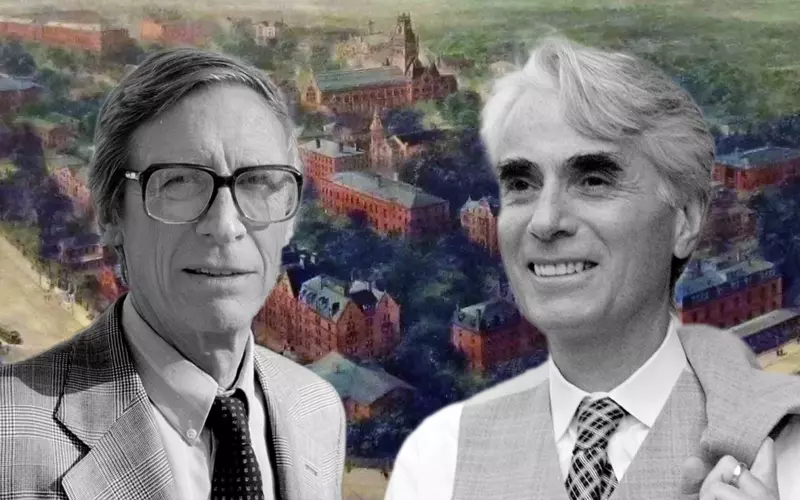
“We are all libertarians …” –Dr. Julia Maskivker
Although Nozick’s valiant pincer movement against Rawls is vulnerable to counter-attack (as we saw in my previous post), Nozick is right about two things: (a) liberty matters, and (b) any attempt to achieve equality — whichever metric we use to measure equality — will come at the expense of liberty. To conclude (for now), I would only add the following additional observation: any attempt to achieve a well-ordered society (“law and order”) will also come at the expense of liberty. As a result, the $64 question is, how much liberty are we prepared to give up in order to achieve other worthy goals, such as equality, safety, or “justice”? And more broadly, is the law-liberty dilemma a “soluble” problem?
My tentative conclusion is, no it is not. Everyone (and every group) must decide for itself how much liberty he (or in the case of a group, it) is willing to trade off in exchange for equality, safety, etc., or vice versa, how much equality, safety, etc., one is willing to trade off for liberty. That is the paradox of politics in a nutshell, and as I see it, there is no scientifically “falsifiable” answer (in the Popperian sense) or single solution to this question. It’s all a matter of preferences, or perhaps aesthetics.
And on this note (aesthetics), I like to compare the great minds I have surveyed thus far — Hume and Smith, Locke and Nozick, Rousseau and Rawls — to the “Old Masters” of our Western art tradition. By way of illustration, just as many accomplished artists from different eras — Caravaggio, El Greco, and Gauguin come to mind — have painted the same pivotal moment in the life of Jesus in different ways, the famous “Agony in the Garden of Gethsemane” that took place between the Last Supper and Jesus’s arrest, so too have the great minds of political philosophy presented their own original portraits of liberty.
For Nozick, for example, liberty is the absence of coercion or interference from others, especially the state. For Rawls, it is the first of his two principles of justice: “an equal right to the most extensive basic liberty compatible with a similar liberty for others.” And for Rousseau, it is obedience to the general will. Yes, we are all libertarians, but how much? Which of these competing conceptions of liberty is the “right” one? For my part, I am inclined to agree with Nozick. Rousseau’s general will is too dangerous, while Rawls is just a Rousseauian wolf in classical liberal clothing. Nozick’s nightwatchman state is not just the lesser evil; it is my aesthetic ideal.

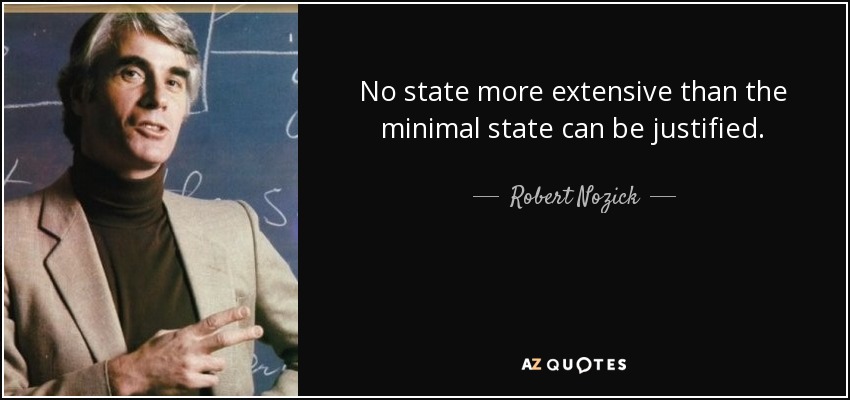
“Individuals have rights, and there are things no person or group may do to them (without violating their rights).” –Robert Nozick
Thus far (see here and here), we have presented the first flank of Nozick’s powerful pincer attack on Rawls: the Wilt Chambelain Argument. Today, we will scrutinize his other flank: the Side Constraint Argument.
In summary, “side constraints” impose strict limits on what we can and cannot do: they are absolute and inviolable Kantian moral rules (such as “don’t kill the innocent”, “don’t steal”, etc.) that prohibit any individual or group, including anyone in the government, from taking or redistributing any “holdings” that have not been acquired unjustly. Side constrains are thus absolute and inviolable because they act as a bright-line barrier or moral boundary: we are not allowed to violate these Kantian moral rules under any circumstances, even if violating them would promote more utility on balance or achieve a worthy goal (like saving more lives). [1] (N.B.: Footnotes are below the fold.) But even if you are a good Kantian, Nozick’s Side Constraint Argument is vulnerable on several fronts.
(Before proceeding, it is worth noting that Nozick would extend the protection of this absolute and inviolable Kantian barrier to non-human animals and that his argument for doing so is a highly creative and ingenious one: Nozick asks us to imagine the possibility of an alien race of “superbeings” who “stand to us as it is usually thought we do to animals” (Nozick, ASU, p. 45, emphasis in original). In other words, even if humans are morally superior to animals, moral side constraints should apply to human-animal interactions as they do to human-human interactions, for if there were such an alien race of superbeings — like the Vulcans in the fictional Star Trek sci fi series — and if they were to ever come into contact with us, wouldn’t we want them to follow Nozick’s side-constraint view of morality in their dealings with us? [2])
Putting aside Nozick’s extension to non-human animals (what about insects, plants, or simple singled-celled organisms, for example?), I am obliged to point out some additional soft spots in Nozick’s second flank. In brief, Nozick is vulnerable to counter-attack on several fronts. One is the source question: what is the ultimate source of his moral side constraints? The other is the content question: what do these moral rules consist of? Are these constraints limited to mere non-aggression, for example, or do they impose an affirmative duty to help the poor or rescue persons in peril? In short, we still have to determine the source and pinpoint the content of Nozick’s side constraints. Alas, here is where Nozick’s second flank, like an elaborately-carved sand castle against the tide, begins to collapse.
Let’s consider the content question first. Above and beyond Nozick’s paradigmatic moral rule “don’t kill the innocent”, what else do these side constraints consist of? For Nozick, these side constraints are limited to mere “non-aggression” — or in Nozick’s own words (ASU, p. 33), “the existence of moral side constraints … leads to a libertarian side constraint that prohibits aggression against another” — i.e. abstaining from the use of force, from theft and fraud, and from enslaving others. [3] Nozick does not, in other words, impose an affirmative duty to help the poor. But why does Nozick curtail his otherwise attractive picture of moral side constraints this way? [4] Also, even if we accept Nozick’s limiting principle (side constraints = non-aggression), how should we define “aggression”? Are surveillance cameras, for example, a form of aggression? [5]
Now, let’s consider the source question. Aside from “because I say so”, what is the ultimate source of Nozick’s side constraints? For Nozick, the source of his side constraints is based on our “moral agency” and our ability to plan for the future. [6] But if moral agency and the ability to make future plans are the source of Nozick’s side constraints, this grounding ends up undermining his defense of animal rights, since it is debatable whether non-human animals ponder the meaning of their lives or have any moral agency themselves. (After all, what other non-human animals, aside perhaps from beavers and octopi, are able to formulate long-term plans?) Worse yet, Nozick not only undercuts his defense of animal rights; he also neglects the social dimensions of human life (e.g. family, church, village, etc.), for in reality it is not “I” in isolation or “me” acting alone who gives meaning to my life; it is my relationships with others that give meaning to my life. [7] However hard we may try, we don’t give meaning to our own lives; others do!
But the main problem with Nozick’s Side Constraint Argument is this: it is impractical and dogmatic. That is, even though side constraints are supposed to be limited to non-aggression, the problem is that Nozick defines the concept of harm so broadly that his non-aggression principle becomes too inviolable and too absolutist to be of any practical use. To see why, let’s return full circle to Nozick’s Wilt Chamberlain Argument. According to Nozick, any attempt to tax Wilt Chamberlain’s earnings would be a form of unjustified state-sanctioned violence in contravention of the non-aggression principle! Why? Because, for Nozick, government taxation is worse than theft; it is a form of forced labor. After all, if the government can’t force you to give up x hours of your personal time per week to help the needy, then why does the government have the right to take the equivalent of x hours of your weekly paycheck to produce the same result? [8]
In short, if side constraints prohibit taxation, then how are essential public goods like courts, cops, and the common law to be financed? Nozick’s famous answer to this question is the “nightwatchman state”, i.e. a minimal government limited to enforcing contracts and to protecting people from force, theft, and fraud. But this formulation poses as many line-drawing questions as it answers! Should, for example, a contract for the purchase and sale of animal meat be enforced? After all, Nozick himself would extend his non-aggression principle to our treatment of non-human animals. If so, what has happened to the value of liberty? Also, how should “fraud” be defined? Does the prohibition against fraud include an affirmative duty to disclose all relevant information? More broadly, how many policemen, soldiers, and wardens should the nightwatchman state hire? How many surveillance cameras, if any, are consistent with the concept of liberty?
Are we thus back to where we started when I began this series on the paradox of politics? I will conclude my series with some final observations (for now) about the law-liberty dilemma in my next post.
To pick up where I left off in my previous post: Robert Nozick’s “Wilt Chamberlain Argument” is a devastating takedown of the difference principle. To see why, recall Rawls’s main motivating rationale when he wrote A Theory of Justice, i.e. the reason why he thinks social inequality is unjust unless it somehow works to the advantage of the least-advantaged members of society:
Those who have been favored by nature, whoever they are, may gain from their good fortune only on terms that improve the situation of those who have lost out. The naturally advantaged are not to gain merely because they are more gifted, but only to cover the costs of training and education and for using their endowments in ways that help the less fortunate as well. No one deserves his greater natural capacity nor merits a more favorable starting place in society. (Rawls, A Theory of Justice, p. 87, reprinted in Cohen 2018, p. 697)
In other words, our social status is largely a result of luck, especially the cards we were dealt with at birth. We cannot control, for example, who are parents are. Nor can we control in which country we are born in or whether we are born healthy or with a disability. But these are precisely the variables in the genetic lottery that determine our social status, i.e. how much our good or bad fortune we will have in life! [1] The genius of the Wilt Chamberlain Argument is that Nozick accepts this genetic lottery argument at face value. After all, the fact that Wilt Chamberlain was such a great athlete was, in large part, a result of his good luck in the genetic lottery. [2]
Furthermore, Nozick’s Wilt Chamberlain Argument is simple, intuitive, and irrefutable:
Let us suppose … everyone has an equal share [of society’s wealth] …. Now suppose that Wilt Chamberlain is greatly in demand by basketball teams, being a great gate attraction. (Also suppose contracts run only for a year, with players being free agents.) He signs the following sort of contract with a team: In each home game, twenty-five cents from the price of each ticket of admission goes to him. (We ignore the question of whether he is “gouging” the owners, letting them look out for themselves.) The season starts, and people cheerfully attend his team’s games, they buy their tickets, each time dropping a separate twenty-five cents of their admission price into a special box with Chamberlain’s name on it. They are excited about seeing him play; it is worth the total admission price to them. Let us suppose that in one season one million persons attend his home games, and Wilt Chamberlain winds up with $250,000, a much larger sum than the average income and larger even than anyone else has. Is he entitled to this income? Is this new distribution D2, unjust? If so, why? (Nozick, ASU, p. 161, reprinted in Cohen 2018, pp. 716-717)
Thus the Wilt Chamberlain Argument not only shows why inequality is inescapable, i.e. why most pattern-based or end-state distributions are unstable; it also shows why such inequality is totally consistent with social justice! (ASU, pp. 160-164) To see why, let’s walk through each step of Nozick’s argument:
Alas, there are two possible blind spots with Nozick’s slam-dunk argument: what if the team decides to breach its contract with Wilt Chamberlain? In that case, Chamberlain could resort to self-help (not play the following season unless he is paid), or he could sue his team in a court of law to enforce his contract. [3] Yet courts are expensive to operate, and contract law (whether based on model legislation like the UCC or common law principles) doesn’t just arise out of thin air. Isn’t it “just” or fair, then, that Wilt Chamberlain be required to pay for this legal infrastructure out of his earnings?
Also, why doesn’t Wilt Chamberlain have a moral duty to share some fraction of his earnings with some less fortunate souls, say poor kids who would like to play basketball or with disabled children who are unable to play basketball altogether? Here, however, is where the second flank of Nozick’s pincer comes into play: Side Constraints. (To be continued …)

[1] Rawls goes even further: like a good Communist, he assumes that “the distribution of natural talents [is] a common asset ….” (Rawls, Theory of Justice, reprinted in Cohen 2018, p. 696)
[2] Of course, Wilt Chamberlain’s playing ability was also due to his own efforts, but let’s assume for the sake of argument that Rawls’s genetic lottery is the determining factor in Wilt Chamberlain’s greatness.
[3] Or, in the likely event the contract has an arbitration clause, Chamberlain could go to arbitration.
I concluded my previous post by stating without qualification that Nozick “totally demolished” Rawls’s difference principle, i.e. Rawls’s claim that social and economic inequalities are only just if they work to the advantage of the least-advantaged members of society. In truth, I undersold Nozick: Nozick demolished not just Rawls but all egalitarian theories of distributive justice. How did Nozick accomplish this feat? By launching an intellectually-lethal pincer attack against equality-based theories of distributive justice in Chapter 7 of his book-length reply to Rawls, Anarchy, State, and Utopia (ASU). On one flank is Nozick’s famous Wilt Chamberlain Argument; on other the flank is Nozick’s notion of non-negotiable Side Constraints.
By way of background, both flanks of this powerful pincer are grounded in Nozick’s distinction between (a) so-called distributive justice, which are based on patterns or end-states, and (b) what Nozick himself calls “justice in holdings”. As Nozick points out, theories of distributive justice, like Rawls’s difference principle, focus on patterns or end-states in which “all that needs to be looked at, in judging the justice of a distribution, is who ends up with what.” (ASU, p. 154) Nozick’s “justice in holdings”, by contrast, is not a matter of patterns or end-states; it is a purely historical question, or more simply put, “whether a distribution is just depends upon how it came about.” (ASU, p. 153) For Nozick, a given distribution of goods will be just so long as the initial acquisition of goods and their subsequent transfer are themselves just, even if people end up with shares of different or unequal sizes.
With this fundamental distinction in mind, let’s return to Nozick’s pincer attack. On one flank, Nozick shows how all theories of distributive justice share the same flaw: they erroneously assume that a large-enough economic pie of goodies already exists to give away, but in reality, the ingredients of the pie first have to be assembled and the pie then has to be baked before it can be sliced up and shared with others. As such, the problem with Rawls’s difference principle — and with other “patterned” or end-state approaches to justice, for that matter, such as “distribute according to moral merit” or “distribute according to usefulness to society” — is that Rawls and his fellow progressives focus exclusively on the question of distribution (who gets what?), while neglecting the equally-important question of production (who makes what?).
But the main problem with Rawls’s difference principle and with other such patterned or end-state theories of justice is that Rawls and company have nothing to say about just deserts. According to Nozick, “Most persons do not accept current time-slice [i.e. end-state] principles as constituting the whole story about distributive shares. They think it relevant in assessing the justice of a situation to consider not only the distribution it embodies, but also how that distribution came about.” (ASU, p. 154, emphasis added) But for Nozick, history (and maybe even public opinion!) matters: “The situation is not one of something’s getting made, and there being an open question of who is to get it.” (ASU, p. 160, emphasis in original) In the real world — that is, beyond the erudite pages of scholarly tomes like Rawls’s Theory of Justice — “Things come into the world already attached to people having entitlements over them.” (Ibid.)
Enter Wilt Chamberlain. (To be continued …)
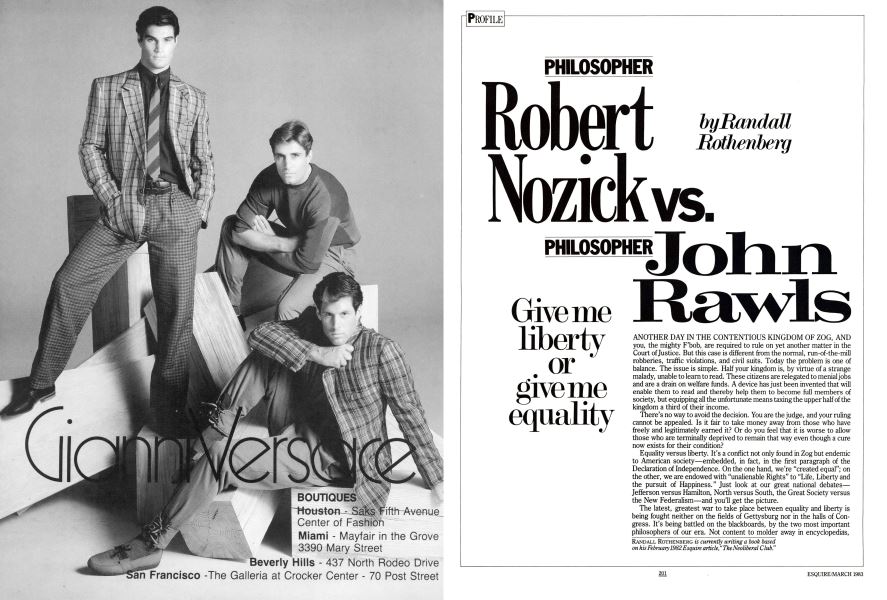
In my previous two posts in this series, I explained why Rawls’s original position is just a dressed-up version of Rousseau’s general will in disguise (see here) and why Rawls’s approach to liberty is, at bottom, no different than Rousseau’s (here). Today, I will expound on Rawls’s approach to liberty and explain why his principle of “equal liberty” is an empty vessel.
First off, let’s recall Rawls’s solution to the law-liberty dilemma. According to Rawls, people in the original position (including children, idiots, and non-human animals?), if we are negotiating behind a veil of ignorance, would agree to two (and only two!!) overarching “principles of justice” to govern our politics in the future. First and foremost, we would agree to the principle of “equal liberty”. Rawls’s famous formulation of this principle is as follows:
“First: each person is to have an equal right to the most extensive basic liberty compatible with a similar liberty for others.” (Rawls, A Theory of Justice, reprinted in Cohen 2018, p. 692)
Rawls himself must have recognized that this formulation (“an equal right to … basic liberty”), standing alone, is a totally empty one because he later defines “basic liberty” thus:
“The basic liberties of citizens are, roughly speaking, political liberty (the right to vote and to be eligible for public office) together with freedom of speech and assembly; liberty of conscience and freedom of thought; freedom of the person along with the right to hold (personal) property; and freedom from arbitrary arrest and seizure as denned by the concept of the rule of law.” (Ibid.)
For good measure, Rawls then adds the following kicker to this laundry list of liberties: “These liberties are all required to be equal by the first principle [of justice], since citizens of a just society are to have the same basic rights.” (Ibid.) But do the words “equal” and “same” really add anything to Rawls’s pedantic inventory of basic liberties? To paraphrase Peter Weston, the concept of equality, standing alone, is an empty one because we always need some external criterion or yardstick to measure the absence or existence of equality in the first place. [1]
Worse yet (especially from a libertarian perspective), notice what is missing from Rawls’s formulaic enumeration of “basic liberties”. Although Rawls is willing to tolerate “freedom of the person”, he limits this liberty to “the right to hold (personal) property” — the classical liberal idea of “natural liberty”, i.e. the liberty to pursue one’s private interests — is nowhere to be found in Rawls’s laundry list of liberties. This glaring omission is the proverbial “dog that did not bark” — another dead giveaway that Rawls is, in reality, a Rousseauian wolf dressed up in contractarian clothing!
But what about Rawls’s other principle of justice, i.e. the “difference principle”, i.e. the notion that social and economic inequalities are only just if they work to the advantage of the least-advantaged members of society? As we shall see in my next post, Rawls’s second principle of justice requires us to turn to his Harvard colleague, Robert Nozick. Why Nozick? Because it was Nozick who totally demolished Rawls’s difference principle once and for all. (To be continued …)

[1] Peter Weston, The Empty Idea of Equality, Harvard Law Review, Vol. 95, No. 3 (1982), pp. 537-596.
In a previous post, I explained why Rawls’s original position is a dressed-up version of Rousseau’s general will in disguise (see here). Today, I will explain why Rawls’s approach to liberty is, at bottom, no different than Rousseau’s.
First off, recall Rousseau’s ingenious solution to the law-liberty dilemma: the Swiss philosopher redefines liberty to mean obedience with the general will. In brief, by complying with the dictates of the general will, you are ultimately obeying yourself because you voluntarily entered into a social compact in which everyone agrees ahead of time to obey the general will.
Now, compare Rousseau’s Orwellian “obedience = freedom” formula with the main gist of Rawls’s Theory of Justice. Rawls’s “money shot” (so to speak) is a hypothetical state of nature (the original position), where everyone would unanimously agree to two high-level principles of justice: (a) equal basic liberty for all, and (b) a universal safety net for the members “the least fortunate group”, whoever they turn out to be (what Rawls calls the “difference principle”).
But notice what Rawls leaves out from this picture: the permanency or finality of his money shot! That is, once the hypothetical votes have been counted — hypothetical because even Rawls has to admit that his original position is just a figment of his imagination! — and once the veil of ignorance is finally lifted, whatever we agreed to in the original position becomes firm and final and can never be changed thereafter! Once again, in other words, it’s what Rawls doesn’t say — the dog that is not barking — that is troubling.
(Of course, you could try to justify the finality of Rawls’s principles — after all, those principles were supposedly chosen on a unanimous basis from behind a veil of ignorance — but this justification does not change the fact that once the veil of ignorance is finally lifted, we are stuck with Rawls’s two principles forever.)
But what about the substance of Rawls’s two principles of justice. Perhaps Rawls’s two principles are so great that we would have no reason to change them. Alas, as I shall explain in my next two posts, neither principle is worth saving. (To be continued …)

I concluded my previous post thus:
“… Rawls and Rousseau are alike in two profound ways. One is that Rawls’s definition of liberty, deep down, is really no different than Rousseau’s. The other is that Rawls’s ‘original position’, in form and in substance, is just Rousseau’s ‘general will’ in disguise.”
Let’s begin with my second claim. To see why there is a family resemblance, if not a direct correspondence, between Rawls’s original position and Rousseau’s general will, recall Rawls’s solution to the law-liberty dilemma: the “original position”. For Rawls, the original position is a hypothetical state of nature where we choose principles of justice from behind an impenetrable “veil of ignorance”, a shroud so deep and dark that it conceals our personal characteristics like race, gender, wealth, and social status. Or in Rawls’s own words:
“In justice as fairness the original position of equality corresponds to the state of nature in the traditional theory of the social contract. This original position is not, of course, thought of as an actual historical state of affairs, much less as a primitive condition of culture. It is understood as a purely hypothetical situation characterized so as to lead to a certain conception of justice. Among the essential features of this situation is that no one knows his place in society, his class position or social status, nor does any one know his fortune in the distribution of natural assets and abilities, his intelligence, strength, and the like. I shall even assume that the parties do not know their conceptions of the good or their special psychological propensities. The principles of justice are chosen behind a veil of ignorance.” (Rawls, A Theory of Justice, p. 11, reprinted in Cohen 2018, p. 688)
According to Rawls, we would want to hedge our bets (so to speak) by choosing only fair principles if we were to find ourselves in this strange situation because we wouldn’t know our own position or status in the future. Yet what, if anything, you may ask, does this ingenious thought-experiment have to do with Rousseau’s general will? After all, even I have to concede that there is at least one major difference between Rawls’s original position and Rousseau’s general will, a temporal one: TIMING. Rousseau’s general will is ex post, while Rawls’s original position is ex ante.
In brief, Rousseau’s general will is ex post because it does not come into existence until after the formation of civil society, that is, until after men have left the state of nature and have agreed to a social compact in which “Each of us put his person and all of his power in common under the supreme direction of the general will ….” (Rousseau, The Social Contract, reprinted in Cohen 2018, p. 272, Rousseau’s emphasis) Rawls’s original position, by contrast, is ex ante because the original position only exists before we have negotiated a social contract, i.e. prior to the creation of civil society.
Despite this temporal difference, I stand by my unconventional claim that Rawls’s original position is just Rousseau’s general will in disguise, for there is one major parallel between both constructs: the total lack of any information to guide one’s vote in both cases! Whether we are talking about real-life flesh-and-blood men voting to express their general will, as the members of ancient Sparta’s popular assembly the Appella presumably did (see here, for example), or about hypothetical Rawlsian men who are negotiating a social contract from behind a veil of ignorance, in both cases the voters are not allowed to have any information to guide their decisions! Veil of ignorance, anyone?
As we have already seen (see here, if you don’t believe me), Rousseau accomplishes this despotic and domineering goal (i.e. suppression of information) by prohibiting debate and discussion among the voters and by banning “factions” and “partial associations” to boot. But by the same token, Rawls is no different in this respect. Although Rawls is able to suppress information in a far more elegant and original way — i.e. by positing a hypothetical and mythical-sounding “veil of ignorance” — don’t be fooled. Rawls’s method is just as despotic and domineering as the Swiss philosopher’s is. In fact, Rawls, even more so than Rousseau, removes altogether our ability to access any information via his veil of ignorance.
But the deeper problem with Rawls is this: if you dig down deep enough, Rawls’s so-called “theory of justice” is in practice no different than Rousseau’s seductive but dangerous redefinition of freedom as total and absolute obedience to the so-called general will. Stay tuned, for we will do this digging in my next post. (Nota bene: I will resume my series on the paradox of politics on Monday, 8 December.)


Welcome to the online home of the IASS
Hopefully It’s Interesting.
In Conversation with Legal and Moral Philosophers
PhD, Jagiellonian University
Books, papers, and other jurisprudential things
Ramblings of a retiree in France
BY GRACE THROUGH FAITH
Natalia's space
hoping we know we're living the dream
Lover of math. Bad at drawing.
We hike, bike, and discover Central Florida and beyond
Making it big in business after age 40
Reasoning about reasoning, mathematically.
I don't mean to sound critical, but I am; so that's how it comes across
remember the good old days...
"Let me live, love and say it well in good sentences." - Sylvia Plath
a personal view of the theory of computation
Logic at Columbia University
Just like the Thesis Whisperer - but with more money
the sky is no longer the limit
Technology, Culture, and Ethics
Just like the horse whisperer - but with more pages
Poetry, Other Words, and Cats


