Abolish E-Verify!

There have been many calls to abolish the U.S. Immigration and Customs Enforcement (ICE) agency. But what if, instead of abolishing ICE, we considered a more modest political proposal? What if we just abolished E-Verify instead, a costly and ineffective program that generates significant false positives (over 80% of “illegal” workers are able to circumvent the system) and a non-trivial amount false negatives (some 64,000 legal workers per year are erroneously flagged as illegal)? Also, even if E-Verify were costless and 100% accurate, why should we tolerate this direct interference with liberty of contract, our natural right to enter into contracts with whoever (whomever?) we wish? In any case, a complete E-Verify dataset is presented below:

Screen Shot 2019-06-05 at 5.02.50 PM

Posted in Uncategorized | Leave a comment

Strategic public intellectuals

Check out this excellent essay by Anastasia Berg and Jon Baskin. (Hat tip: The Amazing Tyler Cowen.) This essay hit close to home, for it explores the moral amd strategic dimensions of intellectual and scholarly discourse, exposes the sheer hypocrisy of most academics and public intellectuals, and explains the relevance of the ideas of Leo Strauss to our contemporary political landscape. Here is the first paragraph of their thought-provoking essay:

Nobody shares all their private complaints with an audience, but how do we know how much to share and with whom? Certainly, in the name of various kinds of shared commitments, it seems best to hash out your differences in private: a team of magazine editors need not disclose every editorial dispute to an article’s author; a couple’s well-being is usually best served by avoiding arguments in the presence of the in-laws. But how far does the strategic logic behind these decisions extend into public intellectual life? Should we attempt to publicly air disagreements with those who are, broadly speaking, on the same “side” of a political, social or spiritual debate as we are, or should we shelter those disagreements from public view in the name of some greater good?

Posted in Uncategorized | Leave a comment

Is taxation forced labor?

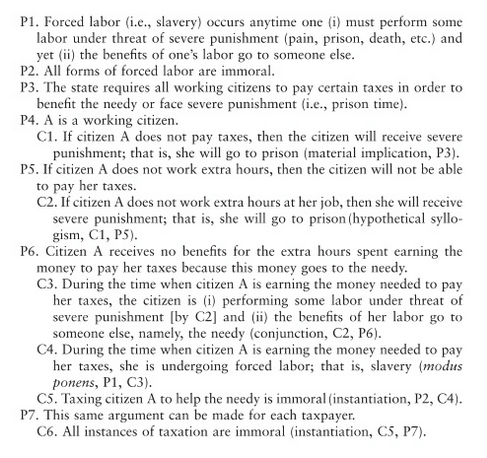
Our colleague Jason Waller, who teaches philosophy at Eastern Illinois University, provides a detailed description of and step-by-step guide to Robert Nozick’s influential “taxation is forced labor” argument in this fascinating book by Michael Bruce and Steven Barbone, editors, Just the arguments: 100 of the most important arguments in Western philosophy, Wiley-Blackwell (1st edition, 2011), pp. 242-243. (We reproduce Professor Waller’s reformulation of Nozick’s reasoning below.) Is the chain of Nozick’s reasoning plausible, or do you reject any of Nozick’s seven premises? For my part, Premise #6 looks debatable, but even if that premise were false, would Nozick’s overall conclusion still be sound? More generally, when is state coercion or public paternalism ever justified?

Screen Shot 2019-06-03 at 6.14.34 AM

Source: Jason Waller (2011)

Posted in Uncategorized | Leave a comment

The Law and Economics of Literary Fan Art

That is the title of my most recent work-in-progress, and it is available here via SSRN. Inspired by my friend and colleague Brian Frye’s frontal attack on plagiarism norms, especially his thought-provoking paper “Plagiarism is not a crime,” my work explores the related problem of “literary fan art,” i.e. unauthorized derivative works by third parties that are based on someone else’s literary work product. Literary fan art poses a difficult legal and economic puzzle: how far should property rights extend in the domain of literature? That is, because copyright laws extend to derivative works, the legal question often boils down to this: when does fan art constitute “fair use”? To motivate the paper, I present some notable examples of contemporary literary fan art inspired by Ernest Hemingway’s classic novella “The Old Man and the Sea.” Next, I show why the traditional fair use standard is utterly unhelpful in solving the fan art puzzle, and then I sketch an alternative Coasean solution to the problem of fan art: the law should assign property rights in fan art to the fans.

Image result for ssrn
Posted in Uncategorized | 1 Comment

Visualization of the world’s forests

Check out this visualization of the world’s forests, courtesy of Esri (the Environmental Systems Research Institute), a supplier of geographic information system software and geodatabase management applications. There are no forests in Australia! More details here. (Hat tip: u/ochang1980.) (Happy 18th Birthday, Aritzia!)

Posted in Uncategorized | Leave a comment

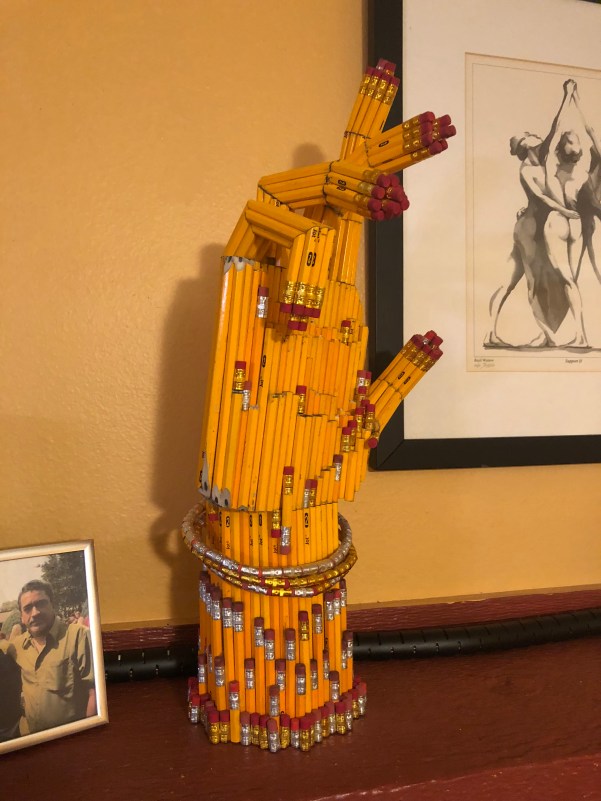
Pencil sculpture

Image credit: Jennifer Gordon-Martin

Posted in Uncategorized | Leave a comment

Three questions for Dan Ariely

I’m interrupting my self-imposed one-week exile from blogging to pose three questions to Dan Ariely, a professor of psychology and “behavioral economics” at Duke University (You see, we finally got around to reading the revised and expanded edition of his 2008 book “Predictably irrational: the hidden forces that shape our decisions.”) Stated bluntly, Professor Ariely’s smug and self-refuting thesis is that people are not only stupid; we are stupid in predictable ways, so here are our three questions:

1. What is the “optimal level” of stupidity? Why isn’t it not zero? Sorry for the double negative, but economists of all stripes will understand the spirit of my first question. When we are making choices in real time, we don’t have infinite amounts of time and cognitive resources to measure all the potential pros and cons of our choices. Simply put, we don’t live an ideal world, a world with zero transaction costs, so some level of stupidity might, in fact, be optimal!

2. What are the sample sizes of each of your experiments? (And what is the average age of the participants?) For example, on page 92 of your book you mention in passing that one of your social science experiments had only 25 participants. Need I say more …?

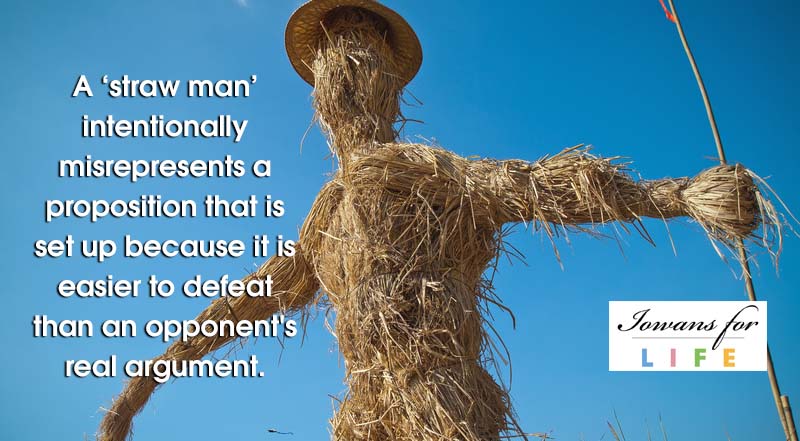
3. Why don’t you address any of Steve Levitt and John List’s criticisms of your methods, especially their point about the paltry financial stakes of most of your experiments? Although you mention in passing Levitt and List’s powerful critique of social science lab experiments at the beginning of your book, at no point do you actually respond to their specific and well-reasoned criticisms. Why not? (Your caricature of and fictional dialogue with your “Mr. Logic” straw man doesn’t count!)

Image result for strawman
Posted in Uncategorized | 2 Comments

Infinite Jest Update (May)

Alas, we still have a long ways to go, as we’re only up to page 538. Also, please note: we will take the rest of May off and resume our blogging duties on Monday, June 3rd.

Image result for infinite jest math
Posted in Uncategorized | Leave a comment

Remember and honor

Posted in Uncategorized | Leave a comment

Three cheers for literary fan art (concluding post)

In our previous post we reframed copyright disputes in general–and the problem of literary fan art specifically–in economic or Coasean terms: under what conditions do copyright owners get to have veto rights over fan art, and by the same reciprocal token, when do fans get to veto the veto rights of copyright owners when they revisualize or reimagine their literary works? Or, stated in plain and simple and jargon-free English, who gets to harm whom?

Once the question of fair use is reformulated this way–in terms of competing and reciprocal harms–, the fan art conundrum becomes soluble; the optimal level of fair use becomes a tractable problem: we should choose that rule or course of action that minimizes the overall level of harm. In the case of literary fan art, for example, my lawyerly intuition is that a narrow reading of the fair use doctrine would do more harm than a broad reading would. That is, courts would produce a greater degree of harm if they granted copyright owners unlimited veto rights over fan art than if they allowed fans greater leeway in reimagining and reinterpreting established works of art. And I would further venture to speculate that–to the extent that fan art rekindles interest in the underlying literary works that are being depicted or introduces those original works to new audiences–fan art will very likely generate new sales and expand the market for those underlying works.

But you don’t need to take my word for it or accept my mere mortal speculations as gospel. The various revisualizations of Hemingway’s novella that we have featured on this blog are paradigm cases of the main point I am trying to make here. Imagine a world without Olympia Le-Tan’s “Old Man and the Sea” clutch bags, or a world without Guy Harvey’s collection of “Old Man and the Sea” watercolors, or a world without Jodi Harvey-Brown’s “Old Man and the Sea” book sculptures. Aside from the fact that that is not a world I would want to live in, none of these pieces of fan art syphon off sales of Hemingway’s book or dissuade us from reading the novella. On the contrary, these sundry pieces breath new life into Hemingway’s story; they invite us to read or reread the old Cuban fisherman’s futile battle with the giant blue marlin. So, three cheers for fan art … for expanding markets, for rousing our collective imagination, and for creating new worlds of beauty!

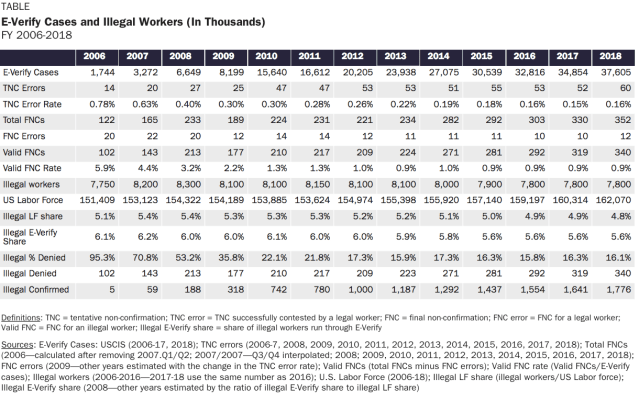
Image result for fair use
Posted in Uncategorized | Leave a comment