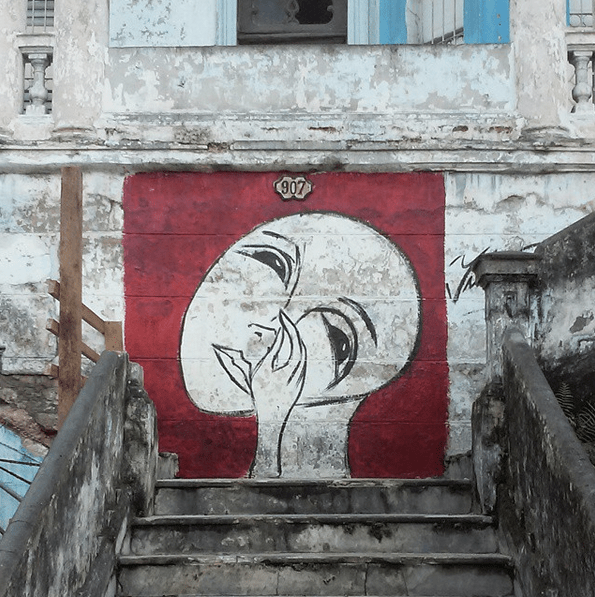
The street artist we have featured in our last few posts, Yulier P. (@yuliergraffiticuba), was detained by the Cuban police in August of 2017 under an obscure urban planning decree that makes it illegal to build without a permit or deface public monuments. (Shout out to Amnesty International for denouncing this arbitrary arrest.) This urban decree (Decree No. 272, which was signed into law by Fidel in 2001), however, does not authorize the government to arrest violators, only to impose fines. In other words, there is a small gap in Cuba’s fascist legal system, since Decree 272 does not really apply to street artists. Is this legal gap the real reason why the Cuban government enacted Decree 349 in 2018–in order to give the government the legal authority to criminalize street art and prosecute street artists like Yulier P.?
#npoc19
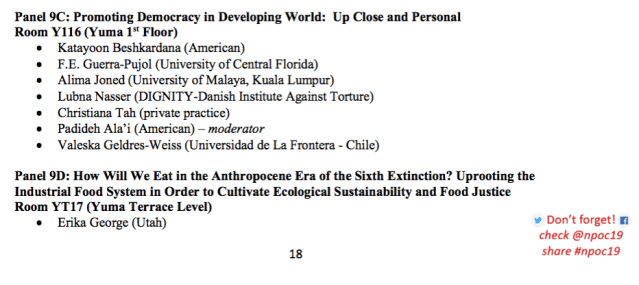
If you are in DC this weekend, we will be presenting our analysis of Cuban Decrees 272 and 349 and the criminalization of street art in Cuba at the 4th National People of Color Legal Scholarship Conference this afternoon (23 March). Shout out to Professor Tony Varona for inviting me to speak and to the American University Washington College of Law for holding this excellent conference. The full npoc program is available here.

“Regalo”
In response to the criminalization of his unauthorized public murals, Cuban graffiti artist Yulier P. found this ingenious and defiant micro-street art solution:
In praise of Yulier P. (part 2)
The murals of Yulier Rodriguez Perez (@yuliergraffiticuba) began to appear on the streets of Havana in 2014. In the words of Deni Ellis Béchard, “He soon established himself as one of the most prolific street artists in Havana, signing his tableaus Yulier P. He often painted … on walls so deeply weathered that his images instantly resembled ancient frescoes. He wanted to remind the people who lived there that it was possible to have a voice and to express their struggles. ‘Cubans have been indoctrinated to fear speaking out. I don’t understand this, since this is a socialist project, created by the people.'” That was before the Cuban government decided to criminalize unauthorized street art …

Image credit: Yulier P
Havana street art
As if existing levels of repression and economic hardship were not enough, the Cuban government has now begun to criminalize street art under a recently-enacted dystopian decree. We will be blogging about the criminalization of Cuban street art in the next day or two.

Image credit: Yulier P.
Debating the Accountable Capitalism Act
We will be blogging somewhat sporadically, if at all, this week and next as we will be spending our spring break visiting family and friends in wintry New York City and then in sunny Jamaica. Hasta pronto …
When does cheating pay?
Answer: When the probability of getting caught, let alone punished, is small. Consider violent crime, by way of example. Our friend and colleague Alex Tabarrok does the probabilistic math here: “In 2017 … victims reported 2,000,990 serious violent crimes [e.g. rape, robbery, or aggravated assault]. In the same year there were approximately 446,510 arrests for these crimes (crime definitions may not line up exactly). In other words, the chance of being arrested for a serious violent crime was only 22%. Data on convictions are harder to obtain but convictions are far fewer than arrests. In 2006 (most up-to-date data I could find but surely lower today) there were 175,500 convictions for serious violent crimes. Thus, considerably fewer than 10% of violent crimes result in a conviction (175,500/2,000,990 = 8.7%). Put differently, the expected time served for a serious violent crime is less than 14 months….”

Sentence diagrams of the opening lines of three famous novels


Spring Break Reading
There is only one item on our spring break reading list: David Foster Wallace‘s Infinite Jest. We picked up a paperback copy of this massive tome for $1 two Fridays ago at our university bookstore and finally cracked open DFW’s beautiful magnum opus. We’re already on page 367 and footnote 141 of this colossal monster of a novel, so we still have over 700 pages and 250 footnotes to go …