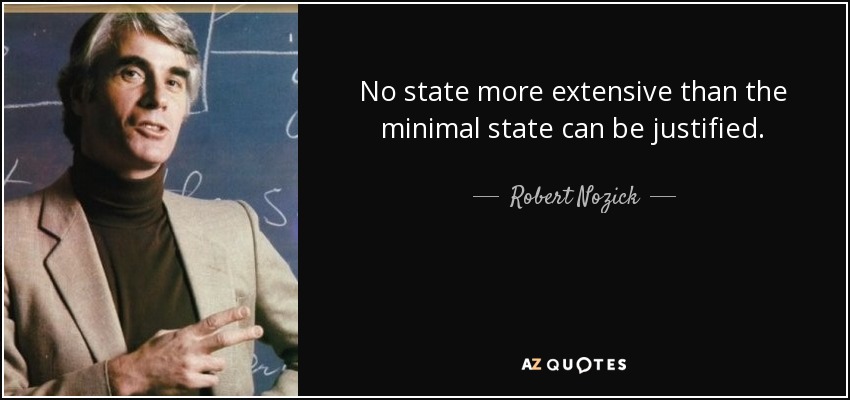
“Individuals have rights, and there are things no person or group may do to them (without violating their rights).” –Robert Nozick
Thus far (see here and here), we have presented the first flank of Nozick’s powerful pincer attack on Rawls: the Wilt Chambelain Argument. Today, we will scrutinize his other flank: the Side Constraint Argument.
In summary, “side constraints” impose strict limits on what we can and cannot do: they are absolute and inviolable Kantian moral rules (such as “don’t kill the innocent”, “don’t steal”, etc.) that prohibit any individual or group, including anyone in the government, from taking or redistributing any “holdings” that have not been acquired unjustly. Side constrains are thus absolute and inviolable because they act as a bright-line barrier or moral boundary: we are not allowed to violate these Kantian moral rules under any circumstances, even if violating them would promote more utility on balance or achieve a worthy goal (like saving more lives). [1] (N.B.: Footnotes are below the fold.) But even if you are a good Kantian, Nozick’s Side Constraint Argument is vulnerable on several fronts.
(Before proceeding, it is worth noting that Nozick would extend the protection of this absolute and inviolable Kantian barrier to non-human animals and that his argument for doing so is a highly creative and ingenious one: Nozick asks us to imagine the possibility of an alien race of “superbeings” who “stand to us as it is usually thought we do to animals” (Nozick, ASU, p. 45, emphasis in original). In other words, even if humans are morally superior to animals, moral side constraints should apply to human-animal interactions as they do to human-human interactions, for if there were such an alien race of superbeings — like the Vulcans in the fictional Star Trek sci fi series — and if they were to ever come into contact with us, wouldn’t we want them to follow Nozick’s side-constraint view of morality in their dealings with us? [2])
Putting aside Nozick’s extension to non-human animals (what about insects, plants, or simple singled-celled organisms, for example?), I am obliged to point out some additional soft spots in Nozick’s second flank. In brief, Nozick is vulnerable to counter-attack on several fronts. One is the source question: what is the ultimate source of his moral side constraints? The other is the content question: what do these moral rules consist of? Are these constraints limited to mere non-aggression, for example, or do they impose an affirmative duty to help the poor or rescue persons in peril? In short, we still have to determine the source and pinpoint the content of Nozick’s side constraints. Alas, here is where Nozick’s second flank, like an elaborately-carved sand castle against the tide, begins to collapse.
Let’s consider the content question first. Above and beyond Nozick’s paradigmatic moral rule “don’t kill the innocent”, what else do these side constraints consist of? For Nozick, these side constraints are limited to mere “non-aggression” — or in Nozick’s own words (ASU, p. 33), “the existence of moral side constraints … leads to a libertarian side constraint that prohibits aggression against another” — i.e. abstaining from the use of force, from theft and fraud, and from enslaving others. [3] Nozick does not, in other words, impose an affirmative duty to help the poor. But why does Nozick curtail his otherwise attractive picture of moral side constraints this way? [4] Also, even if we accept Nozick’s limiting principle (side constraints = non-aggression), how should we define “aggression”? Are surveillance cameras, for example, a form of aggression? [5]
Now, let’s consider the source question. Aside from “because I say so”, what is the ultimate source of Nozick’s side constraints? For Nozick, the source of his side constraints is based on our “moral agency” and our ability to plan for the future. [6] But if moral agency and the ability to make future plans are the source of Nozick’s side constraints, this grounding ends up undermining his defense of animal rights, since it is debatable whether non-human animals ponder the meaning of their lives or have any moral agency themselves. (After all, what other non-human animals, aside perhaps from beavers and octopi, are able to formulate long-term plans?) Worse yet, Nozick not only undercuts his defense of animal rights; he also neglects the social dimensions of human life (e.g. family, church, village, etc.), for in reality it is not “I” in isolation or “me” acting alone who gives meaning to my life; it is my relationships with others that give meaning to my life. [7] However hard we may try, we don’t give meaning to our own lives; others do!
But the main problem with Nozick’s Side Constraint Argument is this: it is impractical and dogmatic. That is, even though side constraints are supposed to be limited to non-aggression, the problem is that Nozick defines the concept of harm so broadly that his non-aggression principle becomes too inviolable and too absolutist to be of any practical use. To see why, let’s return full circle to Nozick’s Wilt Chamberlain Argument. According to Nozick, any attempt to tax Wilt Chamberlain’s earnings would be a form of unjustified state-sanctioned violence in contravention of the non-aggression principle! Why? Because, for Nozick, government taxation is worse than theft; it is a form of forced labor. After all, if the government can’t force you to give up x hours of your personal time per week to help the needy, then why does the government have the right to take the equivalent of x hours of your weekly paycheck to produce the same result? [8]
In short, if side constraints prohibit taxation, then how are essential public goods like courts, cops, and the common law to be financed? Nozick’s famous answer to this question is the “nightwatchman state”, i.e. a minimal government limited to enforcing contracts and to protecting people from force, theft, and fraud. But this formulation poses as many line-drawing questions as it answers! Should, for example, a contract for the purchase and sale of animal meat be enforced? After all, Nozick himself would extend his non-aggression principle to our treatment of non-human animals. If so, what has happened to the value of liberty? Also, how should “fraud” be defined? Does the prohibition against fraud include an affirmative duty to disclose all relevant information? More broadly, how many policemen, soldiers, and wardens should the nightwatchman state hire? How many surveillance cameras, if any, are consistent with the concept of liberty?
Are we thus back to where we started when I began this series on the paradox of politics? I will conclude my series with some final observations (for now) about the law-liberty dilemma in my next post.