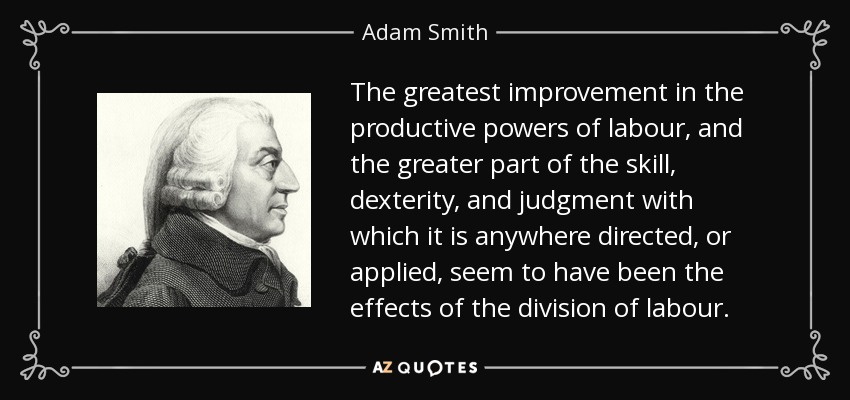
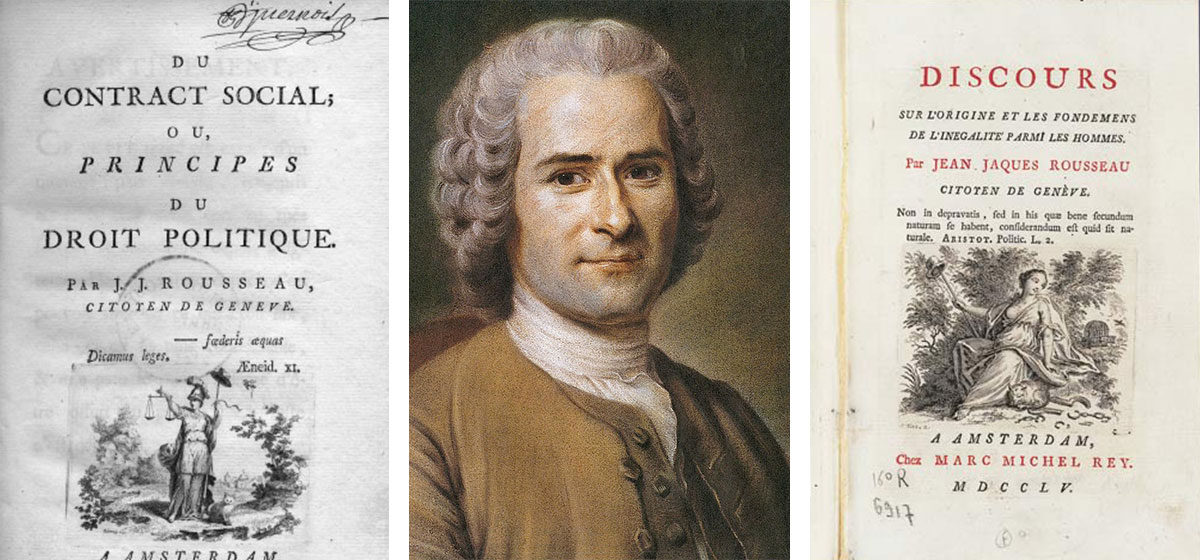
As we saw in a previous post (see here), three passages in Rousseau’s Second Discourse may have resonated with a young Adam Smith. Yesterday, we saw the first of these three fragments; today, we will take a closer look at the second passage. [1] To my mind, Smith’s translation of this particular selection (Smith 1756, pp. 75-77), which consists of seven sentences in all, presents a secular version of the doctrine of original sin:
SENTENCE 1: “Thus are all our faculties unfolded, memory and imagination brought into play, self-love interested, reason rendered active, and the understanding advanced almost to the term of its perfection.”
SENTENCE 2: “Thus are all our natural qualities exerted, the rank and condition of every man established, not only upon the greatness of his fortune and his power to serve or to hurt, but upon his genius, his beauty, his strength, or his address, upon his merit or his talents; and those qualities being alone capable of attracting consideration, he must either have them or affect them: he must for his advantage show himself to be one thing, while in reality he is another.
SENTENCE 3: “To be and to appear to be, became two things entirely different; and from this distinction arose imposing ostentation, deceitful guile, and all the vices which attend them.
SENTENCES 4 & 5: “Thus man, from being free and independent, became by a multitude of new necessities subjected in a manner, to all nature, and above all to his fellow creatures, whose slave he is in one sense even while he becomes their master; rich, he has occasion for their services; poor, he stands in need of their assistance; and even mediocrity does not enable him to live without them. He is obliged therefore to endeavour to interest them in his situation, and to make them find, either in reality or in appearance, their advantage in labouring for his.
SENTENCE 6: “It is this [i.e. this dependence on our fellow man] which renders him false and artificial with some, imperious and unfeeling with others, and lays him under a necessity of deceiving all those for whom he has occasion, when he cannot terrify them, and does not find it for his interest to serve them in reality.
SENTENCE 7: “To conclude, an insatiable ambition, an ardor to raise his relative fortune, not so much from any real necessity, as to set himself above others, inspires all men with a direful propensity to hurt one another; with a secret jealousy, so much the more dangerous, as to strike its blow more surely, it often assumes the mask of good will; in short, with concurrence and rivalship on one side; on the other, with opposition of interest; and always with the concealed desire of making profit at the expence of some other person: All these evils are the first effects of property, and the inseparable attendants of beginning inequality.”
In other words, property rights are our original sin, for once we establish property rights, we become dependent on others and consumed every waking hour by the pursuit of self-interest as well as by the need for external validation. For Rousseau, this pursuit of self-interest and this need for external validation are “moral bads” that distort human nature in three ways:
- Affectation (“deceitful cunning“): in order to attract the attention of and impress our fellow man, we now have to pretend to be something we are not. (See sentences 3-5 above.)
- Interdependence (slavery): we are reduced to “slaves” because we now need the cooperation and assistance of our fellow man. (See sentences 6-7 above.)
- Moral corruption (“consuming ambition”, “secret jealousy”): not only are we slaves to our fellow man; we are also conniving and manipulative, consumed by envy and ambition. (See sentences 8-9 above.)
In Christian theology, the doctrine of original sin refers to Adam and Eve’s fall from grace in the Garden of Eden when they disobeyed God. Although Rousseau rejects this doctrine (he believes that men are inherently good but are corrupted by society), he nevertheless posits a secular version of the doctrine of original sin: property rights. But is Rousseau right? Do property rights corrupt man? (To be continued …)
Continue reading →