
On the Internet, nobody knows you’re a dog; and nobody knows when you’re feeling under the weather either! But I am, so I will share my thoughts on the rule or law (see my previous post) and resume my series on Smith and Rousseau on Monday …

On the Internet, nobody knows you’re a dog; and nobody knows when you’re feeling under the weather either! But I am, so I will share my thoughts on the rule or law (see my previous post) and resume my series on Smith and Rousseau on Monday …
I will resume my series on Smith and Rousseau in the next day or two because I will be speaking at a symposium on the rule of law at the University of St Thomas Law School today.
As we saw in a previous post (see here), three passages in Rousseau’s Second Discourse may have resonated with a young Adam Smith. Yesterday, we saw the first of these three fragments; today, we will take a closer look at the second passage. [1] To my mind, Smith’s translation of this particular selection (Smith 1756, pp. 75-77), which consists of seven sentences in all, presents a secular version of the doctrine of original sin:
SENTENCE 1: “Thus are all our faculties unfolded, memory and imagination brought into play, self-love interested, reason rendered active, and the understanding advanced almost to the term of its perfection.”
SENTENCE 2: “Thus are all our natural qualities exerted, the rank and condition of every man established, not only upon the greatness of his fortune and his power to serve or to hurt, but upon his genius, his beauty, his strength, or his address, upon his merit or his talents; and those qualities being alone capable of attracting consideration, he must either have them or affect them: he must for his advantage show himself to be one thing, while in reality he is another.
SENTENCE 3: “To be and to appear to be, became two things entirely different; and from this distinction arose imposing ostentation, deceitful guile, and all the vices which attend them.
SENTENCES 4 & 5: “Thus man, from being free and independent, became by a multitude of new necessities subjected in a manner, to all nature, and above all to his fellow creatures, whose slave he is in one sense even while he becomes their master; rich, he has occasion for their services; poor, he stands in need of their assistance; and even mediocrity does not enable him to live without them. He is obliged therefore to endeavour to interest them in his situation, and to make them find, either in reality or in appearance, their advantage in labouring for his.
SENTENCE 6: “It is this [i.e. this dependence on our fellow man] which renders him false and artificial with some, imperious and unfeeling with others, and lays him under a necessity of deceiving all those for whom he has occasion, when he cannot terrify them, and does not find it for his interest to serve them in reality.
SENTENCE 7: “To conclude, an insatiable ambition, an ardor to raise his relative fortune, not so much from any real necessity, as to set himself above others, inspires all men with a direful propensity to hurt one another; with a secret jealousy, so much the more dangerous, as to strike its blow more surely, it often assumes the mask of good will; in short, with concurrence and rivalship on one side; on the other, with opposition of interest; and always with the concealed desire of making profit at the expence of some other person: All these evils are the first effects of property, and the inseparable attendants of beginning inequality.”
In other words, property rights are our original sin, for once we establish property rights, we become dependent on others and consumed every waking hour by the pursuit of self-interest as well as by the need for external validation. For Rousseau, this pursuit of self-interest and this need for external validation are “moral bads” that distort human nature in three ways:
In Christian theology, the doctrine of original sin refers to Adam and Eve’s fall from grace in the Garden of Eden when they disobeyed God. Although Rousseau rejects this doctrine (he believes that men are inherently good but are corrupted by society), he nevertheless posits a secular version of the doctrine of original sin: property rights. But is Rousseau right? Do property rights corrupt man? (To be continued …)

Yesterday, I transcribed three separate passages from Jean-Jacques Rousseau’s Second Discourse, and I then asked: why would someone like Adam Smith have singled-out those three specific selections in his 1756 letter to the Edinburgh Review? For reference, Smith’s translation of the first of these substantive passages consists of the following two sentences (Smith 1756, p. 75):
SMITH’S TRANSLATION OF THE FIRST SENTENCE OF PASSAGE #1: “While men contented themselves with their first rustic habitations; while their industry had no object, except to pin together the skins of wild beasts for their original cloathing, to adorn themselves with feathers and shells, to paint their bodies with different colours, to perfect or embellish their bows and arrows, to cut out with sharp stones some fishing canoes or some rude instruments of music; while they applied themselves to such works as a single person could execute, and to such arts as required not the concurrence of several hands; they lived free, healthful, humane and happy, as far as their nature would permit them, and continued to enjoy amongst themselves the sweets of an independent society. [1]
SMITH’S TRANSLATION OF THE SECOND SENTENCE OF PASSAGE #1: “But from the instant in which one man had occasion for the assistance of another, from the moment that he perceived that it could be advantageous to a single person to have provisions for two, equality disappeared, property was introduced, labour became necessary, and the vast forrests of nature were changed into agreeable plains, which must be watered with the sweat of mankind, and in which the world beheld slavery and wretchedness begin to grow up and blosom with the harvest.” [2]
Rousseau thus presents an idyllic picture of the noble savage. My reply to Rousseau is the same as Jake’s reply to Lady Brett in The Sun Also Rises: “Isn’t it pretty to think so?” After all, Rousseau is weaving a totally made-up yarn here, a just-so story of what life must have been like in the remote past. [3] He begins this passage by describing a bygone golden age unspoiled by any small-scale (let alone large-scale) cooperation, an idyllic world in which there is no specialization or division of labor. We can’t use words like “community” or “society” to describe this simple and rustic state of affairs because there is no community or society to speak of!
But every creation myth needs a devil, and so the celebrated “citizen of Geneva” also describes man’s fall from this secular grace in the second sentence of the pivotal passage quoted above. It is here where the Second Discourse reveals the true villain of Rousseau’s mythical just-so story: the division of labor! For Rousseau, specialization is not only the source of private property and economic inequality; it is also the wellspring of our moral corruption. But is the division of labor really a force for bad? What if it were the engine of our economic prosperity and improved quality of life?
Those are precisely the sort of questions that must have piqued a young Adam Smith’s intellectual curiosity when he first encountered Rousseau’s essay. If so, we can see why Smith singled-out the above extract in his 1756 letter to the Edinburgh Review. In fact, perhaps Part 1 of The Wealth of Nations should be read as an extended reply to Rousseau’s critique of the division of labor. (To be continued …)
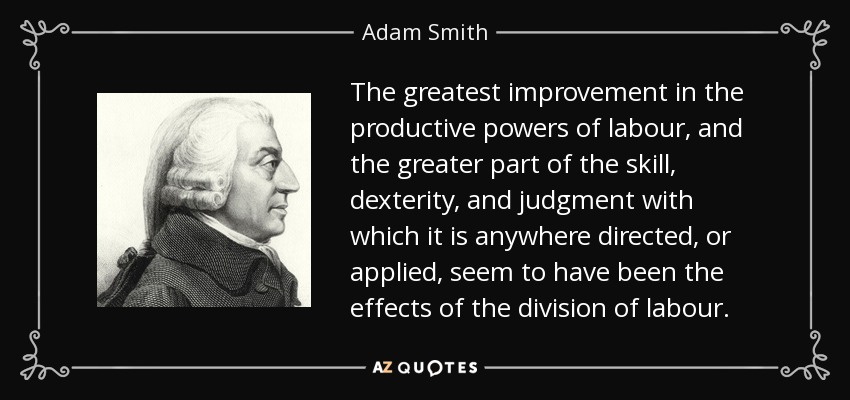

I will begin my survey of Jean-Jacques Rousseau below the fold with three not-so-random fragments or extracts from his celebrated Second Discourse:
Continue readingI have too much going on today, so I will resume my series on J.-J. Rousseau in my next post; in the meantime, enjoy …
In summary, if Jean-Jacques Rousseau wrote the Second Discourse (1755) to explain how men lost their natural liberty in the remote past, he wrote yet another book, Du Contrat social (1762), to explain how they might recover their freedom in the future. Suffice it to say, we will begin exploring the main ideas in both great works in the next day or two …
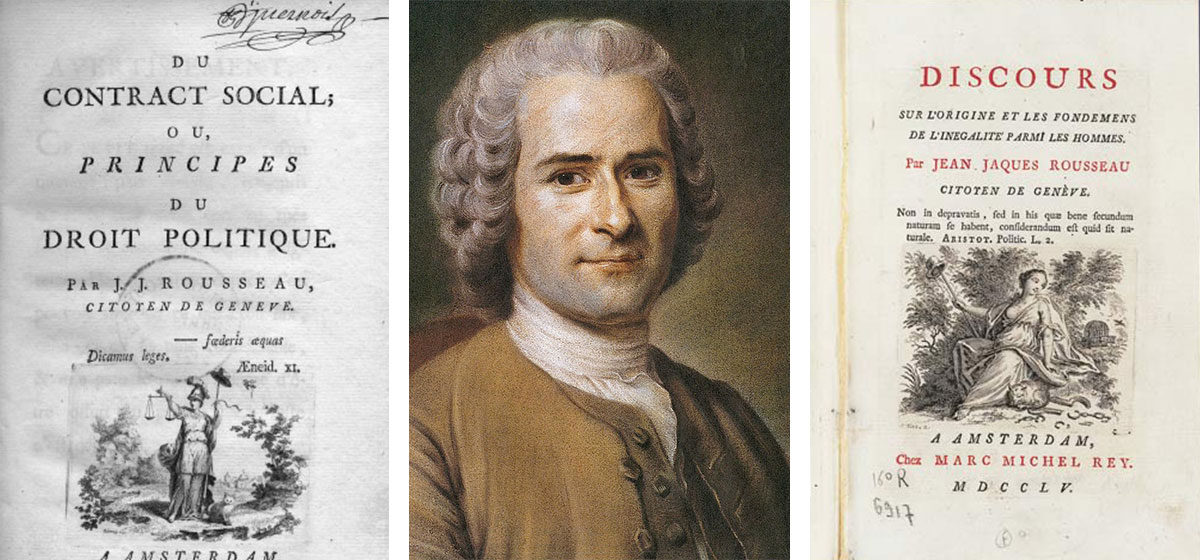
As I mentioned at the conclusion of my previous post, I will begin exploring some of the ideas of the great Jean-Jacques Rousseau next week; in the meantime, below is an amusing quote from Rousseau’s nemesis, Voltaire. By way of background, Rousseau had written an extended essay entitled The Discourse on the Origin of Inequality among Men (often referred to as the “Second Discourse”) in 1755. Among other things, Rousseau describes man as naturally good before he was corrupted by the institution of private property. After reading the Second Discourse, Voltaire began his celebrated reply to Rousseau as follows:
I have received, sir, your new book against the human species, and I thank you for it…. no one has ever been so witty as you are in trying to turn us into brutes: to read your book makes one long to go on all fours.
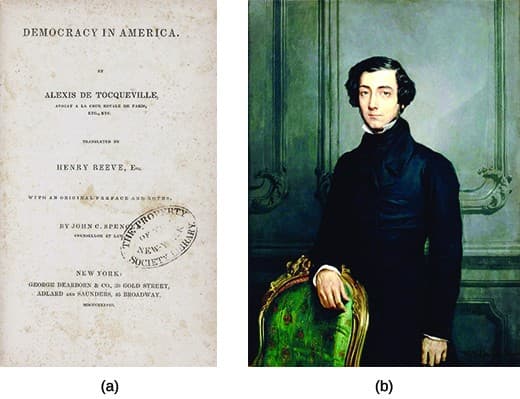
John Stuart Mill and Alexis de Tocqueville are in agreement that the “tyranny of the majority” poses the greatest danger of all to individual liberty, but what is to be done? We already saw Mill’s proposed remedy (the harm principle) and why this antidote is a toothless tiger (the majority itself gets to define what constitutes a harm), but what is de Tocqueville’s solution to the law-liberty dilemma? As it happens, de Tocqueville identifies three specific features of North American society that are supposed to “mitigate” or tame the tyranny of the majority: juries, the legal profession, and the small scale and limited powers of the central government. [1] Alas, for the reasons below, none of these three bygone checks on majority rule are relevant to our political world today:
1. Feature #1: Juries. Let’s start with juries. De Tocqueville extols juries as “a gratuitous public school, ever open, in which every juror learns his rights … and becomes practically acquainted with the laws ….” [2] But as my colleague and friend Marc Galanter has shown, fewer and fewer cases — State and federal, civil and criminal – now go to trial. [3] The number of jury trials in U.S. federal courts, for example, reached a peak in 1985, with a total of 12,529 civil and criminal trials. Since then, we have seen a dramatic decline in the number of jury trials: in 2023 there were a combined total of 2,912 civil and criminal jury trials. [4] Simply put, most cases get settled out of court. As a result, not only has public participation in law cases via juries declined; legal decisions have also become increasingly private, negotiated out of court, and thus invisible to the public.
2. Feature #2: Lawyers. What about the legal profession? According to de Tocqueville, lawyers are a kind of intellectual “aristocracy” who act as a check or “counterpoise” on the tyranny of the majority. [5] How? Because lawyers, by training, are cautious and conservative by nature — conservative not in a political sense but in terms of their “taste for formalities”, their respect for binding precedent, and above all their emphasis on process. [6] Members of the legal profession are thus a stabilizing force that conspire to maintain order: “they constantly endeavor to turn [the institutions of democracy] away from its real direction ….” [7]
Whether or not this idealized picture of the legal profession was true when de Tocqueville was writing Democracy in America, it is certainly not accurate today. According to a 2023 Gallup poll, for example, only 23% of the public view lawyers in a positive light, and fewer still (about 16%) of those surveyed rated their honesty as “high” or “very high”. [8] Either way, regardless how the legal profession is perceived by the public, one could argue that lawyers as a whole have done just as much to promote the tyranny of the majority as they have done to retard it. After all, it is perhaps no coincidence that so many lobbyists are lawyers1
In theory, lobbying allows any interest to be heard; in practice, however, lawyer-lobbyists tend to defend concentrated interests (i.e. factions) that already have clout: large corporations, trade associations, and labor unions. These factions hire lawyer-lobbyists not only to extract rents from government agencies (e.g. subsidies, tax breaks, or regulations that hinder competition) but also to justify their rent-seeking schemes to the broader public through slick ad campaigns and strategic political donations. So, instead of checking majority rule, lawyer-lobbyists often amplify it.
3. Feature #3: Limited Power. Last but not least, de Tocqueville describes a third feature of North American democracy that works to tame the tyranny of the majority, namely the “absence of centralized administration”:
In the American republics, the central Government has never as yet busied itself but with a small number of objects, sufficiently prominent to attract its attention. The secondary affairs of society have never been regulated by its authority, and nothing has hitherto betrayed its desire of even interfering in them. [9]
Hah! Although it is true that our federal government was supposed to have only limited and enumerated powers, [10] it has since grown into such a large behemoth of monstrous proportions that Hobbes’s despotic “Leviathan” pales in comparison! Our current federal regime is not only massive by any measure (the total amount of federal spending represents almost 25% of the U.S.’s total economic output [11]); the Feds now have the almost unlimited power to regulate every nook and cranny of the economy. Indeed, federal law has become so complex and massive no one knows for certain how many federal criminal laws there are! [12]
Are we therefore doomed? Is the tyranny of the majority destined to enslave us? What if, however, the “tyranny of the majority” is a total misnomer? What if, instead of being a force of oppression, majority rule were the true source of freedom? We will explore this counter-intuitive Rousseaian possibility when I resume my series on the paradox of politics next week. (To be continued …)







Welcome to the online home of the IASS
Hopefully It’s Interesting.
In Conversation with Legal and Moral Philosophers
dr hab. prof. UJ, Jagiellonian University
Books, papers, and other jurisprudential things
Ramblings of a retiree in France
BY GRACE THROUGH FAITH
Natalia's space
hoping we know we're living the dream
Lover of math. Bad at drawing.
We hike, bike, and discover Central Florida and beyond
Making it big in business after age 40
Reasoning about reasoning, mathematically.
I don't mean to sound critical, but I am; so that's how it comes across
remember the good old days...
"Let me live, love and say it well in good sentences." - Sylvia Plath
a personal view of the theory of computation
Logic at Columbia University
Just like the Thesis Whisperer - but with more money
the sky is no longer the limit
Technology, Culture, and Ethics
Just like the horse whisperer - but with more pages
Poetry, Other Words, and Cats


