
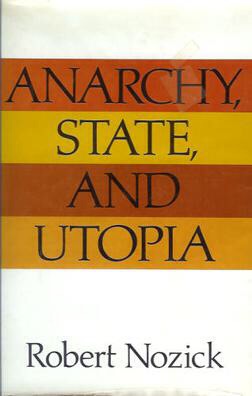
Chapter 1 of Nozick’s classic work “Anarchy, State, and Utopia“ poses the following “what if” thought experiment: What if we lived in a state of nature, in a world in which there were no actual states or governments? This hypothetical first-order inquiry, in turn, raises a methodological second-order question: Why does Nozick himself begin his book with such an abstract, theoretical query?
Nozick provides two reasons for his second-order query. First: because the choice between the state and anarchy is the most fundamental question of political philosophy. And second: because Nozick wants to explain how a state or government could in theory arise in conditions of anarchy. The key words here are “in theory”, for Nozick readily admits that it doesn’t matter to him how the first states or governments really arose. What matters, according to Nozick, is not whether a particular explanation of the state is true or not. (Indeed, Nozick himself, pp. 7-8, describes three ways an explanation could go wrong.) Rather, what matters is whether an explanation “illuminates” the existence of states and governments.
Alas, Nozick doesn’t explain how a “defective” or incorrect explanation could provide any meaningful “illumination.” Worse yet, Nozick makes totally unwarranted assumptions about the state of nature. Instead of assuming a Hobbesian war of all-against-all, he assumes an idyllic Lockean state of nature, one in which “people generally satisfy moral constraints and generally act as they ought” (p. 5). Yet, there is a method to this methodological madness! In the eloquent words of Robert Nozick (id.), “If one could show that [a theoretical] state would be superior to even this most favored situation of [peaceful] anarchy …, or would arise by a process involving no morally impermissible steps, or would be an improvement if it [a state] arose, this would … justify the state[!]” (Note: it appears that Nozick is not searching for a Humean or consequentialist justification; instead, he is looking for a non-instrumentalist or Kantian justification of the existence of states and governments.)

Credit: Kayla Ferguson













 prior probability