Geological timeline

Artist Credit: Ray Troll

Posted in Art, Science | Leave a comment

Falsification, the Coase theorem, and the Apple iPhone case

Broadly speaking, the Coase theorem is a famous proposition from law and economics that postulates that conflicting parties will resolve their dispute by striking a mutually beneficial bargain when property rights are well-defined and when the costs of transacting are low relative to the benefits to be gained if the parties transact. (The classic academic example of Coasean bargaining is the cattle trespass problem–see image below.) Now, here’s a real-world question we recently posed in a previous blog post regarding the ongoing Apple iPhone case: why doesn’t the Coase theorem apply to this dispute? That is, why doesn’t the FBI just offer to pay Apple to unlock the password-protected iPhone at the center of this case? After all, both conditions of the Coase theorem are met here: (i) property rights are well-defined (the phone belongs to San Bernardino County, and the owner wants to unlock its phone), and (ii) the costs of transacting appear to be low (there are only two potential transacting parties here–the government and Apple). Nevertheless, instead of Apple and the FBI reaching a mutually beneficial Coasean bargain as the Coase theorem predicts, the FBI has decided to use the courts to compel Apple into unlocking the phone, and instead of capitulating to the feds, Apple has decided to fight them. So, we reiterate our original question: why doesn’t the Coase theorem work here?

Update (2/22): Professor Alex Tabarrok, an economist at George Mason U, wrote back to us earlier today. His thoughtful response to our original Coasean question is as follows: “Maybe the Coase theorem is working and Apple and its users have a higher value on privacy than the government is willing to pay.” In other words, even if the government were willing to compensate Apple for its services, maybe Apple would refuse to accept any offer of compensation from the feds as a matter of principle. 

But how much is privacy really worth when public safety is at stake? Doesn’t such a blanket refusal to deal signal a weakness with the Coase theorem?

Image Credit: rsvanwassenhove (via slideshare)

Posted in Law, Web/Tech | 1 Comment

Last film rites …

Posted in Culture | Leave a comment

Property rights and the Apple iPhone case

What do you think of Apple CEO Tim Cook’s decision to fight a court order requiring Apple to decrypt an iPhone belonging to Syed Farook, the terrorist who massacred 14 innocent people late last year? Professor Orin Kerr has written up a thoughtful tentative analysis of the recent Apple iPhone court order. Among other things, he notes that the actual owner of the particular iPhone that the FBI wants to crack is not a private citizen but rather San Bernardino County:

“… even if the [FBI] didn’t have a warrant, the [FBI] has the consent of the phone owner. The phone in this case was owned by the San Bernardino County Department of Public Health, Farook’s employer. Farook used it, but the county owned it. The county has already consented to a search of the phone. Some have speculated that the people who communicated with Farook may have Fourth Amendment rights in their communications on the phone. Not so. When you send a communication to someone, you lose Fourth Amendment rights in the communication when the message arrives at its intended recipient. As a result, you have no Fourth Amendment rights in someone else’s phone just because you sent them messages. And even if you did have such rights, either the warrant or the phone owner’s valid consent — or here, both — would ordinarily trump them.”

Critical thinking questions: Instead of forcing Apple to decrypt Farook’s iPhone via a court order, what if the FBI offered to pay Apple to unlock the iPhone? Why doesn’t the Coase theorem work here?

Posted in Law, Web/Tech | 1 Comment

Jurisdiction & Ethics (Lessons 8-9)

“This wasn’t right, damn it. This wasn’t fair.”

–Quoted from Ben Mezrich, The Accidental Billionaires.

In our next lecture (2/22), we are going to re-enact another pivotal scene from the movie “The Social Network”–a scene based on chapter 16 of the book Accidental Billionaires. This scene takes place in the spring of 2004 in the office of Larry Summers, the president of Harvard University. Tyler and Cameron Winklevoss have arranged a meeting with President Summers (in real life, they waited in line like everyone else to meet Dr Summers during his monthly office hours) in order to accuse a fellow student (Mark Zuckerberg) of violating Harvard’s Honor Code. So, we will need three volunteers for this in-class activity. In the meantime, please think about the following three questions:

1. In your opinion, did Mark violate the Honor Code?

2. Does Harvard have “jurisdiction” in this matter?

3. If not, what court would have jurisdiction, a State court or a federal one?

In addition to the technical legal issue of jurisdiction, in the second part of our next lecture we are also going to discuss the fundamental problem of personal ethics. Simply put, how do you decide between right and wrong?

don’t be evil = do the right thing?


Posted in Ethics, Law | Leave a comment

tic tac art (or reverse entropy)

TicTac

Image Credit: Adam Hillman

Posted in Art | Leave a comment

17 x 17 x 17 cube

Posted in Games | Leave a comment

Reblog: “Punctuation in novels”

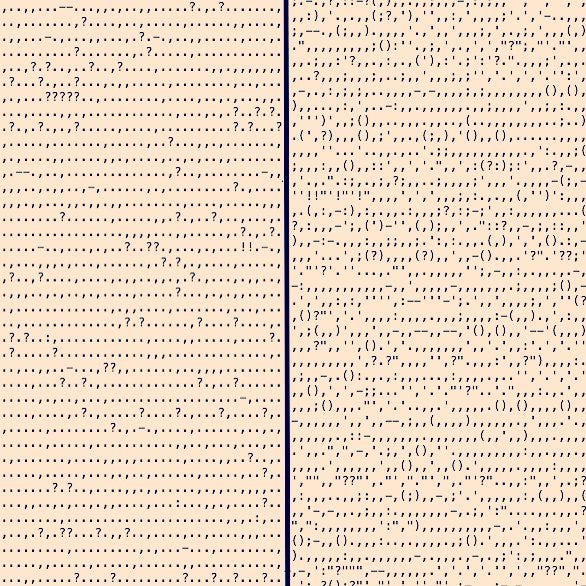
Corrected (2/18): In case you’re wondering, via Adam J. Calhoun this is what two different English-language novels look like if you were to take out all the words and sentences and just leave the punctuation marks behind:

Punctuation in Blood Meridian by Cormac McCarthy (left) and in Absalom, Absalom! by William Faulkner (right). Hat tip: Peak Memory.

Posted in Academia, Art | 1 Comment

Antonin Scalia

We had the honor of meeting the gregarious Antonin Scalia on several occasions during his visit a few years ago to the Pontifical Catholic University in Ponce, Puerto Rico, where we used to teach. At a faculty luncheon in his honor, one of my colleagues (Ruben Nigaglioni, a respected attorney and long-time torts professor) asked Justice Scalia what was the most difficult decision he had ever made as a sitting judge. I will never forget this moment. The room fell quiet as Scalia thought about this question. After a few moments of quiet reflection, Scalia finally answered Boyle v. United Technologies Corporation (a products liability case). He said that his heart told him to rule in favor of the plaintiff, a Marine helicopter pilot who died in a tragic accident caused by a product defect, but his legal reasoning led him to cast the deciding vote in favor of the defendants, the military contractors that had designed and built the defective helicopter. I will never forget this moment (and Scalia’s answer), for it illustrated the enormous chasm that exists between judges and law professors. Law professors get to argue about “hard cases” from the luxury of our Ivory Towers. Judges, however, are the ones who actually have to decide these cases.

Image Credit: Art Lien

Posted in Law | Leave a comment

Valentine’s Day should last all year!

Family = Love

Posted in Culture | Leave a comment