
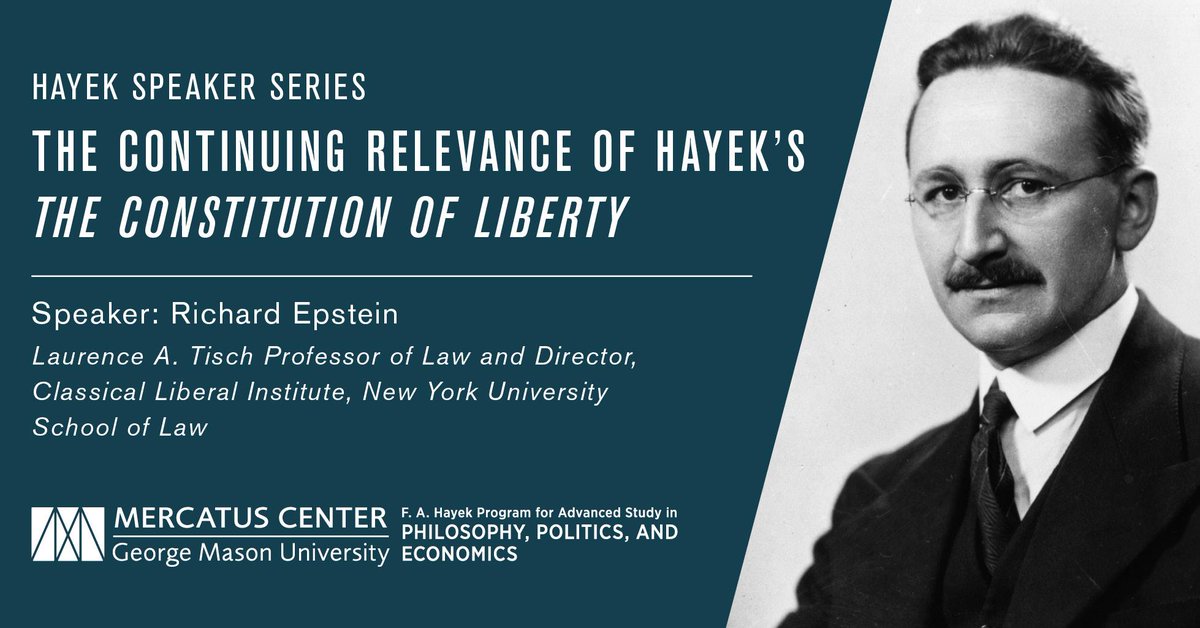
In our previous two posts (part 1 and part 2), we summarized Professor Richard Epstein’s critique of the great F. A. Hayek. It is now time to assess Epstein’s criticisms of Hayek–to critique the critique, so to speak. It pains us to say this, but either Epstein is not a very good reader or he is not a good Bayesian. On page 136 of “The Constitution of Liberty,” Hayek specifically anticipates Epstein’s monopoly problem and concedes that “a monopolist could exercise true coercion … if he were, say, the owner of a spring in an oasis.” In addition, Hayek writes (ibid.):
It is worth pointing out … that whenever there is a danger of a monopolist’s acquiring coercive power, the most expedient and effective method of preventing this is probably to require him to treat all customers alike, i.e., to insist that his prices be the same for all and to prohibit all discrimination on his part.
In other words, Hayek’s solution to the monopoly problem anticipates the exact same argument that Professor Epstein makes in his critique of Hayek. We not only suspect, however, that Professor Epstein is a careless reader; we also suspect that his inability to give Hayek credit where credit is due might be the result of Epstein’s general skepticism about philosophy’s ability to contribute to our understanding of the law. Simply put, Professor Epstein has a particular view of the world. Fine, we all do. In Epstein’s case, his view is that modern philosophy has little to offer legal theory. (See, for example, his thoughtful 1999 Dunbar Lecture published in volume 68 the Mississippi Law Review under the title “Life Boats, Desert Islands, and the Poverty of Modern Jurisprudence.“) Given these priors about philosophy, Epstein must have reasoned thus: Since Hayek, at bottom, is really a philosopher, then Hayek must have little to offer legal theory. But had Epstein read Hayek more carefully, he would not have been so quick to dismiss Hayek’s contributions to law.


 Credit:

/cdn0.vox-cdn.com/uploads/chorus_asset/file/4094468/Screen%20Shot%202015-09-24%20at%204.04.02%20PM.png)








