Fracas at Ferney, part 2: the case of Dillon’s dead dog

What really happened at Voltaire’s estate in Ferney during the morning hours of 7 December 1765, and why was the Scottish philosopher Adam Smith notified of this incident just a few days later? Among Smith’s surviving correspondence from his grand tour years is a legal memorandum from Voltaire’s mistress, Madame Denis, dated 10-11 December 1765, and the first paragraph of her legal memo reports that five men were hunting on Voltaire’s private property a few days earlier:

Samedy 7e du mois, vers les onze heures du matin, les gardes chasses de Madame Denis, Dame de ferney, vinrent avertir que des gens du Village de Saconnex chassaient au nombre de cinq dans les allées du bois de ferney qui est fermé de trois portes, et qui fait partie des jardins du château de ferney.

Next, Madame Denis identifies two of the five members of this Saturday-morning hunting party: Joseph Fillon, a carpenter who lived in a nearby village, and Charles Dillon (pictured below), who at the time was a young English aristocrat residing in Geneva as part of his Grand Tour and who later in life would become the 12th Viscount Dillon:

Joseph Fillon, charpentier, demeurant à Saconnez, a déposé aujourd’hui 10 Decembré devant le procureur fiscal, que c’était Monsieur Dillon qui était venu le prendre à Saconney, avec un soldat de la garnison de genêve pour le mener chasser avec lui à ferney. Que lui, Joseph Fillon, lui avait réprésenté que celà n’était pas permis; que Monsieur Dillon lui répondit que Madame Denis lui avait donné la permission et qu’il lui répondait de tout.

Furthermore, according to no less than four witnesses who overheard him, Mr Dillon was not only trespassing; he also threatened to burn down Voltaire’s house(!): “Quatre personnes ont déposés que Monsieur Dillon a dit en leur présence, qu’il mettrait le feu au château“. In addition, Madame Denis reports that Mr Dillon returned to the village of Ferney at midday two days later (9 Dec.) with four armed men carrying rifles and pistols, who then stormed Voltaire’s estate in search of one of his gamekeepers and threatened to capture him dead or alive:

Trois personnes ont déposé que Monsieur Dillon était venu à midy dans le village de fernex hier 9e du présent mois avec quatre personnes armées de fusils et de pistolets, qu’ils sont entrés chez le garde, qu’ils l’ont cherché chez lui et dans les maisons voisines et que Monsieur Dillon a dit en jurant qu’il l’aurait mort ou vif. Madame Denis fait juges de ces procédés tous les gentils hommes anglais qui sont à genêve.

But why did Charles Dillon threaten to set Voltaire’s house on fire in the first place (Saturday, Dec. 7), and why did he then round up the local carpenter (Joseph Fillon) as well as a guard from the Geneva barracks and return to Ferney two days later (Monday, Dec. 9)? What Madame Denis’s legal memorandum fails to disclose is Mr Dillon’s side of the story. She waits until almost the end of her memo to reveal the inciting incident, so to speak, the event that must have ignited Charles Dillon’s initial outburst of anger: someone had killed one of his hunting dogs.

More to the point, it appears Dillon had reason to believe that it was Voltaire’s hired gamekeeper who had killed his dog while he was out hunting on the morning of Saturday, Dec. 7. Although Madame Denis attempts to shift the blame for this canine crime from the gamekeeper to the local townspeople (“mais ce ne sont pas les gardes qui l’ont tué puisqu’il fut tué pendant que les gardes faisaient leur raport juridique, et qu’il le fut par les gens du village de ferney“), the killing of the bloodhound is not in dispute.

Either way, this act of aggression — the killing of one of Dillon’s hunting dogs on Saturday, 7 December — explains why the young English aristocrat decided to round up a local resident (the carpenter, Joseph Fillon) as well as a guard from the Geneva garrison (“un soldat de la garnison de genêve“) and return to Ferney on Monday, the 9th. But the $64 is, What does Adam Smith have to do with any of these events? Why did Madame Denis send him a copy of her legal memorandum? Rest assured, Alain Alcouffe and I will address these questions in our next post …
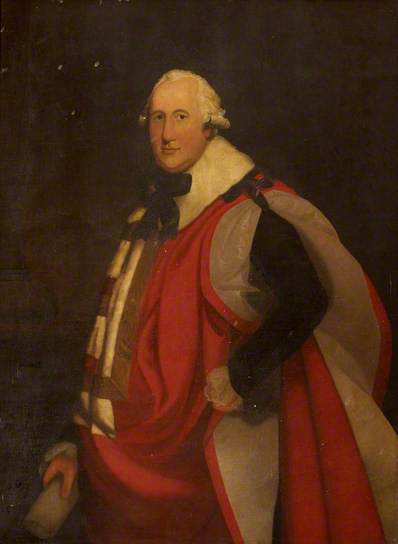
Charles Dillon, 12th Viscount Dillon - Wikipedia
Posted in Uncategorized | 4 Comments

Adam Smith and the Fracas at Ferney

One of the precious few pieces of actual contemporary evidence we have of Adam Smith’s sojourn in Switzerland is a legal memorandum dated 10-11 December 1765 signed by one Madame Denis. (See Letter #89 in Mossner & Ross, editors, The Correspondence of Adam Smith.) As it happens, this memorandum is addressed not just to the Scottish philosopher but to “tous les gentils hommes anglais qui sont à genêve” (“all English gentlemen currently in Geneva”) and is significant for two further reasons: (1) its author, for Madame Denis was none other than Marie Louise Mignot (pictured below), Voltaire’s niece, housekeeper, and mistress, and (2) its contents: the memo reports a series of incidents (what Alain Alcouffe and I like to call “the fracas at Ferney” or Dillon Affair”) that had occurred in the woods near Voltaire’s residence at Ferney during the previous few days — events so egregious that Madame Denis had decided to press charges and initiate legal proceedings against the alleged perpetrator.

According to Madame Denis’s version of this fracas, the wrongdoer in this case was a young English aristocrat named “Dillon” who was hunting game illegally on Voltaire’s private property and had then hurled some violent threats against Voltaire, Madame Denis, and their hired gamekeeper (who, alas, remains unnamed). But as we shall see in our next post, Madame Denis’s memo does not tell the full story, for the alleged aggressor — Charles Dillon, who was residing in Geneva at this time as part of his Grand Tour and who later in life would become the 12th Viscount Dillon — would have a very good reason to be angry with Voltaire’s gamekeeper.

For now, it suffices to say that Adam Smith may have been a recipient of Madame Denis’s memo because he was most likely acquainted, either personally or by reputation, with the English aristocrat at the center of this legal controversy, especially given the small size of the Swiss city-state where Dillon, his tutor Needham, and Smith himself then resided. Stay tuned: Alain Alcouffe and I will tell you what really happened at Ferney in our next two posts.

File:Château de Chantilly, Joseph Siffred Duplessis, portrait of a woman.JPG
Posted in Uncategorized | 5 Comments

Sunday song by Cafuné

Alain Alcouffe and I will resume our series on Adam Smith in Geneva in the next day or two (our upcoming installments will be titled “Fracas at Ferney”); in the meantime, here is the song “High” by the pop duo Cafuné:

Posted in Uncategorized | Leave a comment

Adam Smith and Rousseau the fugitive

As Alain Alcouffe and I have mentioned in our previous two posts (see here and here), much of the scholarly attention to Adam Smith’s sojourn in Switzerland has been devoted to Geneva’s proximity to Ferney, where Smith’s hero Voltaire lived at the time, and to their (Smith and Voltaire’s) mutual interest in the l’affaire Calas or “Calas Affair”, an unjust criminal-religious prosecution that had taken place in Toulouse, France, in 1762. But what most Smith scholars have overlooked is that the little Republic of Geneva was itself the scene of an even more famous intellectual crime that same year, for it was in 1762 that the austere Calvinist authorities in Geneva banned what would become one of the most influential works of political philosophy and issued a warrant for its author’s arrest. (See, e.g., Mason 1993, p. 568.)

Who was this would-be criminal, and what was his great intellectual crime? He was none other than a citizen of Geneva, the great Jean-Jacques Rousseau, and his crime was the publication of Du contrat social; ou, Principes du droit politique. (In addition to The Social Contract, Rousseau’s treatise on education, Émile, was also banned.) Rousseau, now an international fugitive (his works were banned in Paris too), reacted to the suppression of The Social Contract in Geneva by renouncing his Genevan citizenship in 1763 and then indicting the republican regime of that city-state in a letter-essay titled Lettres écrites de la montagne (1764), the last work of Rousseau’s to be published during his lifetime. For his part, given his review of one of Rousseau’s earlier works in his 1756 letter-essay to the Edinburgh Review, Smith must have taken an interest in these developments. (Also, for what it’s worth, a copy of Lettres écrites de la montagne made its way to Adam Smith’s private library. See Mizuta 1967, p. 53.)

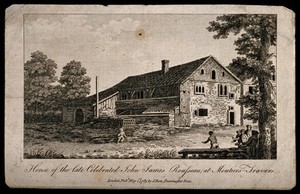
Moreover, Rousseau was still living in the vicinity of Geneva at this time. After his works were declared illegal and a warrant issued for his arrest, he relocated to Môtiers (close to Geneva but outside her legal jurisdiction) in the summer of 1762 and remained there until mid-September 1765. (See here, for example; Durant & Durant 1967, p. 51.) It was during Rousseau’s 26-month residency in Môtiers that he wrote Letters from the Mountain, drafted a constitution for Corsica, and was visited by Adam Smith’s former student, James Boswell, but Rousseau was finally forced to flee after his house (pictured below), which today is a museum, was stoned by a mob on the night of 6 September 1765. (Ibid.) Rousseau then found refuge for a few weeks in a solitary house on the Île de St.-Pierre (St. Peter’s Island) in the independent city-state of Bern (also not far from Geneva), until the Senate of Bern ordered him to leave the island and the canton within fifteen days on 17 October 1765. (Ibid.) On 29 October 1765, Rousseau left Switzerland, never to return.

Whether or not Smith was aware of Rousseau’s dramatic departure from Switzerland, both of Rousseau’s Swiss sanctuaries — the house in Môtiers and the solitary caretaker’s house on St. Peter’s Island — were located near Geneva. Given this geographic proximity, perhaps Smith had every intention of meeting with Rousseau during his sojourn in Switzerland. Among other clues, Smith’s library would eventually contain no less than 15 volumes of Rousseau’s works. (See Mizuta 1967, p. 53.) By way of comparison, although Voltaire was an even more prolific author than Rousseau, only six of Voltaire’s volumes found their way into Smith’s library. (Ibid., p. 60.) Furthermore, if the amount of space Smith devoted to Rousseau in his 1756 letter-essay to the Edinburgh Review is any indication — no less than six out of the 17 paragraphs of this work are addressed to Rousseau, compared to just one paragraph to Voltaire — we can safely say that Smith admired Rousseau as much as, if not more than, Voltaire.

Alas, Adam Smith never did get to meet Rousseau, for by the time the Scottish philosopher had arrived in Geneva, Rousseau was about to take flight from Switzerland for good. So why did Smith stay in Geneva for as long as he did, possibly until end of January or beginning of February 1766? Maybe Smith expected Rousseau to find refuge in some other canton close by or maybe even resurface in his native Republic of Geneva to answer the charges against him. (In the meantime, Smith must have discussed Rousseau’s fate and fugitive status with Voltaire when the two intellectual giants finally met in Ferney.) Either way, as my colleague Alain Alcouffe and I will explain when we resume this series next week, Adam Smith would find many more good reasons to remain in Geneva …

The house of Jean-Jacques Rousseau, in Môtiers, Val-de-Travers,  Switzerland. Engraving, 1783. | Wellcome Collection

Posted in Uncategorized | 3 Comments

Adam Smith in Geneva: Voltaire versus Rousseau

Why did Adam Smith decide to visit Geneva in the fall of 1765? As it happens, the Scottish philosopher and travelling tutor would have had many good reasons for wanting to visit this pious and prosperous republic with his pupils during their grand tour years (1764-66), for Geneva was not only one of the leading centers of international scientific training at this time — Smith, for example, would befriend such leading “natural philosophers” as Charles Bonnet and Georges-Louis Le Sage during his sojourn in Switzerland — this little republic was also one of the last remaining self-governing city-states in all of Europe, a political anomaly that might have piqued the curiosity of any keen student of contemporary political economy and the classical Greek polei of lore.

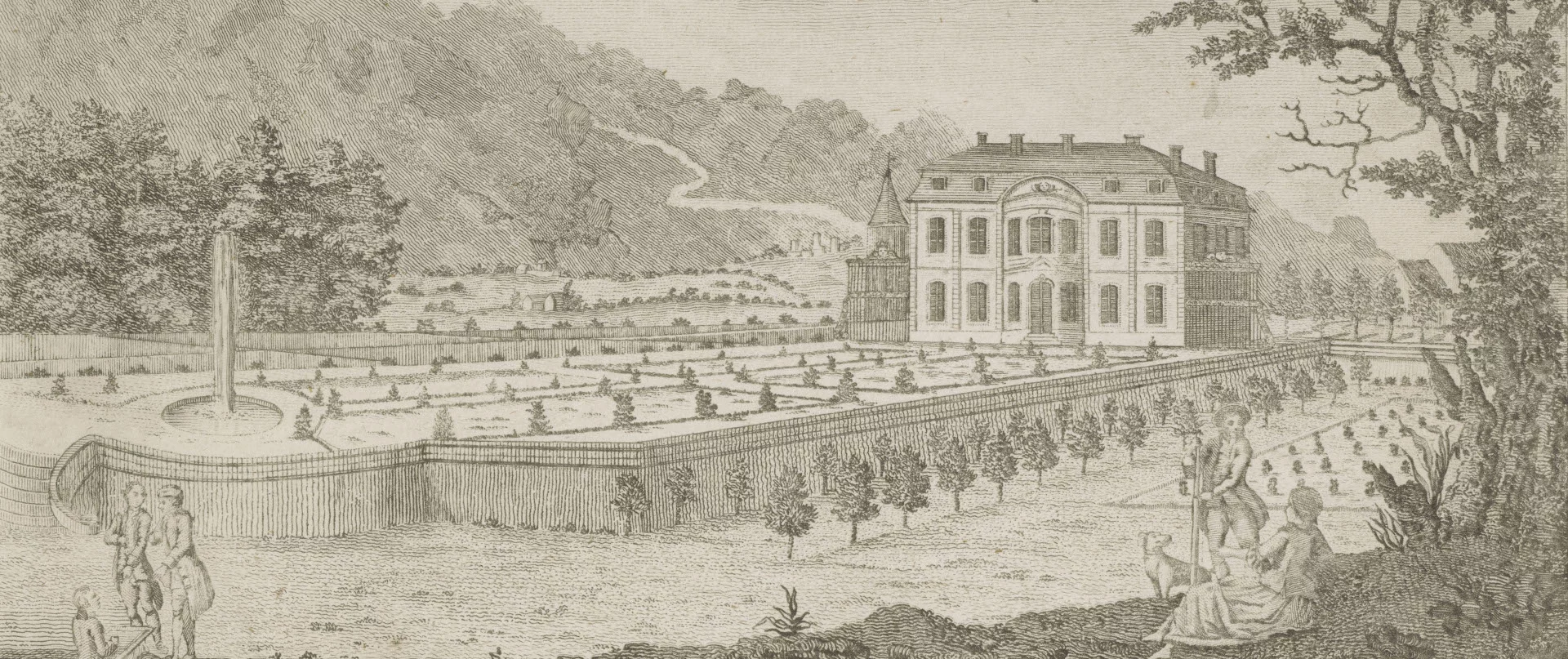
According to most of his biographers, however, Smith’s first and foremost reason for visiting Geneva was the city’s proximity to the famed château de Ferney (pictured below), home of the celebrated Voltaire from 1761 to 1778. This claim is plausible, for the French freethinker was one of the most famous literary figures of the Enlightenment, and when Adam Smith was a professor at Glasgow, he devoted the last paragraph of one of his earliest writings to be published, a letter to the Edinburgh Review, to the great Voltaire, who he described as “the most universal genius” that France has ever produced. [This lengthy letter is reprinted in W. P. D. Wightman, et al., editors, Essays on Philosophical Subjects (Oxford University Press, 1980), and is available here.] So, how could the Scottish philosopher pass up the opportunity to meet one of his intellectual heroes? Alas, as great as Voltaire’s reputation was, the opportunity to exchange ideas with this intellectual giant cannot be the whole story. Why not? Because Smith’s remained in Geneva for several months: from October 1765 until the end of January or beginning of February 1766. If all Smith had wanted to do was to meet Voltaire, then why stay so long in this little republic?

What if Smith had another reason for visiting Geneva, one even more powerful than the intellectual prestige or academic allure of meeting the famed Voltaire? And more to the point, what if this additional motive had to do with Voltaire’s lifelong nemesis and polar opposite, Jean-Jacques Rousseau? Alain Alcouffe and I will explore this intriguing possibility in our next blog post; for now, however, it suffices to say that Geneva was not only Rousseau’s hometown, the city of his birth; Rousseau himself had dedicated his famed Second Discourse to the “Republic of Geneva”. These are important clues for us because, as much as Smith admired Voltaire, the one philosopher who Smith devotes even more space to than Voltaire in his second letter to the Edinburgh Review is none other than Rousseau.

History of castle of Voltaire
Source: https://www.chateau-ferney-voltaire.fr/en/discover/history-of-castle-of-voltaire
Posted in Uncategorized | 4 Comments

Prologue: Adam Smith in Geneva

Why did Adam Smith go out of his way to travel to the little Swiss city-state of Geneva in the fall of 1765? At the time, Geneva was an independent and self-governing republic, but she was much smaller than now, covering an area of 124 square kilometers. [See, e.g., Phillip Judd, “On this day 200 years ago Geneva nearly doubled in size“, Le News (3 March 2016). As an aside, Geneva did not officially join the Swiss Confederation until 19 May 1815 (ibid.).] As it happens, my colleague, friend, and co-author Alain Alcouffe and I have been researching this very question for many months now.

In summary, our point of departure is Chapter 13 of John Rae’s Life of Adam Smith, which recounts many of the most salient events and encounters during the middle phase of Smith’s Grand Tour years–specifically, the time Smith spent in the Republic of Geneva beginning in October 1765. (As an aside, Rae incorrectly has Smith departing Geneva as early as December 1765, but as my colleague Alain Alcouffe and I have discovered, this is wrong, for Smith’s sojourn in Geneva most likely lasted until the end of January or beginning of February 1766.) In brief, Rae and subsequent biographers rightly emphasize Smith’s encounters with his intellectual hero, the famed Voltaire, especially given the stature of this famed Enlightenment figure as well as their mutual interest in l’affaire Calas, a major legal and religious controversy that played out in Toulouse, where Smith had spent most of 1764 and 1765.

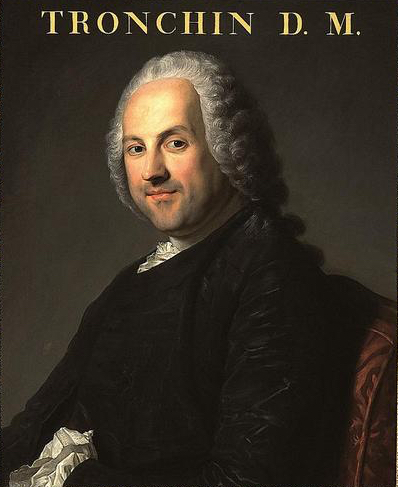
But at the same time, it is also worth pointing out that Smith met, befriended, and exchanged ideas with many other notable historical figures and intellectuals during his stay in Switzerland, including, in alphabetical order, (1) the botanist Charles Bonnet, who by all accounts abhored Smith’s intellectual mentor David Hume; (2) the wealthy and beautiful widow Louise Elisabeth de La Rochefoucauld (duchesse d’Enville), described as Turgot’s “muse” by some of our primary sources; (3) the physicist Georges-Louis Le Sage, who invented the electric telegraph; (4) the hospitable Lord and Lady Stanhope, who hosted many dinner parties for British visitors during their residency in Geneva; and (5) one of the most famous medical doctors of the Enlightenment era, Theodore Tronchin (pictured below), whose son had recently attended Smith’s foundational philosophy lectures at the University of Glasgow.

Prior to his sojourn in Switzerland, however, Smith did not know any of these Lumières; accordingly, Alain Alcouffe and I will explain in our next post why the “City of Calvin” or “Protestant Rome” was such a popular destination for 18th century British aristocrats on their grand tours of Europe.

File:Théodore Tronchin (1709-1781), médecin genevois, professeur à l'Académie.jpg
Posted in Uncategorized | 2 Comments

Wikipedia Wednesday: Marie Louise Nicole de La Rochefoucauld, duchesse d’Enville

https://fr.wikipedia.org/wiki/Marie_Louise_Nicole_de_La_Rochefoucauld (in French)

L’hôtel de La Rochefoucauld, vue par l’arrière depuis la rue des Augustins, sur le plan dit de Turgot (1739).
Posted in Uncategorized | Leave a comment

Tuesdays with TCAT (Tyler Cowen & Alex Tabarrok)

For me, Tyler Cowen and Alex Tabarrok are the original “blog kings” — I have been a huge fan of their “Marginal Revolution” blog since 2006 — so why not share the love every Tuesday by featuring my favorite Cowen/Tabarrok posts from the previous week?

Cowen, 21 Nov — Bike lanes are not about bikes: https://marginalrevolution.com/marginalrevolution/2024/11/bike-lanes-are-not-about-bikes.html

Tabarrok, 22 Nov — Sunstein on DOGE: https://marginalrevolution.com/marginalrevolution/2024/11/sunstein-on-doge.html

Posted in Uncategorized | Leave a comment

This day in legal history: Treaty of Granada

What if southern Spain were still an Islamic emirate? On this day (25 November) in 1491, the Treaty of Granada was signed and ratified by Boabdil, the last sultan of the Emirate of Granada, and Ferdinand and Isabella, the King and Queen of Castile, León, Aragon, and Sicily, who completed the “Reconquist of Spain”. (Here is an English-language translation of the treaty.) Among other things, this treaty decreed a truce between the warring parties, followed by the relinquishment in January 1492 of the sovereignty of the Muslim Emirate of Granada (founded in the 13th century) to the Catholic monarchs of Spain.

Posted in Uncategorized | Leave a comment

Sunday songs: *Tell me* and *Every second*

Posted in Uncategorized | Leave a comment