
Or will Biden? See here: https://manifold.markets/BusinessLawProf/will-president-biden-release-by-dec
In the meantime, it is worth noting that we were lied to about this the last time around (see here), but fwiw check out this report, via Forbes.
Or will Biden? See here: https://manifold.markets/BusinessLawProf/will-president-biden-release-by-dec
In the meantime, it is worth noting that we were lied to about this the last time around (see here), but fwiw check out this report, via Forbes.
Oh, the irony! The self-described “progressive constitutionalist” Harvard law professor Mark Tushnet published his latest paper on court reform (without, alas, any sense of irony) the day after the re-election of Donald J. Trump!

Gino is the Harvard Business School professor accused of using fake data in her papers, including at least one purporting to show how to elicit honest behavior (see here, for example)! Earlier this week, Daniel Engber, a senior editor at The Atlantic, published this damning report explaining why the research fraud problem in the trendy field of behavioral psychology is much bigger than Gino. Below is an excerpt:
More than a year since all of this began [i.e. the original allegations of research fraud committed by Gino], the evidence of fraud has only multiplied. The rot in business schools runs much deeper than almost anyone had guessed, and the blame is unnervingly widespread. In the end, even Schroeder [one of Gino’s co-authors] would become a suspect.
Bonus link: my 2017 refereed paper “Legal Liability for Research Fraud“.
https://en.m.wikipedia.org/wiki/Wikipedia:Chesterton%27s_fence
Alas, I have no idea how I stumbled upon this particular Wikipedia entry, but Chesterton’s fence is the Smithian idea that reforms should not be made until the reasoning behind the existing state of affairs is understood, and the original quotation is from G. K. Chesterton’s 1929 book The Thing in the chapter “The Drift from Domesticity”:
In the matter of reforming things, as distinct from deforming them, there is one plain and simple principle; a principle which will probably be called a paradox. There exists in such a case a certain institution or law; let us say, for the sake of simplicity, a fence or gate erected across a road. The more modern type of reformer goes gaily up to it and says, “I don’t see the use of this; let us clear it away.” To which the more intelligent type of reformer will do well to answer: “If you don’t see the use of it, I certainly won’t let you clear it away. Go away and think. Then, when you can come back and tell me that you do see the use of it, I may allow you to destroy it.”
As an aside, G. K. Chesterton was a popular English author known as the “prince of paradox”; bonus link below:
Are college professors, lawyers, political pollsters, or opera singers examples of productive or unproductive labour? Does this distinction even make sense? See, for example, this short lecture by the imitable Tyler Cowen explaining Adam Smith’s classic distinction, via Marginal Revolution University:
Or, better yet, read Book II, Chapter 3 of The Wealth of Nations.
That is the title of this beautiful homage to the great Martin Gardner by Rebecca DeLee (Liberty University). See also this brief biography titled “A Mind for the Masses“, according to which “Gardner never took a college math course yet his Scientific American columns earned the respect of noted mathematicians.”
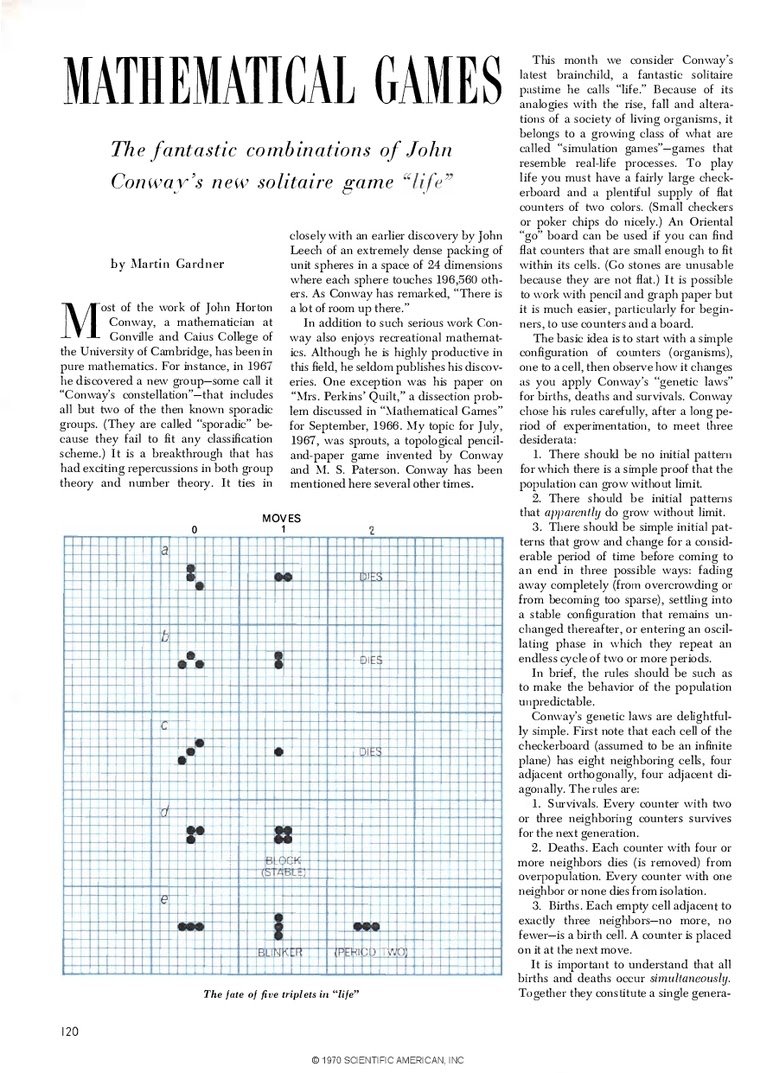
I know of only two such instances in my field (law): my colleagues Brian Frye and Maybell Romero co-authored “The Right to Unmarry: A Proposal” and, pictured below, my wife and former student(!) Sydjia Robinson and yours truly co-authored a novel thought-experiment paper — published in the National Law School of India Review and available here, via JSTOR — proposing a “Unified Code of Procedure” for both civil and criminal cases!
Update #1 — I stand corrected: my new friends Carissa Byrne Hessick and Andrew Hessick have published at least 10 papers together, including this one comparing and contrasting statutory interpretation of civil versus criminal laws: “Constraining Criminal Laws“!







Welcome to the online home of the IASS
Hopefully It’s Interesting.
In Conversation with Legal and Moral Philosophers
Relitigating Our Favorite Disputes
PhD, Jagiellonian University
Inquiry and opinion
Life is all about being curious, asking questions, and discovering your passion. And it can be fun!
Books, papers, and other jurisprudential things
Ramblings of a retiree in France
BY GRACE THROUGH FAITH
Natalia's space
hoping we know we're living the dream
Lover of math. Bad at drawing.
We hike, bike, and discover Central Florida and beyond
Making it big in business after age 40
Reasoning about reasoning, mathematically.
I don't mean to sound critical, but I am; so that's how it comes across
remember the good old days...
"Let me live, love and say it well in good sentences." - Sylvia Plath
a personal view of the theory of computation
Submitted For Your Perusal is a weblog wherein Matt Thomas shares and writes about things he thinks are interesting.
Logic at Columbia University
Just like the Thesis Whisperer - but with more money
the sky is no longer the limit
Technology, Culture, and Ethics
Just like the horse whisperer - but with more pages
Poetry, Other Words, and Cats


 prior probability