Everyone agrees that it would be wrong to punish ordinary soldiers for the crime of aggression launched by their leaders. The question is why, and it is not easy to answer.
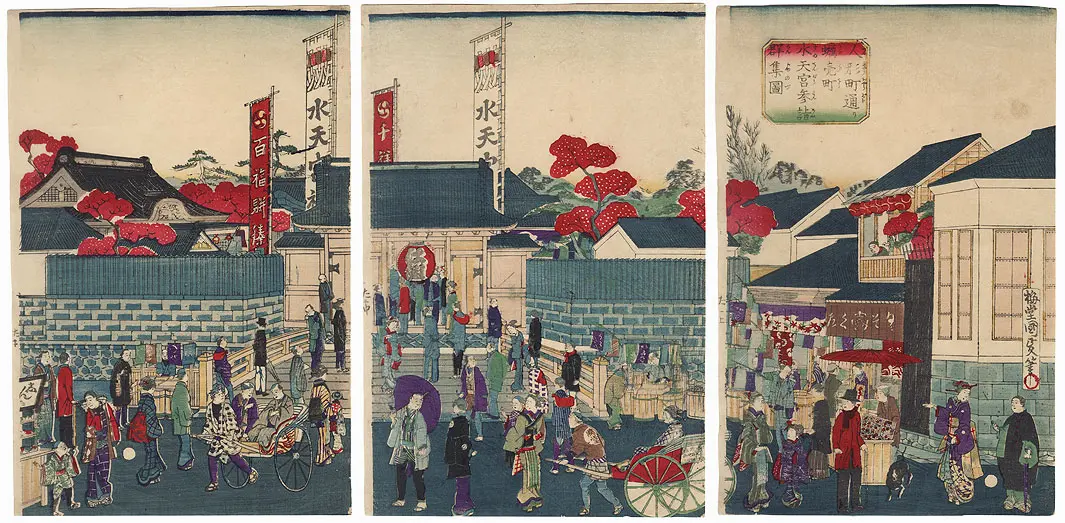
The Meiji era (“enlightened rule”) was officially declared by Japan’s 122nd emperor, Meiji, on this day (23 October) in 1868. It was during Meiji’s reign, which lasted until 30 July 1912, that Japan was transformed from a poor and secluded feudal society into a prosperous industrialized nation.
That is the title of this intriguing paper by Wes Henricksen, a law professor at Barry University in my neck of the woods: Orlando, Florida. His paper (see also here), which was just published in the British Journal of American Legal Studies, not only cites my work on “Gödel’s Loophole“; it contains a comprehensive listing of all references to Jorge Luis Borges in the scholarly legal literature. Below is the full abstract of Professor Henrickson’s beautiful new paper:
The works and ideas of Jorge Luis Borges have had a major impact on literature, movies, art, philosophy, and pop culture. His influence in these areas has been documented and studied. To date, however, there has been no significant effort to catalog or discuss the impact Borges has had on legal scholarship. The impact is significant. Hundreds of law journal articles, essays, and book reviews reference Borges and his work. For instance, authors have used Borges stories as a lens through which to analyze legal doctrines and developments. Others have quoted Borges to help convey particular ideas or principles. This paper aims to identify all references to Borges and his work in the legal scholarly literature, and to analyze the ways authors rely on Borges to determine the nature and extent of Borges’s influence on legal scholarship. My aim is primarily to evaluate the scholarly treatment as a whole, rather than focus on individual cases. As such, I have attempted to compile a comprehensive list of Borges references in the legal scholarship to date. If I have omitted any scholarly works that should be included, please let me know and I will happily add them.
Via Kottke: “Cássio Vasconcellos took aerial photos of scrapyards and arranged the junked cars, planes, trains, and other objects into dense photographic collages.”
In my previous post, I presented two standard interpretations of the fable of the hawk and the nightingale in Hesiod’s 8th-century B.C. poem Works and Days. Today, I will offer my own novel interpretation of this fable. Specifically, what if the fable is an allegory about eternal conflict between making a living and producing lasting art, a conflict that describes the arc of Hesiod’s own life and work, the daily toil that kept him from perfecting and devoting himself to his poetic craft. For starters, Works and Days begins with a hymnic invocation to the Muses calling on them to sing of their father Zeus (lines 1-11), so perhaps the nightingale represents these “Pierian Muses.” (line 1) But what does the hawk represent? According to the introduction to my old edition of Works and Days (pp. 14-15), Hesiod was a promising poet in his youth, but he had to go back to farming after he had some “legal troubles” with his brother, and then “the daily grind [of farming for a living] almost obscured his talents forever …” So, maybe the hawk represents the sands of time. We have only a limited amount of time to make our mark on the world. We don’t know when our time will come–when the hawk of death will swoop us away–but in the meantime we can either make a living or we can strive to create great art like Homer or Hesiod in order to be remembered after we leave the scene. Like the nightingale clutched in the talons of the hawk, we cannot escape our mortality; our time to shine is fleeting …













 prior probability