I will write up a proper eulogy over the weekend, but for now it is with a heavy heart that I share the somber news that my father Don Francisco Florentino Guerra Fernandez died earlier this morning. He was a one-of-a-kind character who loved tinkering with his tools and tending to his own garden, and I am the man, husband, and father I am today because of my father’s love, protection, and good counsel …
Family photo
Standing next to my wife Sydjia (far left), myself (second from right), and three of his grandchildren (Adys, Aritzia, and Kleber), is my father Don Francisco. (This picture was taken in December of 2020.)
PSA: May 1st should be *International Victims of Communism Day*
I know it’s not going to happen, but the United Nations should declare May 1st “International Victims of Communism Day”. To this end, allow me to share my colleague and friend Ilya Somin’s original May Day Proposal from 2007: see here or here. Below is an excerpt, which I have lightly edited for clarity and style (all links are from the original):
Today is May 1st or “May Day“, which began as a holiday for socialists and labor union activists, not just communists. But over time, the date was taken over by the Soviet Union and other communist regimes and used as a propaganda tool to prop up their regimes. I suggest that we instead use this day to commemorate those regimes’ millions of victims. The authoritative Black Book of Communism estimates the total at 80 to 100 million dead, greater than that caused by all other twentieth century tyrannies combined. We appropriately have a Holocaust Memorial Day. It is equally appropriate to commemorate the victims of the twentieth century’s other great totalitarian tyranny, and May Day is the most fitting day to do so. I therefore suggest that May Day be turned into Victims of Communism Day.
Alas, my father is in really bad shape right now, but (contra Hume) my mother and I are still holding out for a miracle. In his honor, below is the soundtrack of my father’s favorite movie, Andy Garcia’s “The Lost City“.
Here is a link to a photo of my father Don Francisco (far left) with his niece Vivian, my mother Oilda, and myself (far right).
I won’t be blogging today or tomorrow due to an illness in my family. (My father was operated on yesterday, so my mother and I will be in the hospital by his side.)

Star Trek Saturday: assorted links re: space debris in Sector 001?
Apropos of my research on space junk, I wondered how the debris problem is solved in the fictional world of Star Trek; below are some helpful links:
- Fandom: “Debris” [https://archive.ph/2GcC0]
- Quora: “In Star Trek, why are phasers not used against space debris, meteor showers etc.?” [https://archive.ph/tnXv9]
- Physics Forum: “Plasma shields like in star trek will they be possible” [https://archive.ph/86pXT]
- Reddit: (see below)
5. YouTube: (see below)
Lit review: survey of proposed solutions to the tragedy of the outer space commons
Thus far this week (see here , here, and here), I have surveyed the newly-published space polices of Department of Defense and the U.S. Space Force, as well as a third report from the RAND Corporation, all of which call for the U.S. military to procure some of the services and systems they need for their outer space operations from private commercial providers. In addition, I also identified a blind spot in all three reports: they omit any discussion of the problem of space debris resulting from greater satellite congestion in outer space, especially in Low Earth Orbit. Lastly, I suggested a different approach (an approach that I am further developing with my colleague and friend Justin Evans) to this “tragedy of the outer space commons”: markets and property rights, i.e. space auctions. Simply put, domestic agencies like the FCC and international ones like the ITU should assign property rights in orbits and allow those rights to be freely traded.
Before taking a deeper dive into our market-based solution to this new tragedy of the commons, however, I should mention that many other solutions to the problem of space debris have been proposed. Broadly speaking, these proposals fall into one of two categories: regulation or innovation, i.e. one group of proposed solutions is purely legalistic or regulatory in nature, while the other is technical or technological.
For an example of the technical approach, see this 2009 paper in Space Review proposing the use of lasers and other “energy systems” to eliminate orbital debris from outer space (Taylor Dinerman, “Unilateral orbital cleanup“, Space Review, May 4, 2009), or this 2011 thesis calling for the development of a “satellite recycling system” that could be used to repair inoperable satellites and even retrieve particles of space junk (Major Patrick V. Long, “Space Junk Norms: US Advantages in Creating a Debris-Reducing Outer Space Norm“, School of Advanced Air and Space Studies, Thesis, May 2011).
By contrast, for some examples of the regulatory or legalistic approach, check out this 2014 paper by Nodir Adilov, Peter J. Alexander, and Brendan M. Cunningham calling for a new Pigovian tax on space launches as well as this 2003 law review article by Robert Bird and this 2013 comment by Gabrielle Hollingsworth calling for a new international agreement or a modification of existing outer space treaties.
Starting next week, I will survey both of these competing groups of proposed solutions to the problem of space junk (i.e. regulatory solutions versus technical ones) and explain where both fall short.
Digression: RAND Report on Commercial Space Services
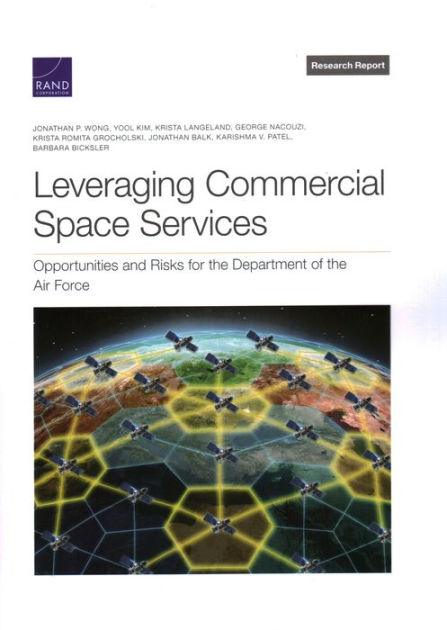
Previously (see here and here), I surveyed two new official public policy reports — one by the Department of Defense; the other by the Space Force — calling for U.S. military to procure some of the services and systems they need for their outer space operations from private commercial providers. As it happens, the RAND Corporation has also published a detailed report (the cover of which is pictured below) describing the risks and benefits of the U.S. military’s “partnership activities” with the commercial space industry. (As I mentioned in a previous post, this third report, which is dated 6 September 2023, is titled “Leveraging Commercial Space Services: Opportunities and Risks for the Department of the Air Force” and is available here.)
Alas, like the DoD’s April 2 report and the Space Force’s April 8 report, the 2023 RAND report does not discuss the elephant in the outer space room: how our growing demand for commercial satellite space services will most likely continue to produce a proliferation of satellite constellations and other spacecraft in an already congested Low Earth Orbit or LEO. Rand’s report merely mentions in passing how the number of commercial satellite communication systems in LEO “is increasing at an astonishing rate” (p. 27). By way of example, “SpaceX is currently providing Ku-band global coverage using nearly 3,000 satellites and has plans to exceed 30,000 satellites over the next few years ….” (Ibid., citing Jeff Foust, “GEO Operators Say They Can Compete Against LEO Systems on Cost,” SpaceNews, March 22, 2022, available here; see also Jamie Morin and Robert S. Wilson, Leveraging Commercial Space for National Security, Center for Space Policy and Strategy, Aerospace Corporation, November 2020, available here.)
In an appendix, the RAND report further describes the increased demand for commercial satellite communication or “SATCOM” services and systems and also identifies several legal challenges confronting the commercial space industry (Appendix C, p. 52, emphasis added):
Today’s demand landscape is different [from that of the the 1990s when high costs and limited demand kept the LEO market small], as the state of technology has generally advanced and demand for bandwidth has soared across every sector. This increased demand generally creates an opportunity for growth in the SATCOM market, and the need for more internet communications is well beyond current supply. But growth in demand is not sufficient to ensure a firm’s viability. In the process of pursuing a place in the pLEO [proliferated Low Earth Orbit] market, firms need to secure spectrum access, orbital deployment authority, and the authority to operate while in space and then ensure financial sustainability thereafter ….
The appendix then points out “two major regulatory factors” in the proliferated Low Earth Orbit market (pp. 52-23, footnotes omitted, emphasis added):
The first, securing access to the spectrum and orbital resources, is considered by many to be the biggest challenge to pursuing pLEO. Spectra and orbits are finite, so once a regulatory agency—such as the FCC, the International Telecommunication Union, or an FCC-equivalent agency in another country—allocates those resources, they are locked until the winning firm fails to meet the criteria to operate in the market or reallocates its spectral and orbital rights. For example, in the V-band spectrum, more than 94,000 satellites have been proposed to the FCC in a rush to secure access to the spectrum and orbits.
When incumbent firms with existing licenses or an ability to navigate the regulatory space are favored in the allocation of the spectrum regardless of whether they can deliver services, it is more difficult for new firms to enter the market. To ensure that licenses are used, the FCC does have a caveat in its allocations that a firm must launch at least half of its proposed satellites by the sixth year of a license and all of its proposed satellites by the ninth year. However, the FCC does not necessarily consider the soundness or feasibility of a business plan in its rulemaking. If a firm occupies a part of the spectrum or orbits and fails to deliver, this could lead to an inefficient use of resources. At the same time, a firm’s ability to innovate can be stymied by the potentially time-consuming process of obtaining a license from the FCC
The second regulatory factor … is the impact of the FCC’s and similar regulatory organizations’ decisionmaking timelines on schedules for delivery of services. Furthermore, when the spectrum has been allocated, the decision has not always been final. For example, the FCC reallocated a portion of the C-band spectrum to the 5G industry in 2020. These uncertainties add to the financial risks that firms face as they navigate the process of obtaining access to the spectrum.
The RAND report thus identifies two significant challenges facing the commercial space industry (i.e., the finite nature of low Earth orbits and the lack of stable property rights in those orbits), but it does not propose a solution to either problem. To this end, my colleague Justin Evans and I would like to make a modest proposal: why doesn’t the FCC (or better yet the ITU) start creating well-defined property rights in orbits and allow for those rights to be traded? Building on my previous work, we will further discuss our novel “space auctions” proposal in a future post.