(Author’s note: below is Part 2 of 3 of my series of blog posts on Adam Smith’s third and last visit to Paris.)
It is my misfortune to be under the necessity of acquainting you of the most terrible calamity that has befallen us. (Adam Smith to Lady Frances, Letter #98.)
Two pieces of personal correspondence, both of which are written in Smith’s hand only four days apart (15 & 19 October 1766), report that Hew Campbell Scott had contracted a fatal fever. (See Letters #97 & #98.) Both missives are addressed to Lady Frances, Henry and Hew’s younger sister, and of all the extant letters of Smith during his travels in France, his 15 October letter to Lady Frances is the longest: a total of 894 words. (The second-longest piece of correspondence Smith wrote during his travels in France, a letter addressed to Charles Townshend, contains 626 words. See Letter #95.) By his own account, Smith wrote this letter late at night–11 o’clock P.M.–and it contains many gruesome details of Hew’s illness; among other things, Smith reports on Hew’s many “vomitings”, “purgings [that] continued with great violence”, and “delirium”, and he also describes how Hew had “bled very copiously at the nose” (Letter #97). By contrast, Smith’s next letter to Lady Frances–the last letter he would write from foreign soil–is short and to the point (Letter #98):
Paris, 19 Oct. 1766
It is my misfortune to be under the necessity of acquainting you of the most terrible calamity that has befallen us. Mr Scott dyed this Evening at seven o’clock. I had gone to the Duke of Richmonds in order to acquaint the Duke of Buccleugh that all hope was over and that his Brother could not outlive tomorrow morning: I returned in less than half an hour to do the last duty to my best friend. He had expired about five minutes before I could get back and I had not the satisfaction of closing his eyes with my own hands. I have no force to continue this letter; The Duke, tho’ in very great affliction, is otherwise in perfect health. I ever am etc. etc.
Adam Smith
Alas, although Smith had consulted with two eminent doctors–Quesnay and Richard Gem, the doctor assigned to the British embassy in Paris (see Armbruster 2019, p. 131)–and Hew had received the best medical care he could have possibly received in the Paris of his day and age, Hew’s illness was a fatal one.
Upon Hew’s untimely demise, moreover, Smith’s grand tour and his third and last sojourn in Paris would come to an abrupt close.
Note: my next few blog posts are from the third and last part of my revised paper “Adam Smith in the Cityof Lights”, which revisits Smith’s last days in Paris (October 1766). Below is an excerpt, where I describe an oft-overlooked aspect of Smith’s travels–his short stay in Compiègne in August 1766. (The works cited are below the fold.)
… for centuries Compiègne was the site where kings stopped on their way to Reims for coronation and where Charles IX (r. 1560-1574) and Louis XIII (r. 1610-1643) celebrated their marriages.” (Plax 2017, p. 109, footnote omitted)
Adam Smith’s second sojourn in Paris (February to July 1766) concluded when Smith and his pupils travelled to Compiègne sometime in August of 1766. (Rae 1895, p. 197.) As an aside, both John Rae and Ian Simpson Ross incorrectly describe the Scottish philosopher’s stay in Compiègne as an “excursion”. Rae (1895, p. 22), for example, reports that Smith “had been in the habit while in Paris of taking his pupils for excursions to interesting places in the vicinity, … and in August 1766 they went to Compiègne to see the camp and the military evolutions which were to take place during the residence of the Court there”, while Ross (2010, p. 227) writes, “[Smith] took his protégés, Buccleuch and his brother, on excursions to places of interest such as Compiégne when the Court went there for the diversion of hunting.”
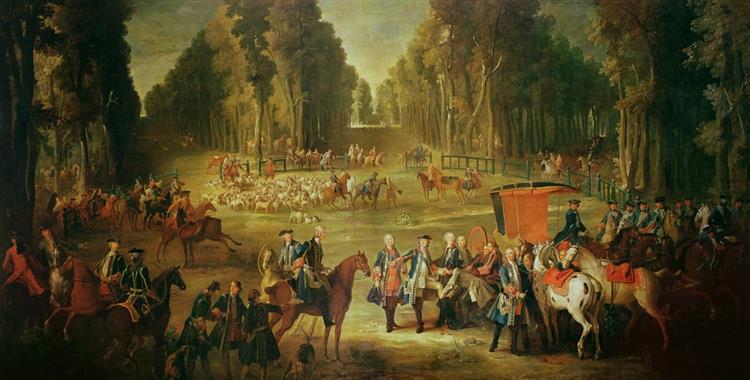
But the visit to the royal hunting park at Compiègne was not a mere “day trip” or weekend excursion. Instead, it was most likely one of the highlights of Adam Smith’s three-year grand tour travels and probably deserves a chapter or paper of its own, for it was in Compiègne that Smith and his pupils got to reside at a royal château and attend one or more hunts with the King of France. The pristine 20,000-acre forest at Compiègne was not only one of the oldest royal hunting grounds in France, dating to the time of the Merovingian king Clovis; the whole area was saturated with the history of past French kings and the origins of the monarchy: “French kings, beginning with Francis I, began the habit of short, but frequent, stays to enjoy the hunt” (Plax 2017, p. 109).
As it happens, Compiègne was also the site of Louis XV’s favorite chateau and hunting grounds, and the Chateau de Compiègne was the center of court life and the exercise of royal power when Louis XV and his Court were in town during the summer months (Plax 2017). In the words of art historian Julie Anne Plax, “Versailles was and always would be associated with Louis XIV, but Compiègne, with its well-ordered hunting park, would bear the mark of Louis XV …” (ibid., p. 116). Among other things, Louis XV had commissioned the construction of a new royal château, the plans for which were drawn by Ange-Jacques Gabriel, and every summer the king moved his royal court to Compiègne, where he hunted on the average of four to five days a week (ibid., p. 103). In 1764, for example, David Hume, in his capacity as Secretary of the British Embassy, had followed the French Court to Compiégne and spent the months July and August there (Mossner 1970, p. 461). For his part, Smith must have somehow secured a coveted invitation to make this visit, perhaps through Smith’s contacts at Britain’s embassy in Paris.
What is unclear, however, is how long Smith’s sojourn in Compiègne lasted. In a letter dated August 1766 from David Hume addressed to Adam Smith, Smith’s Paris mailing address “Anglois Hotel du Parc roiale, Fauxbourg St Germain a Paris” is crossed out and a new forwarding address, consisting of the words “a Compiègne”, are added twice, in another hand. (See Letter #96, note 1, in Mossner & Ross 1987.) Additionally, in a letter dated 26 August 1766 (Letter #94), Smith reports to Lord Townshend that Duke Henry became ill “on Thursday last” (ibid.). Following the Gregorian calendar, which was adopted in France in 1582 (see, e.g., E. Cohen 2000), 26 August 1766 would have been a Tuesday. We can therefore surmise that Smith and his pupils had arrived in Compiègne toward the middle part of August, perhaps even earlier, but how long did they stay there? Smith’s only other letter from Compiègne is dated 27 August 1766 (Letter #95), so he must have remained there until the end of August or the beginning of September, at least until Duke Henry recovered from his illness.
Alas, upon their return to the French capital at the end of the summer/beginning of fall 1766, Smith’s last days in Paris would be somber ones, marred by the death of Duke Henry’s younger brother, Hew Campbell Scott.
To be continued …
“Hunting at the Saint-Jean Pond in the Forest of Compiegne” by Jean Baptiste Oudry (1737)Continue reading →
(Author’s note: below is the last part of my series of blog posts on Adam Smith’s second visit to Paris.)
Je suis comme ces folles jeunes qui écoutent un amant sans penser au regret, toujours voisin du Plaisir. Grondez-moi, battez-moi, tuez-moi! Mais j’aime Monsier Smith, je l’aime beaucoup. Je voudrais que le diable emporta tous nos gens de letters, et qu’il me raptous Mr Smith. [My translation: Oh these Scotsmen! These Scotsmen! They come to please me and distress me. I am like a foolish young girl who listens to her lover without ever thinking of loss, which always accompanies pleasure. Scold me, beat me, kill me! But I love Mr. Smith, I love him greatly. I wish the devil would take all our men of letters, so long as brings Mr. Smith back to me.]
–Letter from Madame Riccoboni to David Garrick, reprinted in Nicholls 1976, pp. 88-89
Are these the words of a woman with a mere “schoolgirl crush on the Scot” (Leddy 2013, p. 11), or are they something more? Are they not a romantic confession of a woman madly in love with Adam Smith? As it happens, the author of this love letter was none other than Marie-Jeanne Riccoboni, an accomplished actress in the famed Théâtre-Italien as well as an illustrious femme de lettres, one of the most well-known and best-selling European novelists of her day (Darnton 1998, p. 255). But she was not only 10 years older than Smith; perhaps she was also prone to literary exaggeration.
At the same time, her love letter is addressed to a close friend and confidant, fellow actor and author, the English thespian David Garrick, who she had befriended during his visit to Paris in 1763 and with whom she maintained a years-long correspondence. (See Nicholls 1976, pp. 18-19.) But could Madame Riccoboni’s letter have been meant for Adam Smith himself? That is, was it a confession of sorts? According to one Smithian scholar (Fay 1956, p. 6), Madame Riccoboni may have given this letter to the object of her affections for him to deliver in person to Garrick upon his return to London, but Smith never delivered Riccoboni’s letter.
Moreover, the first reference to or mention of Smith in Madame Riccoboni’s correspondence occurs as early as May 1766, during Smith’s second visit to Paris. Specifically, in a letter dated 21 May 1766, Riccoboni writes:
Il vient ici deux Anglois, l’un est ami de Garrick, l’autre est éscossois; mon Dieu quel Escossois! Il parle durement avec grandes dents–il est laid comme un diable. C’est Mr Smith, autheur d’un livre que je n’ai point lu. Je lui parle de l’Escosse et sur tout des montagnes. [My translation: Two Englishmen have arrived here. One is a friend of Garrick’s; the other is Scottish; my God what a Scot! He speaks with difficulty through big teeth–and he’s ugly as fuck. He’s Mr. Smith, author of a book I haven’t read. I talk to him about Scotland, and especially about mountains.]
–Letter reprinted from Madame Riccoboni to Robert Liston, reprinted in Nicholls 1976, pp. 70-72
Why does Madame Riccoboni report this initial encounter with Smith, and why is it significant? As it happens, her May 21 letter is addressed to Sir Robert Liston, a Scotsman who at the time had much in common with Smith. Like the Scottish philosopher, Liston was also residing in Paris in his capacity as a tutor to two sons of a British political figure, Sir Gilbert Elliot, the 3rd Baronet of Minto. (See Charrier-Vozel n.d.; Nicholls 1976, p. 20.) It is thus most likely that Riccoboni is simply informing Liston about the arrival of a fellow Scotsman and fellow tutor in Paris. But at the same time, despite Smith’s difficulty in speaking, his big teeth, and his ugly face (“Il parle durement avec grandes dents–il est laid comme un diable”), it sure sounds like she might be flirting with Smith, talking about Scotland and mountains. Could they have fallen in love that summer?
Alas, all we know for certain is that they must have met on more than one occasion after their initial meeting in May of 1766, for according to Smith himself, in a letter to his friend David Hume dated 6 July 1766, Smith had discussed the news of the so-called “Hume-Rousseau affair” with Riccoboni–along with several other persons as well–specifically, how, or whether, Hume should respond to Rousseau’s baseless accusations: “I am thoroughly convinced that Rousseau is as great a Rascal as you, and as every man here believes him to be; yet let me beg of you not to think of publishing anything to the world upon the very great impertinence which he has been guilty of to you…. Your whole friends here wish you not to write, the Baron [d’Holbach], D’Alembert, Madame Riccaboni, Mademoiselle Riancourt, Mr Turgot etc. etc.” (Letter #93)
This is a significant revelation because Rousseau’s first open declaration against Hume, accusing his Scottish host of abject treachery, does not occur until 23 June 1766. (See, e.g., Klein, et al., 2021.) Most likely, then, Smith and Riccoboni, along with the rest of their intellectual and artistic circle, discussed l’affaire Rousseau–Hume at length at one of the famed salons of Paris sometime between receiving news of Rousseau’s June 23 indictment and the 6th of July, i.e. the date of Smith’s letter to Hume. Beyond this, however–beyond their initial meeting and subsequent discussions about Hume and Rousseau–it is impossible to say with any degree of certainty whether Smith and Riccoboni were involved in a romantic relationship.
Aside from Madame Riccoboni, did Adam Smith develop any other romantic attachments during any of his three visits to Paris? Did he fall in love? The Abbé Colbert, Smith’s closest confidant during his time in Toulouse (March 1764 to October 1765), alludes to this possibility in a letter to Smith dated either 18 February 1766 or 18 September 1766 (see Letter #91, which is also reprinted in Buchan 2006, p. 77; Fay 1956, p. 157; Mossner & Ross 1987, p. 111; Ross 2010, p. 227):
Et tu, Adam Smith, philosophe de Glasgow, heros et idole des high-broad Ladys, que fais tu, mon cher ami? Comment gouvernes tu La duchesse d’Anville et Mad. de Boufflers, ou ton coeur est il toujours epris des charms de Mad. Nicol et des apparent apparens que laches de cette autre dame de Fife, que vous aimees tant? [My translation: And you, Adam Smith, Glasgow philosopher, high-broad Ladies’ hero and idol, what are you doing my dear friend? How do you govern the Duchess of Anville and Madame de Boufflers, where your heart is always in love with Madame Nicol and with the attractions as apparent as hidden of this lady of Fife that you loved.]
–Letter #91, reprinted in Fay 1956, p. 157
Is this passage a “smoking arrow”, so to speak, or was Colbert just writing in jest–the equivalent of literary banter among close friends? Putting aside the “lady of Fife”, Colbert’s letter refers to three possible love interests who are Frenchwomen: the “Duchess of Anville”, “Madame de Boufflers”, and “Madame Nicol”. Of these three women, however, only one was a Parisian: Madame de Boufflers.
To begin with, the “Duchess of Anville” most likely refers to Marie-Louise-Nicole Elizabeth, duchesse d’Anville (1716–1794), who was a granddaughter of La Rochefoucauld, the celebrated author of the Maxims. (Mossner & Ross, 1987, p. 111, n. 3.) According to Mossner and Ross (ibid.), she may have met Smith in Geneva, which Smith visited between his first and second visits to Paris. What about “Madame Nicol”? Alas, her the precise identity is unclear. According to Alain Alcouffe and Philippe Massot-Bordenave (2020, p. 262), she may have been the wife of Jacques Nicol de Montblanc, a wealthy landowner who presided over the Mont Blanc Estate in the present Croix Daurade district of Toulouse, but aside from this conjecture, we have no idea who “Madame Nicol” was, or where she was from. (Cf. Fay 1956, p. 157: “Is there a lead to the Nicol in Lord Holland’s postscript to Townshend of 27 May 1765, ‘I could say a great deal of Nicoll now at Thoulouse, but I think you know him?’”)
That leaves Madame de Boufflers. As it happens, Madame de Boufflers was not only one of the leading salonnières of pre-revolutionary France (Mossner 1970, pp. 459-460); she was also “one of the most prominent Anglophiles in Paris” (Stewart 1970, p. 184), having befriended both David Hume and Adam Smith during their respective stays in Paris and maintaining a healthy correspondence with them thereafter, but that said, we have no other evidence to suggest a romantic attachment between Smith and Madame de Boufflers. Perhaps it was Madame Riccoboni who had already stolen Smith’s heart.
(Author’s note: below is Part 3 of my series of blog posts on Adam Smith’s second visit to Paris; footnotes are below the fold.)
… Smith was there [in Paris] precisely at the peak of Physiocratic influence, 1766. (Young 2002, p. 10)
… the encounters with the economic theorists of France can be considered one of the most exciting passages in Smith’s intellectual development, second in importance only to his early contacts with Hume. (Ross 1984, p. 185; Ross 2010, p. 231)
“Physiocracy” was no doubt an influential school of political economy at the time, one that Smith would later discuss in Book IV of The Wealth of Nations, but is the assessment in the second passage above–though by no less an authority than Ian Simpson Ross–an accurate one, or is it pure hyperbole? What, in short, did Adam Smith learn from the so-called “physiocrats”? (See generally Carey 2020.) As an aside, I am placing the label “physiocrat” inside scare quotes because the eminent luminaries of the famed laissez-faire school did not call themselves by this label, but rather referred to themselves as leséconomistes. (In fact, the term “physiocracy” was first coined by Pierre Samuel du Pont de Nemours in 1767, i.e. the year after Smith had concluded his travels, with the publication of Physiocratie, ou Constitution Naturelle du Gouvernement le Plus Avantageux au Genre Humain. See G. Smith 2008, p. 378.)
We know that Smith did meet with both Anne Robert Jacques Turgot and François Quesnay, especially during Smith’s second and third visits to Paris in 1766, because Smith himself refers to his personal discussions with Turgot and Quesnay in his personal correspondence during this time. (See Letters 93, 94, and 97, reprinted in Mossner & Ross 1987.) But when and where did they meet, and what did they talk about?
Did Smith, for example, ask Quesnay or Turgot about their entries in Diderot and d’Alembert’s famed Encyclopedia? Did Smith discuss any of the ideas in Turgot’s Reflections on the Formation and Distribution of Wealth, which the the Frenchman was writing at the time? Did Smith confer with either économiste about the problems of taxation or take notice of the commotion caused by the recent publication of Richesses de l’Etat in May of 1763, a provocative political pamphlet whose title is similar to Turgot’s Reflections and Smith’s Wealth of Nations? By the same token, was Smith aware of the tableau economique or any of the five political economy papers that Quesnay himself may have published in 1766 (see Fonseca n.d.), including Quesnay’s “Analyse de la formule arithmétique du Tableau Économique de la distribution des dépenses annuelles d’une Nation agricole”, which was published in the June 1766 issue of Pierre Samuel du Pont de Nemours’s Journal de l’agriculture, du commerce et des finances. Or was Smith aware of the 1763 and 1764 royal edicts liberalizing the grain trade in most of France? As it happens, one of the most remarkable natural experiments in the annals of political economy was occurring on French soil at this very moment in history, the brain child of the so-called Physiocrats. At their instigation (see, e.g., Bloomfield 1938, pp. 733-734), France had recently deregulated the sale of grain–the kingdom’s most essential agricultural staple–but in Paris the old police regulations and price controls still applied. (See generally Kaplan 2016. See also Baker 1978, p. 701; Charbit 2002, p. 875; Touzery 1994, p. 516.) The people of the Kingdom of France were thus literal guinea pigs in a massive real-time clinical trial, with Parisians serving as the control group.
Alas, there is no direct evidence that Smith discussed any of these topics or problems of political economy with either Quesnay or Turgot, and any statement to the contrary is pure speculation. The first point to consider is the opportunity of a meeting. Adam Smith was in Paris on three occasions: 10 or 12 days in February 1764 (Rae 1895, p. 174; Ross 2010, p. 210), followed by two extended stays in 1766. Specifically, Smith remained in Paris from February 1766 to July 1766, was in Compiègne for an extended visit in August 1766, and then returned to Paris in September or October 1766. What about Quesnay or Turgot?
François Quesnay was a royal physician and was thus based for most of the year in the Palace of Versailles, Fontainebleau, or the Château de Compiègne, the latter place being Louis XV’s place of residence during the summer months. Thus, it is most likely that Smith and Quesnay first met during Smith’s extended stay in Compiègne in August 1766, for the first time the name of Quesnay is mentioned in Smith’s correspondence is in a letter by Smith to Lord Townshend. (See Letter #94, reprinted in Mossner & Ross 1987.) The letter is dated 26 August 1766 and Smith’s return address is Compiègne. (Ibid.)
In fact, Quesnay is mentioned only one other time in Smith’s surviving correspondence–the other reference to Quesnay appears in Smith’s 15 October 1766 letter to Lady Frances, the sister of his pupils, Henry and Hew Campbell Scott. (See Letter #97.) Neither of these letters, however, make any mention of political economy. Instead, both letters are devoted to the physical ailments of the pupils under Smith’s care and to the efforts of Quesnay and other eminent physicians to treat their respective illnesses.
For his part, Turgot was based in Limoges in central France from 1761 to 1774, for Turgot was a royal Intendant (tax collector) for the French provinces of Angomois, Basse-Marche, and Limousin, a region later known as Limoges. Furthermore, we know that Turgot could not have been in Paris during the first half of 1766, for his own correspondence shows that he spent the first part of 1766 in Limoges. (See Groenewegen 1993 [1969], p. 107 & p. 116, n.6.) Turgot was, however, “definitely in Paris from July to September 1766.”[i] Smith and Turgot’s main opportunity of meeting would therefore have occurred either in July 1766 or September 1766, depending on how long Smith’s August 1766 stay in Compiègne lasted.
According to one contemporary source (André Morellet), Smith and Turgot may have met on several occasions: “M. Turgot, who like me loved things metaphysical, estimated [Adam Smith’s] talents greatly. We saw [Smith] several times; [Smith] was presented at the house of M. Helvetius; we talked of commercial theory, banking, public credit and several points in the great work he was meditating …” (Morellet, Mémoires, Vol. I, p. 237). Although this extract makes reference to Turgot’s Reflections, there is no additional evidence to show whether Smith discussed any problems of political economy with Turgot. What we do have direct evidence of, however, is that Smith and Turgot took great interest in l’affaire Rousseau-Hume and discussed this matter at length among themselves. In a letter to his friend David Hume dated 6 July 1766 (Letter #93), Smith writes:
I am thoroughly convinced that Rousseau is as great a Rascal as you, and as every man here believes him to be; yet let me beg of you not to think of publishing anything to the world upon the very great impertinence which he has been guilty of to you…. Your whole friends here [Paris] wish you not to write, the Baron [d’Holbach], D’Alembert, Madame Riccaboni, Mademoiselle Riancourt, Mr Turgot etc. etc.
In addition, Smith singles out the opinion of his fellow political economist Turgot at the very end of his July 6 letter to Hume (ibid.):
Mr Turgot, a friend every way worthy of you, desired me to recommend this advice to you in a Particular manner, as his most earnest entreaty and opinion. He and I are both afraid that you are surrounded with evil counsellours, and that the Advice of your English literati, who are themselves accustomed to publish all their little gossiping stories in Newspapers, may have too much influence upon you.
This second passage suggests that Smith and Turgot took great interest in the Hume-Rousseau affair and discussed this matter at length among themselves, but there is no direct evidence, either in Smith’s own meagre correspondence or in that of Turgot, that they discussed any of the great issues of political economy of the day, such as the ongoing debate over taxation or the effects of the liberalization of the grain trade or the economic table of Quesnay.
To recap, we know for certain that Smith and Quesnay discussed the health of Smith’s pupils, and we also know for certain that Smith and Turgot discussed the Hume-Rousseau affair. Of course, it is plausible to assume that Smith, Quesnay, and Turgot also discussed problems of political economy, but to quote one scholar (Groenewegen 1993 [1969], p. 107), “it appears just as likely that they discussed philosophy, history, law, philology and literature”.[ii] Moreover, the économistes were not the only leading lights that Smith met during his second Paris sojourn, for he also befriended a best-selling literary lady and possible love interest, Madame Marie-Jeanne Riccoboni.
(Author’s note: below is Part 3 of my series of blog posts on Adam Smith’s second visit to Paris.)
I never saw so much wit, grace, and beauty united in one person. Mme de Boufflers, at the age of thirty, had all the bloom of twenty: she was justly esteemed the most amiable woman of her time; and the more she was known, the more she was admired. (Dutens 1806, pp. 8-9, quoted in Mossner 1970, p. 425)
The salons of pre-revolutionary Paris were the social space of Parisian high society, or le monde, and the salon of Marie Charlotte Hippolyte de Saujon (Madame la Comtesse de Boufflers, pictured below) was the most splendid and sumptuous of all. As it happens, Adam Smith himself may have become acquainted with the salon society of Paris through the Countess de Boufflers, who was the “principal mistress” of Louis François de Bourbon, the 6th Prince of Conti (Mossner 1970, p. 434). Her salon met on Friday evenings in the Prince of Conti’s urbane residential headquarters, the Temple, a medieval compound that was originally built in the 13th century by the Knight Templars and subsequently destroyed during the tumult of the French Revolution (ibid., p. 459). (For a period painting depicting the intimate setting of her salon, see “Supper of the Prince de Conti at the Temple” (1766) by Michel Barthelemy.)
Although neither Boufflers nor the Temple are mentioned in Smith’s surviving Paris correspondence, other evidence indicates that Smith was personally acquainted with the Comtesse and was a guest at her salon, which attracted some of the foremost men of letters of the Enlightenment era, including such leading lights David Hume, who lived in Paris from 1763 to 1765 and became close friends with the Comtesse; Horace Walpole, who attended many a soiree in the Temple during his five visits to Paris; and J. J. Rousseau, who resided there before departing with Hume to London in January 1766 (Mossner 1970, p. 511). Was Adam Smith among her famed guests?
In a letter addressed to her close friend and confidant David Hume, which is dated 6 May 1766, the Comtesse de Boufflers writes: “Je vous ai dit, ce me semble, que j’ai fait connoissance avec M. Smith, et que, pour l’amour de vous, je l’avois fort accueilli.” (Stewart 1970, p. 185. “I told you, it seems to me, that I became acquainted with Mr. Smith, and that, for your sake, I warmly welcomed him.” My translation.) In other words, the Comtesse de Boufflers tells Hume that she “warmly welcomed” Smith (“je l’avois fort accueilli”). This declaration implies that Smith must have attended her famed salon at least once in the spring of 1766, i.e. during his second visit to Paris. In fact, Smith may have visited the Temple and Madame de Boufflers more than once, for in another letter addressed to David Hume, this one dated 25 July 1766, the Comtesse reports: “Je fait priet votre ami Mr Smith de venir chez moi. Il me quitte a l’instant.” (Stewart 1970, p. 185. “I prayed for your friend Mr Smith to pay me a visit. He’s leaving me right now.” My translation.)
What did Smith and Boufflers and her dinner-party guests talk about? Did they, for example, discuss the nature of human sympathy or the finer points of Smith’s impartial spectator? In her May 6 letter to Hume, the Comtesse de Boufflers reports that she is reading Smith’s Theory of Moral Sentiments: “Je lis actuellement sa théorie des sentiments moraux: je n’en suis pas fort avancée, mais je crois de cela me plaira.” (Stewart 1970, p. 185. “I am currently reading his theory of moral sentiments: I am not very advanced, but I think I will like it.” My translation.) Did she begin reading Smith’s Theory of Moral Sentiments in anticipation of meeting Smith, or did meeting Smith leave such a great impression on the Comtesse as to motivate her to read his first magnum opus? Either possibility is plausible.
It is also, however, possible that Smith did not discuss his philosophical work at all, that he just had a good time. Although some scholars, such as Dena Goodman (1989, 1996), have described the central role the Paris salons played in Europe’s literary and intellectual circles, other scholars, such as Nancy Collins (2006) and Antoine Lilti (2005), have painted a less rarified and more snobbish picture of these sumptuous salons, describing them as “frivolous and light-hearted” (Ketton-Cremer 1966, p. 211). (Cf. Lilti 2009, p. 10: “Salons were mostly organized as little courts, revolving around the hostess, and ruled by the ideals of politesse, witty conversation, social distinction, and galanterie.”)
Whichever of these pictures of the pre-revolutionary salon is the more accurate one, perhaps it was at the Comtesse de Boufflers that Smith obtained introductions to such leading lights as Marie-Jeanne Riccoboni, an illustrious femme de lettres and one of the most well-known and best-selling European novelists of her day, or to Anne Robert Jacques Turgot, one of the most original and preeminent économistes of the Age of Enlightenment.
To be continued …
Comtesse de Boufflers
Supper of Prince de Conti at the Temple (1766) by Michel Barthelemy Ollivier
Author’s note: below is Part 2 of my series of blog posts on Adam Smith’s second visit to Paris; footnotes are below the fold. (I discussed his first visit to Paris last week.)
Voltaire had heard of him, David Hume was his intimate, students had travelled all the way from Russia to hear his labored but enthusiastic [lectures]. (Heilbroner 1999, p. 42)
When Adam Smith installed himself in Paris in 1766, he was already one of the foremost philosophers of his age. In summary, his reputation in Parisian intellectual circles and in the wider République des lettres of the European Enlightenment was a function of two variables. One is the reception in France of Smith’s first magnum opus, The Theory of Moral Sentiments; the other is his close connection with David Hume, who had already befriended many of the leading philosophes and salonnières of the French capital and spoken highly of Smith during his (Hume’s) celebrated residency in Paris from October 1763 to January 1766. Much has already been written of Hume’s Parisian sojourn and of his friendship with Smith (Mossner 1980; Rasmussen 2017), so I will focus instead on the early reception of The Theory of Moral Sentiments in France.
First off, soon after the publication of Smith’s Theory of Moral Sentiments in 1759, the first French-language publication to take notice of Smith’s new treatise was a subscription periodical, the Journal encyclopédique, which published a prominent and favorable review of the first edition of The Theory of Moral Sentiments as early as October 1759.[i] This review appears on pages 3-18 of the 15 October 1759 edition of the Journal encyclopédique. This issue of the journal consists of 168 pages in all, and “The Theory of Moral Sentiments, by Adam Smith Professor of Moral Philosophy in the University of Glasgow” is the first work to be reviewed there.)
The next chapter in the French reception of Smith’s first magnum opus was the publication, a few years later, of an anonymous French translation of either the first or second edition of The Theory of Moral Sentiments.[ii] This first translation of Smith’s work into French, the lingua franca of Europe at the time,[iii] appeared either in 1763 or 1764 and was titled Métaphysique de l’âme.[iv] There is some controversy, however, as to the identity of Smith’s translator. A contemporary source identifies the translator as one “Eidous”,[v] who was most likely Marc-Antoine Eidous (c.1724-c.1790), a prolific Encyclopédiste — he contributed 450 articles to the first five volumes of Diderot and d’Alembert’s Encyclopédie — as well as a tireless translator.[vi] (See also Alcouffe & Massot-Bordenave 2020, pp. 26-27.) Another contemporary source (none other than David Hume) identifies “Mr Fitzmaurice”[vii] as the translator.
In a letter dated 28 October 1763, Hume informs Smith that “The Baron d’Holbac … told me that there was one under his Eye that was translating your Theory of moral Sentiments” and that a second savant, one “Mr Fitzmaurice”, was involved in some way in this translation project (see Letter #77, reprinted in Mossner & Ross 1987).[viii] Hume also tells Smith that both Holbach and Fitzmaurice “wish to know if you propose to make any Alterations on the Work, and desire you to inform me of your Intentions in that particular” (ibid.). Still others, however, have suggested that the French translator of Smith’s first work was one Abbé Blavet.[ix]
For his part, Smith replied to Hume’s 28 October 1763 letter on 12 December 1763 (see Appendix E, Letter A in Mossner & Ross 1987), writing as follows:
Make my most respectful complements to the Baron de Holbac. The second edition of my Book is extremely incorrectly printed. I think it necessary however that it should be followed, rather than the first edition which is not quite so incorrect, on account of a very considerable addition which I have made to the third Part in order to obviate an objection of our friend Elliot. As soon as I have a months leisure I intend to new cast both the second and third parts of it, of which the form is at present by no means agreeable to me. A months leisure, however, is what I very seldom have in my present situation. It may be a year hence before I am able to execute this, and I should be sorry if the translation we[re] to stop upon this account. As soon as I have executed it I shall communicate the alterations to the Baron de Holbac the very day I deliver them to the English Bookseller.
In other words, although the first edition ofSmith’s Theory of Moral Sentiments contained fewer errors than the second edition, part three of the second edition contained “a very considerable addition” (ibid.), a revision that Smith wanted to see included in the translation. Also, Smith indicates that he is going to make additional substantial revisions to parts two and three of his treatise but that, at the same time, he would hate to further delay the translation of his work as is: “I should be sorry if the translation we[re] to stop upon this account” (ibid.). Smith’s reply to Hume thus leads me to believe that it was the first edition of The Theory of Moral Sentiments, not the second edition, that was translated into French in 1763 or 1764.
Moreover, Smith’s first great work had not only been translated into French in 1764; this translation had also been reviewed in three of Paris’s four great literary journals: the prestigious periodical Correspondence littéraire, philosophique et critique had published a short one-paragraph review of this new French translation in December 1764,[x] while the Année littéraire, a French literary periodical led by Élie-Catherine Fréron (1718–1776), a leading light of the “Counter-Enlightenment” (see generally Balcou 1975), published a much longer, 24-page review of the French translation of Smith’s work, also in 1764.[xi] (Fréron had published eight issues of his literary journal in 1764, and the review of the Métaphysique de L’âme appears on pages 145-168 of the sixth issue.[xii]) In addition, the Journal encyclopédique (vol. 7) published a prominent and favorable review of the original first edition of Smith’s moral philosophy treatise in October of 1759. (Alas, a fourth Parisian literary newsletter–Mémoires secrets pour servir à l’histoire de la république des lettres en France, depuis 1762Jusqu’à nos jours–did not take any notice of Smith’s Theory of Moral Sentiments.)
In short, by the time of Smith’s return to the French capital in 1766, his Theory of Moral Sentiments had already captured the attention of the Baron d’Holbach, had been translated into French, the lingua franca of the Enlightenment, and had also been reviewed in three of the leading Parisian periodicals. In addition to the attention paid to him by the philosophes of Paris, what other attractions captured Smith’s attention? Among other things, Smith’s reputation may have led to invitations to the celebrated salons of the leading ladies of pre-revolutionary Paris.
Author’s note: the next part of my revised paper “Adam Smith in the Cityof Lights” revisits Smith’s return to Paris in 1766. Below is an excerpt, where I explains how Smith once again found himself in Paris in 1766:
Request to relocate
After taking up residence in the tranquil French town of Toulouse, Smith and Duke Henry were subsequently joined by Henry’s younger brother, Hew Campbell Scott. As a result, the Scottish philosopher now had two teenage boys under his care: Duke Henry, who was 17 when he began his grand tour in Paris in 1764, and Hew, who was just a year younger than Henry.
At some point in time, however, perhaps after the arrival of his brother Hew, Duke Henry wrote a letter to his stepfather, the British politician Charles Townshend (pictured below), requesting permission to relocate to Paris. (As an aside, according to Alain Alcouffe and Philippe Massot-Bordenave, it was Smith–not his teenage pupils Henry and Hew–who wanted to relocate from Toulouse to Paris. Alcouffe and Massot-Bordenave also speculate that Smith was becoming “impatient” to relocate to the French capital. See Alcouffe & Massot-Bordenave 2020, p. 283.)
For his part, Townshend granted the request to relocate in a letter addressed to Duke Henry dated April 22, 1765. (For reference, Lord Townshend’s reply to his stepson is reprinted in full in Alcouffe & Massot-Bordenave 2020, pp. 284–285; Fay 1956, p. 152; and Ross 1974, pp. 182–184.) For some unknown reason, though, Smith was in no hurry to leave Toulouse, after all, for Smith and his teenage pupils remained in the south of France until the fall of 1765 before travelling to Geneva and then to Paris. (See timeline in Alcouffe & Massot-Bordenave 2020, pp. xiii-xiv.) In addition, when Townshend finally granted Duke Henry’s request to relocate to Paris, he also warns his stepson “against any female attachment” (Alcouffe & Massot-Bordenave 2020, p. 284; Ross 1974, p. 184). The relevant (and juiciest) part of Townsend’s letter contains the following injunction:
If you go much into mixed company, as I suppose you will, let me warn you against any female attachment. Your rank & fortune will put women of subtle characters upon projects which you should not be the dupe of, for such connexions make a young man both ridiculous & unhappy. Gallantry is one thing; attachment is another; a young man should manifest spirit & decorum even in this part of his character, & preserve his mind entire & free in lesser as well as greater things.
Could Townsend’s dire admonition “against any female attachment” have also been meant for Adam Smith? (See, e.g., Guerra-Pujol 2021.) Either way, Townsend’s warning may not have been an academic or abstract one, for an aristocratic female contemporary with direct knowledge of Lord Townsend’s habits and dispositions, Lady Louisa Stuart (1827, p. 38), once described Duke Henry’s stepfather as “a man of pleasure, a libertine.” In any case, Smith eventually returned to the City of Light sometime in February 1766, almost two years to the day of his first visit to Paris in 1764.
(Author’s note: below is Part 3 of 3 of my series of blog posts on Adam Smith’s first visit to Paris.)
The pamphlet, Richesses de l’etat, took Paris by storm and stirred up an enormous debate about royal finances. (Darnton 2024, p. 72)
When Adam Smith arrived in Paris in February 1764, an enormous public controversy was swirling around the French capital. By all accounts, the ostensible culprit was a recently published pamphlet titled Richesses de l’etat, ou Lettre écrite à l’auteur de ce systeme, par un de ses confrères. (See Anon. [Roussel de la Tour] 1763. For reference, a 1764 reprint of this pamphlet is available here.) Although this pamphlet was published anonymously, it was subsequently attributed to Roussel de la Tour (see Darnton, 2024, p. 75; Higgs 1897, p. 61.) Within two years of its original publication in May 1763, more than 40 pamphlets were circulated in response to Roussel’s proposal (Shovlin 2006, p. 96).
Roussel’s pamphlet had kindled the embers of public debate in Paris for several reasons. First and foremost, it was provocative. Roussel proposed nothing less than an end to France’s “unjust system of taxation” (Darnton 2010, p. 72). At the time, commoners contributed a disproportionate share of the kingdom’s taxes, while nobles and clergy were excluded from most taxes (see, e.g., Hauser, 1933). Under Roussel’s proposed tax system, by contrast, most peasants would be exempt from paying taxes. Moreover, France’s tax system was not only unfair; it was also notoriously suboptimal and inefficient (see, e.g., Chanel 2015; White 2004).
Under Roussel’s proposed scheme, France’s complicated plethora of direct and indirect taxes (see pie chart below), including the taille (a land tax) and the vingtième (a 5% property tax), would be scrapped and replaced by a single graduated tax on the incomes of the wealthiest two million families of the kingdom. For Roussel, France’s complicated tax system not only had to be simplified; nothing less than a “radical reorganization” of the tax system would be required (Shovlin 2006, p. 95).
Another reason why Roussel’s work received so much attention was the kingdom’s dire financial straits: France was bankrupt. (See, e.g., Riley 1986). Roussel, however, had projected that his proposed “single tax” reform would generate 700 million livres per annum, more than double France’s tax revenues (Darnton 2024, pp. 72-73; Shovlin, 2006, p. 96). Moreover, Roussel’s provocative proposal not only purported to replenish the royal coffers; it also took direct aim at the inequity of the France’s complex tax system in which the poorest people generally paid the most in taxes, while the wealthiest paid little or no tax, a mind-boggling lack of proportionality that may have informed Smith’s four maxims of taxation in Book V of The Wealth of Nations (Kim, 2023).
Was Smith aware of Richesses de l’Etat or of the intense public debate it had provoked, and if so, was he thinking of Roussel’s proposal when he (Smith) formulated his maxims of taxation in The Wealth of Nations? Although Smith does not refer to Roussel or to Richesses de l’etat by name in any edition of his Wealth of Nations, the title of his second magnum opus most certainly does, since a literal translation of the words “richesses de l’etat” means “wealth of the state.” In addition, Smith was in Paris at the height of the controversy generated by this pamphlet, and as it happens, a copy of Roussel’s work made its way into Smith’s library (see Bonar 1932, p. 157; see also Klein & Humphries 2016, p. 455), so perhaps the question we should be asking instead is, How could Smith have not been aware of the controversy surrounding Roussel’s pamphlet?
In any case, even if Smith had not read Roussel’s work himself or debated its merits with the économistes and philosophes of pre-revolutionary France, it is also possible that Smith learned about the kingdom’s archaic system of taxation during his subsequent travels in the south of France. (See Alcouffe & Massot-Bordenave 2020, pp. 198-207.) Some 10 or 12 days after their arrival in Paris in mid-February 1764 (Ross 2010, p. 210), Adam Smith and his pupil Duke Henry travelled south and took up residence in the tranquil town of Toulouse. They would not return to Paris until two years later.
(Author’s note: below is Part 2 of 3 of my series of blog posts on Adam Smith’s first visit to Paris.)
I take this first opportunity, after my arrival in this Place [Paris], which was not till yesterday to resign my Office into the hands of Your Lordship, of the Dean of Faculty, of the Principal of the College and of all my other most respectable and worthy collegues. Into Your and their hands therefor I do hereby resign my Office of Professor of Moral Philosophy in the University of Glasgow and in the College thereof, with all the emoluments Privileges and advantages which belong to it. I reserve however my Right to the Salary for the current half year which commenced at the 10th of October for one part of my salary and at Martinmass last for another; and I desire that this Salary may be paid to the Gentleman who does that part of my Duty which I was obliged to leave undone, in the manner agreed on between my very worthy Collegues and me before we parted. I never was more anxious for the Good of the College than at this moment and I sincerely wish that whoever is my Successor may not only do Credit to the Office by his Abilities but be a comfort to the very excellent Men with whom he is likely to spend his life, by the Probity of his heart and the Goodness of his Temper.
Adam Smith’s letter of resignation dated 14 Feb. 1764
We know two things for sure about Smith’s first visit to Paris in February 1764. One is that it was a short visit, for less than two weeks after arriving in the French capital, Smith and his pupil Duke Henry proceeded to Toulouse in the south of France, where they lived and travelled for most of the next 18 months. (See generally Alcouffe & Massot-Bordenave 2020.)
The other thing we know is that Smith resigned his professorship on his first full day in the City of Light: Valentine’s Day, 14 Feb. 1764. On that fateful day, Smith wrote a letter addressed to one of his former students, Thomas Miller (Ross 1995, p. 148), who was the Lord Rector of Glasgow University from 1762 to 1764. (See Letter #81, note 1, in Mossner & Ross 1987.) In this letter, Smith does two things: (1) he officially resigns his professorship for good (previously, he had taken a temporary leave of absence), and (2) he asks that the remainder of his salary go to Thomas Young, another former student of Smith’s, who had taken over smith’s moral philosophy lectures when Smith had first taken his leave of absence in the fall of 1763.
Why did Smith decide to resign his prestigious professorship instead of just extending his temporary leave of absence? Whatever his reasons, having resigned his professorship on 14 February, Smith remained in Paris for less than a fortnight. Did he take notice during this short interval of one of the most pressing topics of public controversy at the time?



.jpg)





