*Adam Smith, David Hume, and the Balliol College Conspiracy*

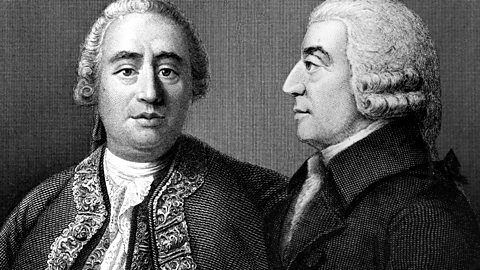
That is the title of my new paper (preprint available here via SSRN), which will be published in an upcoming issue of History of Economic Ideas, a refereed journal specializing in the history of economic thought. (This is one of the papers I was editing over the weekend.) My paper attempts to confirm the veracity of the oft-told story about Adam Smith having been reprimanded by his academic superiors at Oxford for having read one of David Hume’s early works, perhaps Hume’s Treatise of Human Nature. Among other things, a reviewer brought to my attention the fact that neither C. R. Fay’s biography Adam Smith and the Scotland of His Day nor Lord Keynes’s introduction to David Hume’s “Abstract of A Treatise of Human Nature, 1740” mention the supposed Oxford incident. Although the absence of evidence is not necessarily evidence of absence, these omissions are revealing and support my tentative verdict that “the Balliol College conspiracy” is more likely than not pure fiction.

Ingeniería Económica: Las preguntas más frecuentes: ADAM SMITH: Carta a  David Hume
Posted in Uncategorized | Leave a comment

Monday music: *Eternal Twilight*

Posted in Uncategorized | Leave a comment

Sunday song: *Places*

I haven’t been blogging too much lately because I am busy editing, line by painstaking line, two of my forthcoming papers in order to get them ready for publication: “Adam Smith, David Hume, and Balliol College Conspiracy” and part 1 of “Smith in the City of Lights“. I will post and say more about the revised and corrected versions of my scholarly papers in the next day or two; in the meantime, allow me to share some music for everyone to enjoy …

Posted in Uncategorized | Leave a comment

Postscript to Rousseau’s Second Discourse

Earlier this month, I wrote up a seven-part survey of Jean-Jacques Rousseau’s Discourse on the Origin of Inequality, which is also known as “The Second Discourse”; see links below for a complete compilation of my previous Rousseau posts. Today, however, I want to conclude my survey with a letter dated 30 August 1755, a short missive that is addressed to Rousseau himself. This piece of correspondence, which is available here (also here), was composed by none other than Voltaire — perhaps the greatest, and no doubt the most prolific (see here, for example), man of letters produced by the Enlightenment — and contains what has to be one of the greatest literary put downs of all time!

Among other things, Voltaire not only begins his 1755 letter by acknowledging that he has received a copy of Rousseau’s “new book against the human race”; he also sums up the Second Discourse thus: “The horrors of that human society–from which in our feebleness and ignorance we expect so many consolations–have never been painted in more striking colors: no one has ever been so witty as you are in trying to turn us into brutes: to read your book makes one long to go about all fours.” Touché! (Shout out to my colleague and friend Janet Bufton for bringing this remarkable letter to my attention.)

  1. Three questions for Jean-Jacques Rousseau (18 Jan.)
  2. Rousseau’s axioms (19 Jan.)
  3. Rousseau: the first post-modernist? (19 Jan.)
  4. Rousseau’s rebuttal (22 Jan.)
  5. Rousseau through the eyes of Adam Smith (23 Jan.)
  6. Rousseau through the eyes of Adam Smith redux (23 Jan.)
  7. The banality of Jean-Jacques Rousseau (24 Jan.)

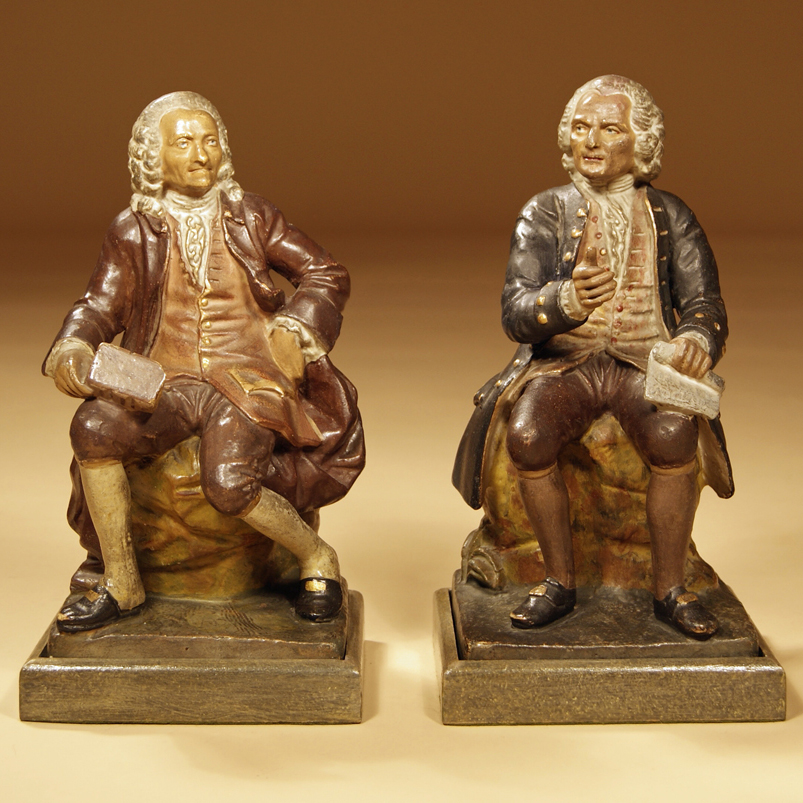
Pictured below: A pair of painted plaster figures depicting the philosophers Jean-Jacques Rousseau (1712-1778) and Voltaire (1694-1778); more details are available here.

Sculptures of Voltaire & Rousseau
Posted in Uncategorized | 2 Comments

Friday funnies: *Unlockable achievements of academia*

File under: Play stupid games, win stupid prizes. Via https://errantscience.com/

210312_-_Academic_Achievements
Posted in Uncategorized | Leave a comment

*David Hume – An Apologia*

That is the title of this new paper by Dr Peter Hutton and Professor David Ashton explaining why the great David Hume has been “unjustly vilified” by his detractors. Alas, this paper is gated, but I will request a copy or pre-print from the authors directly. In the meantime, here is a free synopsis of Dr Hutton and Prof Ashton’s argument: an excellent op-ed piece they wrote for The Herald condemning Edinburgh University’s rush to judgment against the 18th-century Scottish essayist without even a semblance of due process (hat tip: Brian Leiter).

David Hume: Balanced skepticism
Posted in Uncategorized | 2 Comments

Taxonomy of USA road signs redux

Posted in Uncategorized | Leave a comment

Railroad workers > moral philosophers

I once proposed this creative solution to the famous Trolley Problem thought-experiment in moral philosophy: an auction conducted from behind a Rawlsian veil of ignorance. The technical but simple solution pictured below, however, is pure genius!

Posted in Uncategorized | 5 Comments

The banality of Jean-Jacques Rousseau

Note: this is the last part (part 7, if you are keeping count!) of my review of Rousseau’s Discourse on the Origin of Inequality

Rousseau concludes his Discourse on the Origin of Inequality (a/k/a “The Second Discourse”) with an appendix consisting of 14 beautifully-written and memorable paragraphs. In summary, Rousseau’s appendix restates the following themes from the main body of his Second Discourse proper:

  1. Rousseau’s $64 question and his zero-sum picture of society: First off, after comparing and contrasting modern man, i.e. man in the state of civilized society, who has become “wretched” and “wicked” (see Para. 1 & Para. 2 of the Appendix), with savage man, i.e. man in the state of nature, who was originally “naturally good” (Para. 2), Rousseau promptly poses the $64 question: how did man fall from his state of natural grace, so to speak? For his part, the Swiss author answers this key question by painting a zero-sum picture of “society”, or in the immortal words of Rousseau himself: “Thus it is that we find our advantage in the misfortunes of our fellow-creatures, and that the loss of one man almost always constitutes the prosperity of another” (Para. 2).
  2. Luxury: the greatest of all evils. Among the many evils of civilized society in Rousseau’s fevered mind, he especially singles out the problem of luxury goods. For Rousseau, the pursuit of luxury is not only “a remedy much worse than the disease it sets up to cure” (Para. 10); it is also “the greatest of all evils” (ibid.). Why? Because luxury goods “bring[] oppression and ruin on the citizen and the labourer; it is like those scorching winds, which, covering the trees and plants with devouring insects, deprive useful animals of their subsistence and spread famine and death wherever they blow” (ibid.). Okie, dokie …

  3. What is to be done? Rousseau concludes the appendix by asking another key question, perhaps the most important and poignant one of all: “What is to be done?” (Para. 14). That is, given man’s fall from secular grace (see item #1 above), how can we remedy our dire moral predicament? Alas, Rousseau’s reply is beyond banal or cliché. Although he concedes that we cannot go back to the state of nature, he utterly and totally fails to provide any practical method of actually remedying the evils of modern society:

As for men like me …, who can no longer subsist on plants or acorns, or live without laws and magistrates …., [we] will respect the sacred bonds of [our] respective communities; [we] will love [our] fellow-citizens, and serve them with all their might; we will scrupulously obey the laws, and all those who make or administer them; [we] will particularly honour those wise and good princes, who find means of preventing, curing or even palliating all these evils and abuses, by which we are constantly threatened; [we] will animate the zeal of their deserving rulers, by showing them, without flattery or fear, the importance of their office and the severity of their duty (Para. 14).

In other words, grin and bear it! Yeah, Rousseau might talk a good game, but at the end of his celebrated Second Discourse all we are left with is nothing but glittering generalities and banal clichés. Merci pour rien, Jean-Jacques

Many men talk a good game. Few deliver" Poster for Sale by PGPshop |  Redbubble
Posted in Uncategorized | Tagged , , | 3 Comments

Wikipedia Wednesday: Texas secession movements

See here: https://en.m.wikipedia.org/wiki/Texas_secession_movements

Bonus link: Can Texas secede from the United States?

Bonus “Texit” meme, via DeviantArt:

Texit meme by Drogin1 on DeviantArt
Posted in Uncategorized | 1 Comment