
I pre-ordered this little book many months ago (hat tip: Tyler Cowen), and my copy has just arrived. Suffice it to say, I will report back soon.
Creative Commons
Blogs I Follow






I pre-ordered this little book many months ago (hat tip: Tyler Cowen), and my copy has just arrived. Suffice it to say, I will report back soon.
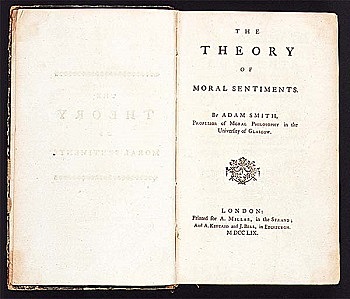
The great Adam Smith identifies three types of civil society in his first magnum opus The Theory of Moral Sentiments:
Below is the full passage from Smith’s Theory of Moral Sentiments, Book 2, Section 2, Chapter 3, Paragraphs 1-3:
“All the members of human society stand in need of each others assistance, and are likewise exposed to mutual injuries. Where the necessary assistance is reciprocally afforded from love, from gratitude, from friendship, and esteem, the society flourishes and is happy. All the different members of it are bound together by the agreeable bands of love and affection, and are, as it were, drawn to one common centre of mutual good offices.
“But though the necessary assistance should not be afforded from such generous and disinterested motives, though among the different members of the society there should be no mutual love and affection, the society, though less happy and agreeable, will not necessarily be dissolved. Society may subsist among different men, as among different merchants, from a sense of its utility, without any mutual love or affection; and though no man in it should owe any obligation, or be bound in gratitude to any other, it may still be upheld by a mercenary exchange of good offices according to an agreed valuation.
“Society, however, cannot subsist among those who are at all times ready to hurt and injure one another. The moment that injury begins, the moment that mutual resentment and animosity take place, all the bands of it are broke asunder, and the different members of which it consisted are, as it were, dissipated and scattered abroad by the violence and opposition of their discordant affections. If there is any society among robbers and murderers, they must at least, according to the trite observation, abstain from robbing and murdering one another. Beneficence, therefore, is less essential to the existence of society than justice. Society may subsist, though not in the most comfortable state, without beneficence; but the prevalence of injustice must utterly destroy it.”
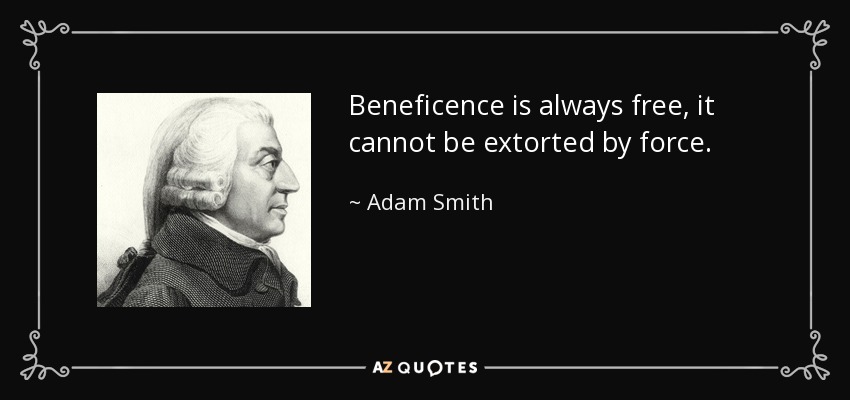
“To be deprived of that which we are possessed of, is a greater evil than to be disappointed of what we have only the expectation. Breach of property, therefore, theft and robbery, which take from us what we are possessed of, are greater crimes than breach of contract, which only disappoints us of what we expected. The most sacred laws of justice, therefore, those whose violation seems to call loudest for vengeance and punishment, are the laws which guard the life and person of our neighbour; the next are those which guard his property and possessions; and last of all come those which guard what are called his personal rights, or what is due to him from the promises of others.”
–Adam Smith, The Theory of Moral Sentiments, Book 2, Sec. 2, Ch. 2, Para. 3
That is the title of my new paper (preprint available here via SSRN), which will be published in an upcoming issue of History of Economic Ideas, a refereed journal specializing in the history of economic thought. (This is one of the papers I was editing over the weekend.) My paper attempts to confirm the veracity of the oft-told story about Adam Smith having been reprimanded by his academic superiors at Oxford for having read one of David Hume’s early works, perhaps Hume’s Treatise of Human Nature. Among other things, a reviewer brought to my attention the fact that neither C. R. Fay’s biography Adam Smith and the Scotland of His Day nor Lord Keynes’s introduction to David Hume’s “Abstract of A Treatise of Human Nature, 1740” mention the supposed Oxford incident. Although the absence of evidence is not necessarily evidence of absence, these omissions are revealing and support my tentative verdict that “the Balliol College conspiracy” is more likely than not pure fiction.
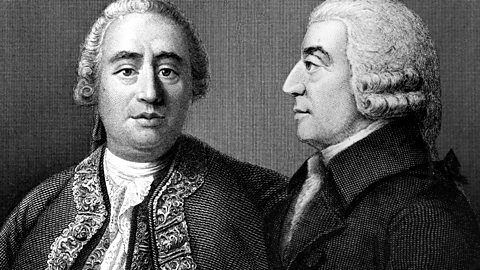
I haven’t been blogging too much lately because I am busy editing, line by painstaking line, two of my forthcoming papers in order to get them ready for publication: “Adam Smith, David Hume, and Balliol College Conspiracy” and part 1 of “Smith in the City of Lights“. I will post and say more about the revised and corrected versions of my scholarly papers in the next day or two; in the meantime, allow me to share some music for everyone to enjoy …
Earlier this month, I wrote up a seven-part survey of Jean-Jacques Rousseau’s Discourse on the Origin of Inequality, which is also known as “The Second Discourse”; see links below for a complete compilation of my previous Rousseau posts. Today, however, I want to conclude my survey with a letter dated 30 August 1755, a short missive that is addressed to Rousseau himself. This piece of correspondence, which is available here (also here), was composed by none other than Voltaire — perhaps the greatest, and no doubt the most prolific (see here, for example), man of letters produced by the Enlightenment — and contains what has to be one of the greatest literary put downs of all time!
Among other things, Voltaire not only begins his 1755 letter by acknowledging that he has received a copy of Rousseau’s “new book against the human race”; he also sums up the Second Discourse thus: “The horrors of that human society–from which in our feebleness and ignorance we expect so many consolations–have never been painted in more striking colors: no one has ever been so witty as you are in trying to turn us into brutes: to read your book makes one long to go about all fours.” Touché! (Shout out to my colleague and friend Janet Bufton for bringing this remarkable letter to my attention.)
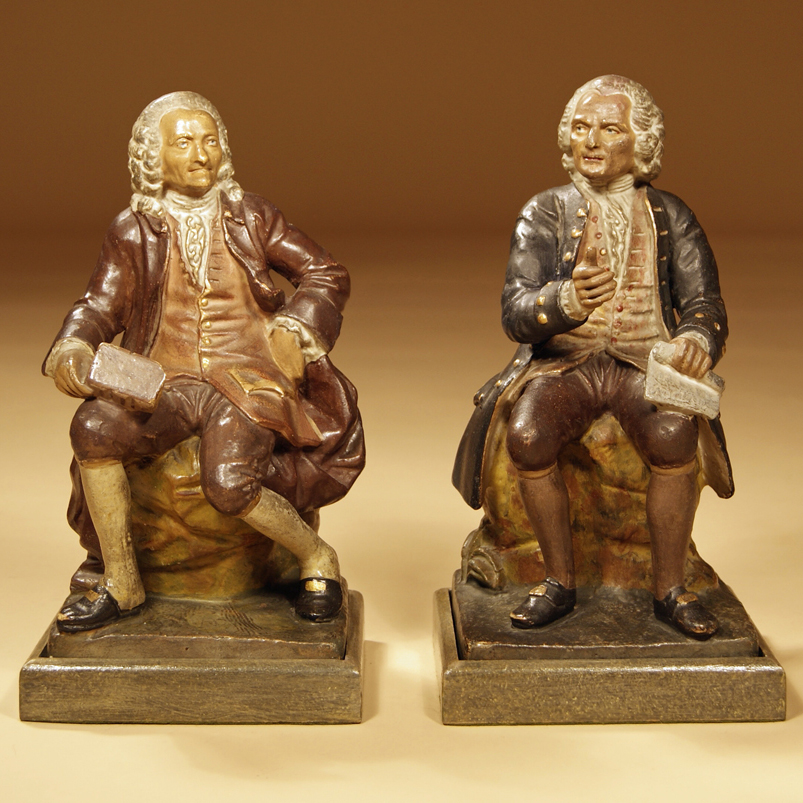
Pictured below: A pair of painted plaster figures depicting the philosophers Jean-Jacques Rousseau (1712-1778) and Voltaire (1694-1778); more details are available here.
File under: Play stupid games, win stupid prizes. Via https://errantscience.com/

That is the title of this new paper by Dr Peter Hutton and Professor David Ashton explaining why the great David Hume has been “unjustly vilified” by his detractors. Alas, this paper is gated, but I will request a copy or pre-print from the authors directly. In the meantime, here is a free synopsis of Dr Hutton and Prof Ashton’s argument: an excellent op-ed piece they wrote for The Herald condemning Edinburgh University’s rush to judgment against the 18th-century Scottish essayist without even a semblance of due process (hat tip: Brian Leiter).


Welcome to the online home of the IASS
Hopefully It’s Interesting.
In Conversation with Legal and Moral Philosophers
Relitigating Our Favorite Disputes
PhD, Jagiellonian University
Inquiry and opinion
Life is all about being curious, asking questions, and discovering your passion. And it can be fun!
Books, papers, and other jurisprudential things
Ramblings of a retiree in France
BY GRACE THROUGH FAITH
Natalia's space
hoping we know we're living the dream
Lover of math. Bad at drawing.
We hike, bike, and discover Central Florida and beyond
Making it big in business after age 40
Reasoning about reasoning, mathematically.
I don't mean to sound critical, but I am; so that's how it comes across
remember the good old days...
"Let me live, love and say it well in good sentences." - Sylvia Plath
a personal view of the theory of computation
Submitted For Your Perusal is a weblog wherein Matt Thomas shares and writes about things he thinks are interesting.
Logic at Columbia University
Just like the Thesis Whisperer - but with more money
the sky is no longer the limit
Technology, Culture, and Ethics
Just like the horse whisperer - but with more pages
Poetry, Other Words, and Cats

 prior probability