My previous post surveyed this powerful critique of information markets made by Nick Whitaker and J. Zachary Mazlish. Among other things, Whitaker and Mazlish identify three types of investors — savers, gamblers, and sharps — and explain why existing information markets do not appeal to these investors. To recap, three problems with information markets stand out: (1) they are zero-sum (“every winner … necessitates an equal and opposite loser”), which scares away savers; (2) their time horizons are often way too long, for it can take months or even years for some prediction markets to resolve, which repels gamblers who like fast action, i.e. bets that resolve quickly; and (3) they lack liquidity and thus do not attract sharps. (Or to put this third problem another way, without a critical mass of savers and gamblers, it is not worthwhile for most sharps to trade.)
So, what is to be done?
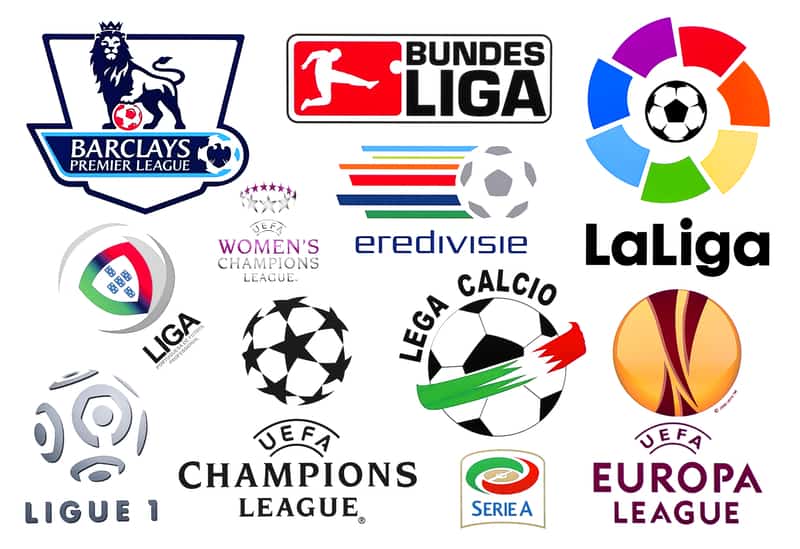
Allow me to introduce you to my secret weapon, my colleague and friend Steve Kuhn. Building on my previous work on “retrodiction markets” (see here, for example), Kuhn has developed an elegant and ingenious solution to the problems identified by Whitaker and Mazlish, an idea he first shared with me on May 16 of this year: a “World Truth League” modelled after professional sports associations, such as the Bundesliga in Germany or the Serie A league in Italy or the Premier League in England. (See, for example, the European football league logos pictured above.) But instead of competing to score the most goals, teams in Kuhn’s truth league would compete over the accuracy of their predictions and retrodictions. By combining the excitement, competition, and camaraderie of sports with the unbeatable information-discovery benefits of markets, a World Truth League would overcome the limitations that hamper existing information markets.
Ideally, our proposed truth league would feature a roster of well-known and respected forecasting and hindcasting teams composed of individuals or groups. These teams could consist of well-known pundits or famous talking heads like New York Times opinion columnists David Brooks, Frank Bruni, Ross Douthat, Maureen Dowd, Thomas L. Friedman, Ezra Klein, and Paul Krugman, just to name a few, as well as influential bloggers with many loyal followers like Scott Alexander, Bryan Caplan, Tyler Cowen, Robin Hanson, Nate Silver, and Alex Tabarrok. The possibilities are endless. (As an aside, teams composed of lesser-known bloggers and pundits could play in a relegation league.)
Better yet would be actual “teams”, i.e. groups of individuals who share the same institutional affiliation. By way of example, imagine how cool it would be if, say, wonky Microsoft Research, the classical liberal Mercatus Center, or the progressive editorial board of the New York Times were to field their own teams.
In addition, the World Truth League could also feature artificial intelligence/large language model-inspired teams fielded by popular “AI” or “LLM” programs, including the current crop of top AI models (the best of the best, so to speak), such as Anthropic’s Claude 3.5 Sonnet, the latest iteration of Google’s Gemini, Meta’s Llama 2, and OpenAI’s GPT-4o, as well as lesser-known or experimental ones like Falcon 2 and VimGPT. (Look them up!)
Simply put, a league format in which well-known and highly-regarded individuals, institutions, and A.I. models compete against each other in real time would attract a lot of public interest and free publicity. By their very nature, sports–and games more generally–combine excitement, competition, and camaraderie. (See, for example, this 2014 essay in the Columbia Journalism Review. See also Johan Huizinga’s classic study Homo Ludens: A Study of the Play-Element in Culture.) Their zero-sum nature is thus a feature, not a bug, or as Whitaker and Mazlish themselves observe, sports betting is popular because of the communal nature of sporting events and their inherent unpredictability:
Beyond their exciting unpredictability and quick conclusions, sports matches are communal events of general interest. People are already fans of sports teams, even before the betting starts, and the predictable pace of seasons creates an ongoing community.
But these observations pose many additional nuts-and-bolts questions. How many rounds would the teams play, and how would we score each round? Would there be playoffs or a championship? And, most importantly, how would the accuracy of each team’s forecasts or predictions–as well as their “hindcasts” or “retrodictions”–be measured? Steve and I and a few others have been working on these logistical questions for many weeks, and I will report our preliminary results in my next post.
Note: This post was revised and updated on July 1st.