*David Hume – An Apologia*

That is the title of this new paper by Dr Peter Hutton and Professor David Ashton explaining why the great David Hume has been “unjustly vilified” by his detractors. Alas, this paper is gated, but I will request a copy or pre-print from the authors directly. In the meantime, here is a free synopsis of Dr Hutton and Prof Ashton’s argument: an excellent op-ed piece they wrote for The Herald condemning Edinburgh University’s rush to judgment against the 18th-century Scottish essayist without even a semblance of due process (hat tip: Brian Leiter).

David Hume: Balanced skepticism
Posted in Uncategorized | 2 Comments

Taxonomy of USA road signs redux

Posted in Uncategorized | Leave a comment

Railroad workers > moral philosophers

I once proposed this creative solution to the famous Trolley Problem thought-experiment in moral philosophy: an auction conducted from behind a Rawlsian veil of ignorance. The technical but simple solution pictured below, however, is pure genius!

Posted in Uncategorized | 5 Comments

The banality of Jean-Jacques Rousseau

Note: this is the last part (part 7, if you are keeping count!) of my review of Rousseau’s Discourse on the Origin of Inequality

Rousseau concludes his Discourse on the Origin of Inequality (a/k/a “The Second Discourse”) with an appendix consisting of 14 beautifully-written and memorable paragraphs. In summary, Rousseau’s appendix restates the following themes from the main body of his Second Discourse proper:

  1. Rousseau’s $64 question and his zero-sum picture of society: First off, after comparing and contrasting modern man, i.e. man in the state of civilized society, who has become “wretched” and “wicked” (see Para. 1 & Para. 2 of the Appendix), with savage man, i.e. man in the state of nature, who was originally “naturally good” (Para. 2), Rousseau promptly poses the $64 question: how did man fall from his state of natural grace, so to speak? For his part, the Swiss author answers this key question by painting a zero-sum picture of “society”, or in the immortal words of Rousseau himself: “Thus it is that we find our advantage in the misfortunes of our fellow-creatures, and that the loss of one man almost always constitutes the prosperity of another” (Para. 2).
  2. Luxury: the greatest of all evils. Among the many evils of civilized society in Rousseau’s fevered mind, he especially singles out the problem of luxury goods. For Rousseau, the pursuit of luxury is not only “a remedy much worse than the disease it sets up to cure” (Para. 10); it is also “the greatest of all evils” (ibid.). Why? Because luxury goods “bring[] oppression and ruin on the citizen and the labourer; it is like those scorching winds, which, covering the trees and plants with devouring insects, deprive useful animals of their subsistence and spread famine and death wherever they blow” (ibid.). Okie, dokie …
  3. What is to be done? Rousseau concludes the appendix by asking another key question, perhaps the most important and poignant one of all: “What is to be done?” (Para. 14). That is, given man’s fall from secular grace (see item #1 above), how can we remedy our dire moral predicament? Alas, Rousseau’s reply is beyond banal or cliché. Although he concedes that we cannot go back to the state of nature, he utterly and totally fails to provide any practical method of actually remedying the evils of modern society:

As for men like me …, who can no longer subsist on plants or acorns, or live without laws and magistrates …., [we] will respect the sacred bonds of [our] respective communities; [we] will love [our] fellow-citizens, and serve them with all their might; we will scrupulously obey the laws, and all those who make or administer them; [we] will particularly honour those wise and good princes, who find means of preventing, curing or even palliating all these evils and abuses, by which we are constantly threatened; [we] will animate the zeal of their deserving rulers, by showing them, without flattery or fear, the importance of their office and the severity of their duty (Para. 14).

In other words, grin and bear it! Yeah, Rousseau might talk a good game, but at the end of his celebrated Second Discourse all we are left with is nothing but glittering generalities and banal clichés. Merci pour rien, Jean-Jacques

Many men talk a good game. Few deliver" Poster for Sale by PGPshop |  Redbubble
Posted in Uncategorized | Tagged , , | 3 Comments

Wikipedia Wednesday: Texas secession movements

See here: https://en.m.wikipedia.org/wiki/Texas_secession_movements

Bonus link: Can Texas secede from the United States?

Bonus “Texit” meme, via DeviantArt:

Texit meme by Drogin1 on DeviantArt
Posted in Uncategorized | 1 Comment

Rousseau through the eyes of Adam Smith redux

Note: this is part 6 of my review of Rousseau’s Discourse on the Origin of Inequality (1754)

In my previous post (“Rousseau through the eyes of Adam Smith“), I mentioned how Adam Smith’s 1756 Letter-Essay to the Edinburgh Review singles out several important sections from the second part of Rousseau’s Discourse on Inequality — specifically, the passages corresponding to paragraphs #21, #30, #31, and #63 of the G. D. H. Cole translation, to be more exact — and I included Smith’s own translations of these three pivotal passages (see here) for good measure. Here, I will conjecture why Smith chose to include those three passages in particular in his 1756 Letter.

First off, Excerpt #1 (Paragraph #21) pinpoints the exact moment in time when “equality [among men] disappeared”. According to Smith’s translation of Rousseau, inequality emerged as soon as men in the state of nature began to cooperate with each other: “from the instant in which one man had occasion for the assistance of another, from the moment that he perceived that it could be advantageous to a single person to have provisions for two, equality disappeared, property was introduced, labour became necessary, and the vast forests of nature were changed into agreeable plains …” (Smith 1756, Para. 13).

For its part, Excerpt #2 (Paragraphs #30 & #31) not only paints a zero-sum picture of trade and commercial society (Rousseau condemns man’s “concealed desire of making profit at the expense of some other person”); this passage also purports to show a direct connection or deep link between commercial society and moral corruption. How do markets morally corrupt men? According to Rousseau, society, markets, and cooperation corrupt men in two ways. To begin with, when men are engaged in trade, each man is constantly comparing his lot in life to that of his fellow men, and furthermore, each man’s “insatiable ambition” and “secret jealousy” will cause him to lie, cheat, and steal in order to outshine his peers: “an insatiable ambition, an ardor to raise his relative fortune, not so much from real necessity, [but from a desire] to set himself above others, inspire all men with a direful propensity to hurt one another; with a secret jealousy, so much the more dangerous, as to strike its blow more surely, it often assumes the mask of good will …” (Smith 1756, Para. 14).

Lastly, Excerpt #3 (Paragraph #63) compares and contrasts man in the state of nature with modern man, man in the state of civilized society: “The savage breathes nothing but liberty and repose; he desires only to live and be at leisure …. The citizen [civilised man], on the contrary, toils, bestirs and torments himself without end, to obtain employments which are still more laborious: he labours on till his death [and] even hastens it …” (Smith 1756, Para. 15).

So, what did Adam Smith make of these passages? We know that Smith found Rousseau’s work to be highly original — see Paragraph 10 of his 1756 Letter-Essay to the Edinburgh Review — but at the same time, Smith appears to be dismissive of the substance of Rousseau’s Second Discourse. Toward the end of Paragraph 12 of his 1756 Letter-Essay, for example, Smith writes (emphasis added):

[Rousseau’s] work is divided into two parts: in the first, he describes the solitary state of mankind; in the second, the first beginnings and gradual progress of society. It would be to no purpose to give an analysis of either; for none could give any just idea of a work which consists almost entirely of rhetoric and description.

Although Smith says that “it would be to no purpose to give an analysis” (see the full quotation above) of Rousseau’s Second Discourse, one of the ironies of Smith’s 1756 Letter-Essay is that he (Smith) does just that in Paragraphs 11 and 12 of his letter. Among other things, Smith points out two problems with Rousseau’s work. One is Rousseau’s incomplete picture of man in the state of nature, or in Smith’s own words, “Mr. Rousseau, intending to paint the savage life as the happiest of any, presents only the indolent side of it to view, which he exhibits indeed with the most beautiful and agreeable colours, in a style, which, tho’ laboured and studiously elegant, is every where sufficiently nervous, and sometimes even sublime and pathetic” (Smith 1756, Para. 12).

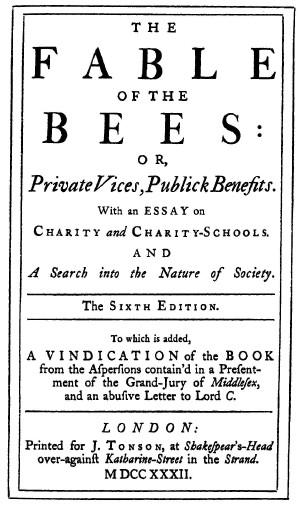
The bigger problem for Smith, however, appears to be Rousseau’s take on Bernard Mandeville, the scandalous author of The Fable of The Bees: or, Private Vices, Publick Benefits (see here), who famously claimed that “private vices” like self-interest produce great “publick benefits” such as wealth and prosperity. Although Smith commends Rousseau for “soften[ing], improv[ing], and … strip[ping] [Mandeville’s fable] of all that tendency to corruption and licentiousness which has disgraced them in their original author” (Smith 1756, Para. 11), at the same time Smith criticizes Rousseau for taking man’s innate sense of “compassion” or “pity” — which, according to Smith’s reading of Mandeville, is “the only amiable principle [that Mandeville] allows to be natural to man — “a little too far”: “It is by the help of [Rousseau’s rhetorical] style, together with a little philosophical chemistry, that the principles and ideas of the profligate Mandeville seem in [Rousseau] to have all the purity and sublimity of the morals of Plato, and to be only the true spirit of a republican carried a little too far” (Para. 12).

To conclude, although Adam Smith admires Rousseau’s originality and rhetoric, Smith disagrees with the substance of Rousseau’s argument. As it happens, Smith has much more to say about Mandeville and Rousseau in his first book, The Theory of Moral Sentiments, which was first published in 1759. (See here, for example.) To what extent should Smith’s Theory of Moral Sentiments — and The Wealth of Nations, for that matter — be read as a direct reply to the works of Rousseau and Mandeville? That is a question I will consider in a future post …

The Fable of the Bees or Private Vices, Publick Benefits, Vol. 1 | Online  Library of Liberty
Posted in Uncategorized | Tagged , , , | 1 Comment

Rousseau through the eyes of Adam Smith

Note: this is part 5 of my review of Rousseau’s Discourse on the Origin of Inequality (1754)

Thus far, we have surveyed the first of two parts of Rousseau’s Discourse on Inequality (a/k/a “the Second Discourse”), where Rousseau paints a rosy picture of the state of nature (see here and here), as well as his preface to the Second Discourse (here) and his “Dedication to the Republic of Geneva” (here), so let’s now jump into the second and last part of this great work, where Rousseau explores the origins of human inequality.

As it happens, when Adam Smith wrote his March 1756 letter to the Edinburgh Review (see here), he not only devoted a large chunk of his letter-essay to Rousseau’s Second Discourse — no less than six out of 17 paragraphs in the 1756 letter are addressed to Rousseau Smith also singled out several sections from the second part of this work. Specifically, Smith translated three lengthy passages corresponding to paragraphs #21, #30, #31, and #63 in the G. D. H. Cole translation of the second part of Rousseau’s essay!

I therefore propose we follow the Scottish philosopher’s footsteps by revisiting those same three pivotal passages, so to this end, I am including below the fold Adam Smith’s own translations of these three sizeable excerpts, followed by the standard G. D. H. Cole translations of the same:

Continue reading
Posted in Uncategorized | 2 Comments

Rousseau’s rebuttal

Note: this is part 4 of my review of Rousseau’s Discourse on the Origin of Inequality (1754)

Today, I will survey the first part of Rousseau’s Discourse on the Origin of Inequality (a/k/a “the Second Discourse”), which by my count contains 50 paragraphs. Among other things, the first part of Rousseau’s Second Discourse contains a lengthy but fascinating digression on the origins of language, attempts to rebut the Hobbesian picture of life in the state of nature (recall that, according to Hobbes, life outside of society is “solitary, poor, nasty, brutish, and short“), and then concludes with one of the most memorable literary pictures of all time: Rousseau’s rosy portrait of the noble savage.

For my part, I will skip over Rousseau’s lengthy digression on the origins of language — except to note that these passages may have been of great interest to someone like Adam Smith, who began his scholarly career by delivering a series of lectures on “rhetoric and belles lettres”; see here, for example: “Adam Smith’s first lectures after his university studies (at Glasgow and then Oxford) were on rhetoric and belles lettres (polite learning)” — and proceed directly to Rousseau’s rebuttal of Hobbes, which by my count appears in Paragraph 34 of the first part of the Discourse. This rebuttal is so spellbinding, if not mesmerizing, that I shall requote it in full below the fold:

Continue reading
Posted in Uncategorized | 3 Comments

Sunday song: *Comfortable*

Posted in Uncategorized | 1 Comment

Star Trek maps (circa 1980)

More details are available here, via Wikipedia.

Posted in Uncategorized | Leave a comment