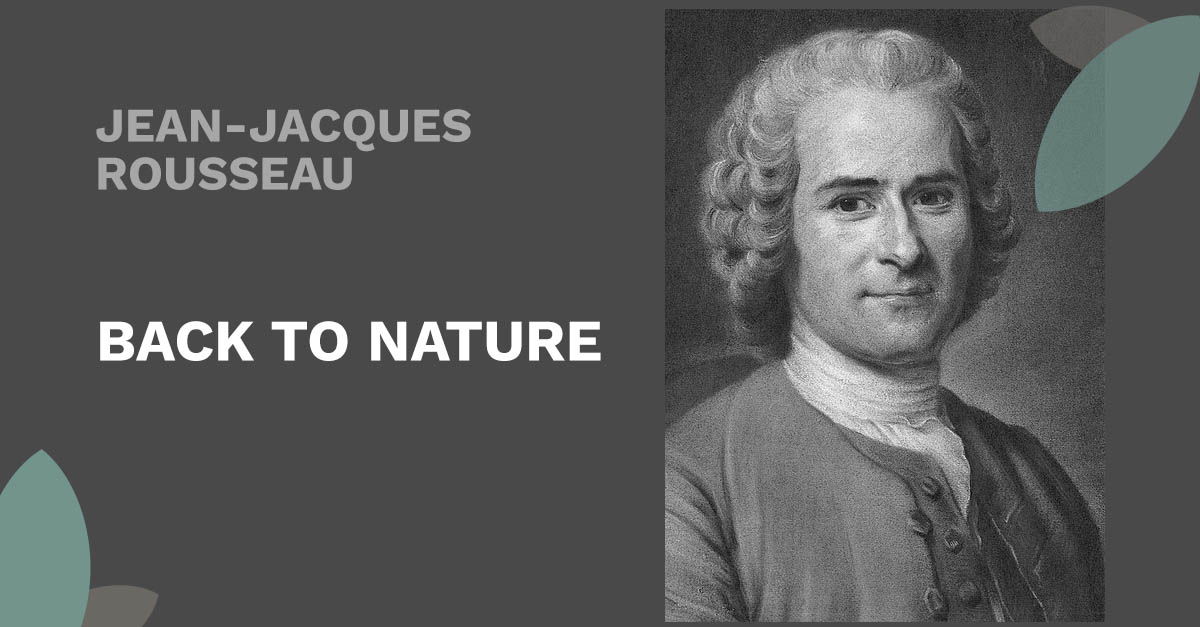
Rousseau: the first post-modernist?

Note: this is part 3 of my review of Rousseau’s Discourse on the Origin of Inequality (1754)

Thus far, we have surveyed Rousseau’s “Dedication to the Republic of Geneva” as well as the preface to his Discourse on Inequality, so we are now ready to jump into the main body of the Discourse proper, which is subtitled “A Dissertation on the Origin and Foundation of the Inequality of Mankind”. In summary, Rousseau’s Dissertation begins with a few opening paragraphs (seven in all). Here, in this short amount of space, Rousseau accomplishes two major tasks: he tells us why he is writing this work, and he describes his method of reasoning.

  1. Motivation: Rousseau reveals what is motivating his work in the fourth paragraph of this opening section: “To mark, in the progress of things, the moment at which right took the place of violence and nature became subject to law, and to explain by what sequence of miracles the strong came to submit to serve the weak, and the people to purchase imaginary repose at the expense of real felicity” (Para. 4). In plain words, Rousseau is going to explain the emergence of modern commercial society.
  2. Method: Rousseau is not only going to explain the emergence of modern commercial society; he is going to start his analysis with something called “the state of nature” — a mythical time when men (and women?) were free. According to Rousseau, previous writers who have invoked “the state of nature” have committed a major fallacy: they have “transferred to the state of nature ideas which were acquired in society; so that, in speaking of the savage, they described the social man” (Para. 5). How will Rousseau himself escape this error?

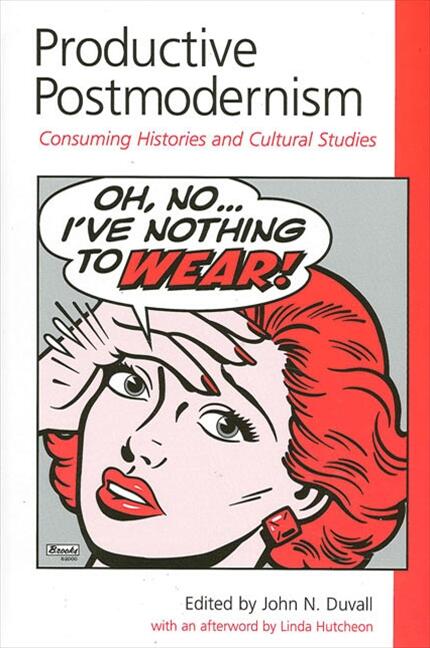
Rousseau concludes this opening part of the Dissertation with a startling admission: he will not waste his time with historical facts: “Let us begin then by laying facts aside …. The investigations we may enter into … must not be considered as historical truths, but only as mere conditional and hypothetical reasonings, rather calculated to explain the nature of things, than to ascertain their actual origin; just like the hypotheses which our physicists daily form respecting the formation of the world” (Para. 6). Wait! Is Rousseau trying to say that history is “social constructed”? Is Rousseau thus the first post-modernist? Either way, Rousseau’s analogy to science is inapt, since science consists of “falsifiable” claims and propositions, i.e. ideas that can actually be tested.

I will be attending a research seminar at the University of Florida this weekend, so I will resume my review of Rousseau on Monday, Jan. 22.
Posted in Uncategorized | Tagged , , , | 2 Comments

Rousseau’s axioms

Note: below is part 2 of my review of Rousseau’s Discourse on the Origin of Inequality (1754)

The preface to Rousseau’s Discourse on Inequality consists of only 15 paragraphs, but it was music to my law professor ears, for it not only contains an original discussion of “the law of nature”; the preface also reveals what motivated Rousseau to write the Second Discourse in the first place: to discover “the real foundations of human society” and the true “nature of man” (Para. 7). According to Rousseau: “… [although] all human institutions seem at first glance to be founded merely on the banks of shifting sand [,] … only by taking a closer look, and removing the dust and sand that surround the edifice, [are we able to] perceive the immovable basis on which it is raised, and learn to respect its foundations” (Para. 14). So, what are these foundations?

For Rousseau, these foundation are the precepts of natural law! But this observation begs the deeper question, how do we discover these supposedly eternal and unchanging precepts, or “principles prior to reason” (Para. 11)? Here is where Rousseau’s discussion of natural law takes an especially refreshing and totally novel and unexpected turn, for Rousseau concedes that no one really knows for sure! Or in the immortal words of the Swiss recluse himself: “We cannot see without surprise and disgust how little agreement there is between the different authors who have treated this great subject” (Para. 9). In fact, “the definitions [of natural law] of these learned men, all differing in everything else, agree only in this, that is impossible to comprehend the law of nature …” (Ibid.).

Undaunted, Rousseau makes a further contribution to the natural law literature by presenting his own definition of the true law of nature! In summary, Rousseau reduces natural law to two basic precepts: one is the law of self-preservation (“one of [these natural law principles] deeply interest[s] us in our own welfare and preservation”); the other is what I will call, for lack of a better term, the law of pity, i.e. our genuine concern for the welfare of others (“the other [principle] excit[es] a natural repugnance at seeing any other sensible being … suffer pain and death”). (Note: all the quotes cited here are from Para. 11 of the preface.) For Rousseau, these two precepts or principles play the same role in law and politics that axioms do in mathematics, for it is from “these two principles … that all the [remaining] rules of natural right appear … to be derived.”

To conclude, why is Rousseau’s approach to the law of nature so original and novel? Because Rousseau totally eschews the idea of the “common good” as part of his definition of natural law! This omission is a feature — not a bug — because trying to figure out what the “common good” is a fool’s errand, especially in a pluralist society like ours. (Paging Thomas Aquinas!) My next post will make two preliminary points about what Rousseau refers to as “the state of nature” (Saturday, Jan. 20), and I will then proceed to the First Part of Rousseau’s Discourse proper on Monday, Jan. 22.

Image credit: Prachaya (Adobe Stock)
Posted in Uncategorized | 2 Comments

Three questions for Jean-Jacques Rousseau

Note: this is part 1 of my review of Rousseau’s Discourse on the Origin of Inequality (1754)

Rousseau’s Discourse begins with a “Dedication to the Republic of Geneva” signed by none other than “J. J. Rousseau” himself and dated 12 June 1754 (and postmarked, so to speak, from Chambéry, a small Alpine town in southeast France). Rousseau’s dedication to his hometown is relatively brief and obsequious, consisting of only 23 paragraphs — with just about every single one of them heaping almost unbridled adulation on his fellow Genevans — so much so that one is left wondering what the true level of Rousseau’s sincerity is! Despite its brevity and fawning nature, Rousseau’s dedication is worth reading on its own merits because the Swiss author introduces two important puzzles or topics in this part of the Discourse:

  1. The problem of constitutional design: what is the optimal level of democracy, and what is the optimal political unit, a small city-state or a large nation-state?
  2. The problem of luxury markets: what is the relation between the pursuit of luxury and male virtue (and, I might add, between luxury and female chastity)?

For starters, Rousseau’s ideal political constitution consists of a small city-state in which “all the individuals [are] well known to one another” (Para. 2) and in which strict procedural limits are placed on democracy. By way of example, although Rousseau prefers a small city-state in which “the right of legislation [is] vested in all the citizens” (Para. 8), at the same time he would limit this law-making power, allowing only the magistrates to propose new legislation: “each man should not be at liberty to propose new laws at pleasure; [instead] this right should belong exclusively to the magistrates” (Para. 9). As such, my first question for Rousseau is this: who are these magistrates? Are they judges? The chief executive? Or someone else entirely? Also, how are they appointed, and why should we trust them?

The other important topic introduced in the dedication is the problem of luxury. Rousseau not only rails against the “vanities of luxury” (Para. 20); he specifically decries “the grandeur of palaces, the beauty of equipages, sumptuous furniture, the pomp of public entertainments, and all the refinements of luxury and effeminacy” (Para. 22). In addition, he praises his fellow Genevans for their self-reliance: “You are neither so wealthy to be enervated by effeminacy … nor poor enough to require more assistance from abroad than your own industry is sufficient to procure you” (Para. 13). For Rousseau, simply put, there is an inverse relation between luxury and virtue. But this observation begs the question: how exactly does the pursuit of luxury make men more effeminate and women less chaste? That is my second question for the Swiss author.

I will now conclude this post with one last question for Rousseau: dude, why are you so damn paranoid?! Specifically, why do you adopt such a sinister tone towards the end, where you write, “Beware particularly, as the last piece of advice I shall give you, of sinister constructions and venemous rumours, the secret motives of which are often more dangerous that the actions at which they are levelled” (Para. 15). What in the hell is Rousseau talking about here, and why does his warning sound so ominous?!

A Plan of the City of Geneva: (1800) Map | Antiquariaat Dat Narrenschip
Posted in Uncategorized | Tagged , , , , | 2 Comments

Outline and schedule of my upcoming review of Rousseau’s Second Discourse

What is liberty? What is the relation between liberty, luxury, and “commercial society” more generally? And in what ways does commerce and the pursuit of luxury promote or hinder liberty? Among other things, I recently read Jean-Jacques Rousseau’s Discourse on the Origin of Inequality (1754) to prepare for an Adam Smith reading group led by Edward J. Harpham, Professor Emeritus of Political Science at the University of Texas (Dallas campus), to discuss these fundamental questions of political and moral philosophy with Professor Harpham and a small circle of fellow scholars. It suffices to say that I found this work to be one of the most compelling pieces of literature I have ever read. I will therefore be reviewing G. D. H. Cole’s translation of Rousseau’s Discourse, available here, in the days ahead as follows:

  1. Dedication to the Republic of Geneva (pp. 1-7) — Thursday, Jan. 18
  2. Preface (pp. 7-10) — Friday, Jan. 19
  3. Opening paragraphs of “A Dissertation on the Origin and Foundation of the Inequality of Mankind” (pp. 11-12) — Friday, Jan. 19
  4. The First Part (pp. 12-29) — Monday, Jan. 22
  5. The Second Part (pp. 29-47) — Tuesday, Jan. 23
  6. The Appendix (pp. 47-51) — Wednesday, Jan. 24
Jean-Jacques Rousseau · Back to Nature · Education · Pedagogy
Posted in Uncategorized | Leave a comment

Wikipedia Wednesday: phantom time conspiracy theory

Did Charlemagne, King of the Franks, really exist? You tell me! Here is a link to the craziest conspiracy theory that you’ve probably never even heard of: https://en.wikipedia.org/wiki/Phantom_time_conspiracy_theory

100+ Charlemagne Drawing Stock Illustrations, Royalty-Free Vector Graphics  & Clip Art - iStock
Posted in Uncategorized | 2 Comments

*Adam Smith in Love* update

My first refereed Adam Smith paper — “Adam Smith in Love“, Econ Journal Watch, Vol. 18, No. 1 (2021), pp. 127-155 — has now been downloaded (and presumably read) over 2500 times! Below is some music from Barry White to commemorate this milestone:

Posted in Uncategorized | 5 Comments

Review of Adam Smith’s 1756 letter-essay

Although Adam Smith’s 1756 “Letter to the Authors of the Edinburgh Review” consists of only 17 paragraphs, this survey essay makes for remarkable reading for two reasons. First off, it is one of Smith’s first publications — appearing in print in March of 1756, the year the Scottish professor would attain the age of 33. (Adam Smith’s first published piece, a review of Samuel Johnson’s celebrated Dictionary of the English Language, appeared in the first issue of the Edinburgh Review in August of 1755. See page 660 of Jeffrey Lomonaco’s excellent essay in the Journal of the History of Ideas, Vol. 63, No. 4 (Oct., 2002), pp. 659-676, available here.) Secondly is its scope. Simply put: “the thirty-two-year-old writer presumes to pass judgment on the writing and learning of Europe as a whole …” (See page 659 of Lomonaco’s essay.) But this observation begs the question: who was this thirty-something moral philosophy professor trying to impress?

To be frank, the young Smith does come across as a pedantic know-it-all, especially in the first few paragraphs of his beautiful letter-essay. After dismissing the intellectual state of southern Europe — “In Italy, the country in which [the pursuit of knowledge] was first revived, it has been almost totally extinguished. In Spain … it has been extinguished altogether.” (Para. 3) — and damning with faint praise “the Academies … both in Germany and Italy, and even Russia (Ibid.), Smith finally gets around to the famed symbol of the great Enlightenment movement that was sweeping Europe at the time, or what Smith, quoting no less an authority than Voltaire, refers to as this “immense and immortal work, which seems to accuse the shortness of human life” (Para. 6): the new “French Encyclopedia” of Diderot and d’Alembert. Smith’s praise of this ambitious project is so great that his letter-essay should be titled “A Paean to the Pursuit of Knowledge”.

But the Enlightenment thinker who Smith appears to have the highest praise for is none other than his future nemesis Jean-Jacques Rousseau: “I observe some traces of [originality], not only in the Encyclopedia, but in the Theory of agreeable sentiments by Mr. De Pouilly … and above all, in the late Discourse upon the origin and foundation of the inequality amongst mankind by Mr. Rousseau of Geneva” (Para. 10, emphasis added). For my part, I would add that Rousseau’s “Discourse on inequality”, though published in 1754, is still one of the most compelling works of any genre of literature that I have ever read! Smith himself devotes no less than six of the 17 paragraphs of his letter-essay to Rousseau’s work, so I will therefore turn to the Swiss author starting on Thursday of this week …

File:Encyclopedie de D'Alembert et Diderot - Premiere Page - ENC 1-NA5.jpg
Posted in Uncategorized | Tagged , , , | 1 Comment

Trump train soundtrack: B side

Below is an alternate version of Lee Greenwood’s classic anthem:

Posted in Uncategorized | Leave a comment

Previews of coming attractions

FYI: I will be blogging about the following works (beginning with item #1 below) in the days and weeks ahead:

  1. Review of Adam Smith’s 1755 “Letter to the Authors of the Edinburgh Review”, available here.
  2. Review of Jean-Jacques Rousseau’s Discourse on the Origin of Inequality, available here.
  3. Review of Truth and Evidence (NYU Press, 2021), a collection of essays edited by Melissa Schwartzberg and Philip Kitcher.
Previews of Coming Attractions – Sunrise Christian Reformed Church
Posted in Uncategorized | Leave a comment

Sunday song: Ain’t About You (featuring Kiiara)

Posted in Uncategorized | Leave a comment