Check out this recent report by Morgan Cloud with the provocative title “Trump Could Legally Use the U.S. Military as Domestic Law Enforcers” (2 December 2023). As it happens, this possibility is not just liberal media hype. The incumbent president (Joe Biden) not only appears to be senile for all intents and purposes; his main rival, Donald J. Trump, is still the front-runner in next year’s presidential election. More importantly, as I explain in-depth in my 2019 University of Arkansas law review article “Domestic Constitutional Violence” (see here or here), there is a 200-year body of law, now codified in volume 10 of the U.S. Code (§§ 251–255), authorizing the president to unilaterally use military force within the United States to deal with sundry domestic dangers. Maybe the Congress should revisit these perilous laws … before it’s late!
As you may have heard by now, the top four teams to make the College Football Playoff this season are Michigan (the winner of the “Big 10” Conference), Washington (the “Pac 12” champ), Texas (“Big 12”), and Alabama (“SEC”). Two of those teams went undefeated (Michigan and Washington), but Texas and Alabama were both one-loss teams. Why did Texas and Alabama both get invited to participate in the playoff ahead of Florida State, the only other major undefeated team in college football?Alas, that is the wrong question. What we should be asking instead is: How was FSU excluded?
Here’s what sealed FSU’s fate: the voting rules used by the selection committee. Recall from my description of Step #2 in my previous post how each committee member first selects the top six teams (in no particular order), and further recall from my description of Step #3 how committee members then rank those six teams from one to six. Now, here is the key: only the top three (i.e. the three teams with the most votes) get seeded. In other words, even if Florida State is considered a top six team (which the Seminoles arguably are, since they went undefeated this season), FSU would be one of six teams competing for just three (not four) playoff spots during these initial rounds of the selection process.
Alas, since Florida State failed to win enough votes to make the top three (a reasonable outcome given the rather lackluster performance of FSU’s offense of late), the Seminoles would now be competing with five other teams for the one remaining playoff spot during the next round of voting! Although the Seminoles went undefeated, does anyone really believe that FSU could beat Ohio State or even Oregon in a head-to-head match-up, let alone Alabama or Georgia, without star quarterback Jordan Travis or back-up QB Tate Rodemaker, both of whom are injured? That’s what I thought!
Although a strong case can be made that Florida State University should be in this year’s College Football Playoff (the Seminoles not only went undefeated this season; they arguably have the best defense of all the top teams), they were excluded by the playoff selection committee. What most, if not all, sports commentators and FSU fans have failed to mention, however, is that this egregious injustice is not just the inevitable by-product of scarcity — the fact that there are many more deserving teams than the precious few four available playoff spots. Instead, this shocking failure might have also resulted from the quirky voting rules used by the committee! In summary (see also here), the committee goes through the following five steps to produce their playoff rankings:
Step #1: Each committee member (there are 13 members in all) individually and subjectively selects 30 teams that they think are the best in the country. (Also, if three or more committee members pick a team, that team stays under consideration.)
Step #2: Each committee member then selects (again, individually and subjectively) who he or she thinks the best six teams are, in no particular order. The six teams that get the most overall votes in this round make up the pool for the next step.
Step #3: Next, each member ranks those top six teams in the pool (i.e. the six teams that got the most votes in the previous step) from one to six, with one being the best, and based on those rankings, teams obtain points as follows: teams ranked No. 1 will get one point; teams ranked No. 2 will get two points; and so on. The three teams that get the fewest points win the top three seeds (spots 1, 2, and 3).
Step #4: Each committee member then selects another set of six teams (again, in no particular order), and the three teams that get the most votes in this round will be added to the next set of three top seeds (spots 4, 5, and 6).
Last step: Steps three and four are repeated until all top-25 teams have been seeded.
Note: Tomorrow I will explain how these voting rules ended up hurting FSU’s chances for a playoff spot.
Hafiz (b. 1325, d. 1390) was a prodigious Persian poet who is best known for his magnum opus The Divan of Hafiz (دیوان حافظ), a posthumous compilation of his surviving poems. His stunning tomb, which I hope to visit one day, is located in Shiraz (شیراز), a city in south-central Iran known for its literary history and many gardens; hat tip: mathematician Cliff Pickover (@pickover).
“Rule of law” means that no one is above the law, including the public officials whose duty it is to make, enforce, and interpret ours laws and regulations. (See here or here, for example.) In other words, the same leaders who gave us the TSA should be required to go through TSA lines at the airport like the rest of us, right? Alas, check out this 2010 report from CBS News: “While the rest of the country enters a ‘Constitutional Twilight Zone’ every time they step into an airport, many top politicians and government officials have their rights to privacy fully protected when they fly, reports the Associated Press. Cabinet secretaries, top congressional leaders, and an exclusive group of senior U.S. officials are exempt from … airport screening procedures ….”
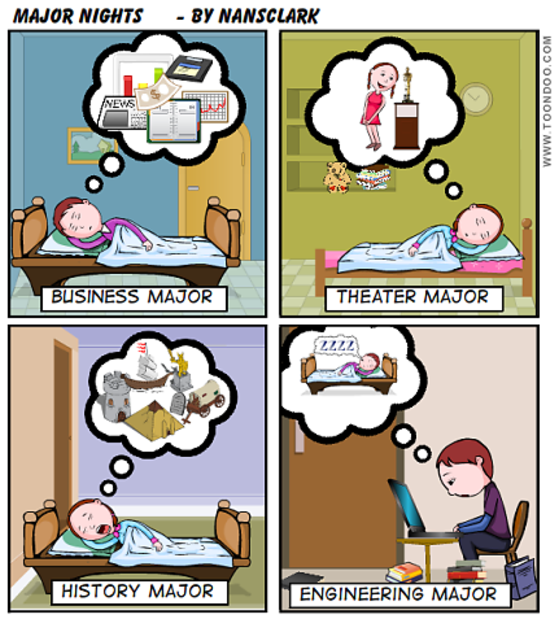
Via Nanette South Clark (Engineering Comic): “I remember what my biggest dream was, so I decided to make a comic about it. I had many 4am homework conversations at Denny’s with my fellow engineering students where we talked about switching majors so we could get a little shut-eye. I was particularly jealous of the geologists because they always looked so happy.”
Image credit: Nanette South Clark (Engineering Comic)
See here. Could someone please inform the sorry-ass editors at Sports Illustrated (or their AI bots) that Coach Prime’s last-place team was only able to muster a single solitary victory against their conference opponents this season? Either we are being trolled by the lamestream media again or the AI systems at this once venerable publication have run amok!
Coach Prime is here, and he's just getting started












 prior probability