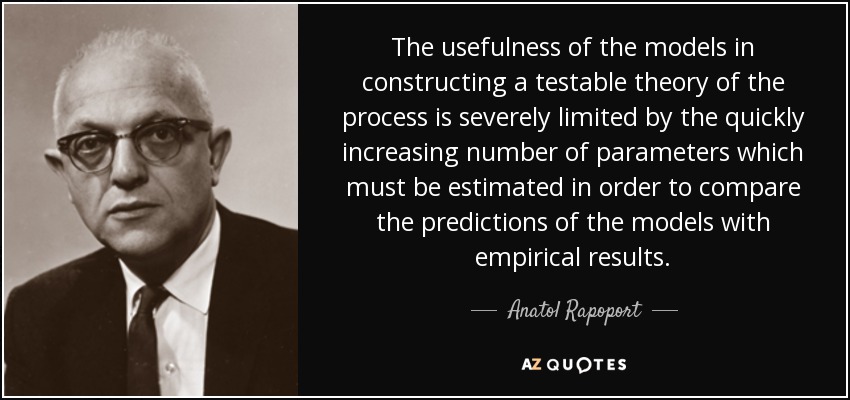
Named after famed game theorist Anatol Rapoport (pictured below), here are his four rules:
You should attempt to re-express your target’s position so clearly, vividly, and fairly that your target says, “Thanks, I wish I’d thought of putting it that way.”
You should list any points of agreement (especially if they are not matters of general or widespread agreement).
You should mention anything you have learned from your target.
Only then are you permitted to say so much as a word of rebuttal or criticism.
Bravo! PS: I discovered Rapoport’s rules in part six of this fascinating blog post by Dr Eiko Fried titled “Antidotes to cynicism creep in academia”.
That is the title of my latest work-in-progress — a compilation of some of my previous blog posts on business ethics, along with some new material. Below is the abstract:
In a brief digression in his best-selling book Capitalism and Freedom, first published in 1962, the late great Milton Friedman famously asserted: “There is one and only one social responsibility of business–to use its resources and engage in activities designed to increase its profits so long as it stays within the rules of the game, which is to say, engages in open and free competition, without deception or fraud.” The Chicago School economist then expanded on this simple idea in a short essay published in 1970, an essay whose provocative title said it all: “The Social Responsibility of Business Is to Increase Its Profits.” As it happens, both Friedman’s 1962 digression as well as his lengthier 3000-word essay invoke the name of the great Adam Smith, but Friedman’s invocation of the Scottish philosopher/political economist begs the question, Is the Nobel laureate’s simple profit-maximization model of business ethics the logical conclusion of Smith’s metaphorical “invisible hand,” or is it a dangerous betrayal of Smith’s true moral ideals? This essay will revisit Friedman’s 1970 essay with this fundamental question in mind.
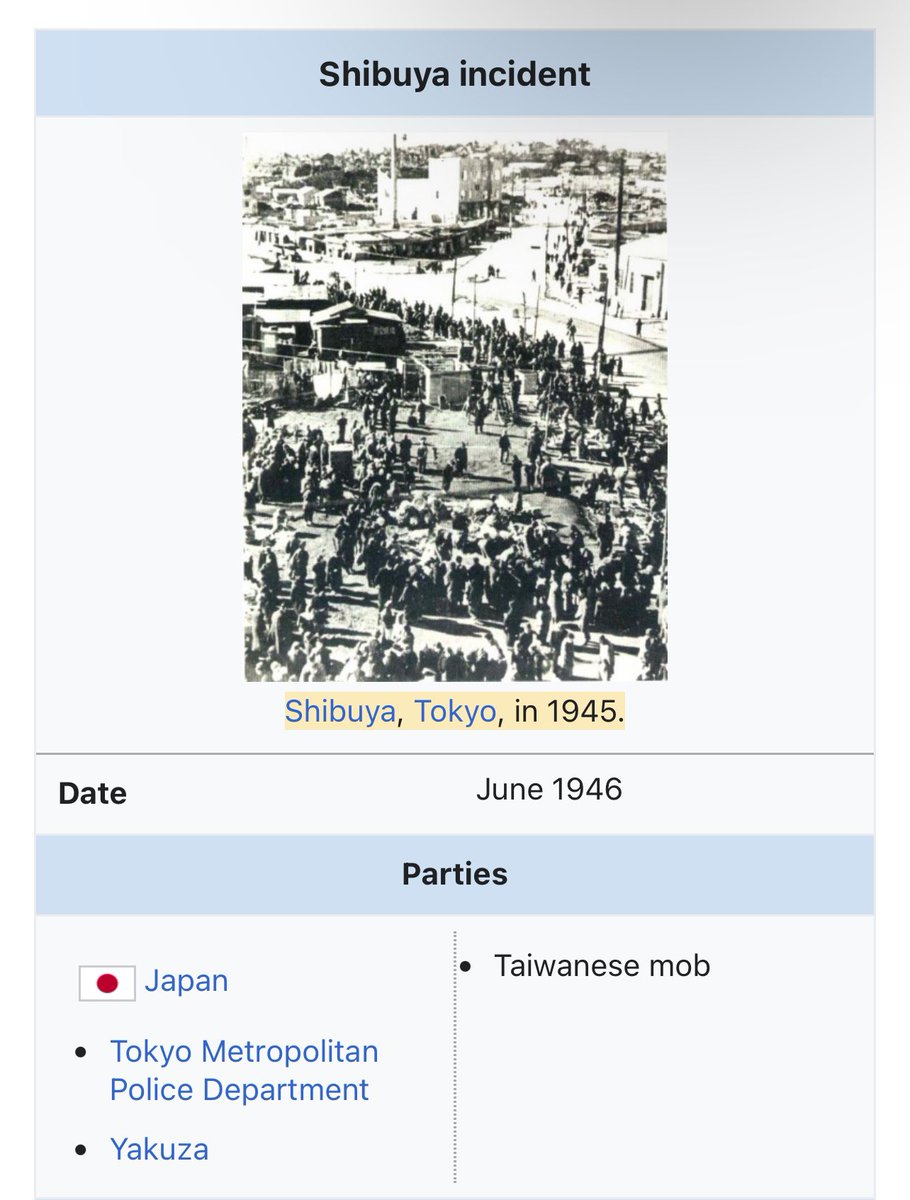
(Not to be confused with the Shibuya incident in Jujutsu Kaisen (呪術廻戦), a manga written and illustrated by Gege Akutami.) Via Wikipedia, links in the original: “The Shibuya incident (渋谷事件, Shibuya jiken) was a violent confrontation which occurred in June 1946 between rival gangs near Shibuya Station in Tokyo, Japan. The years after World War II saw Japan as a defeated nation and the Japanese people had to improvise in many aspects of daily life. In the chaos of the post-war recovery large and very lucrative black markets opened throughout Japan. Various gangs fought for control over them. There were also many non-Japanese “third nationals” in post-war Japan. These “third nationals” or “third-country people” were former subjects of the Empire of Japan whose citizenship then transferred to other countries like China and Korea. The Shibuya incident involved former Japanese citizens from the Japanese province of Taiwan fighting against native Japanese Yakuza gangs. After the fight, the Chinese nationalist government stepped forward to defend the Taiwanese.”
The latest issue of EconJournalWatch is available here. (The table of contents of the new issue is also pictured below.) Two articles in particular caught my attention: one calling into question a series of studies by McKinsey & Company claiming a positive relationship between executive racial/ethnic diversity and firm performance (see here); the other debunking a much-cited 2015 Nature article on global temperatures and economic growth (here).
Alas, the front-runners for this year’s U.S. presidential elections are a senile octogenarian and a crooked businessman! So, who else is voting for RFK Jr.?
By the way, why is Easter Sunday so “early” this year? Via the Royal Museum Greenwich (RMG), “The simple standard definition of Easter is that it is the first Sunday after the full Moon that occurs on or after the spring equinox. If the full Moon falls on a Sunday then Easter is the next Sunday.” This rule of thumb, however, is valid for the determination of the date of Easter in the Western/Catholic liturgical calendar; the date used by Eastern/Orthodox churches can be one, four, or five weeks later! See here.
File under: FINALLY! Via Wired, check out philosopher Leif Wenar’s devastating and definitive critique of such intellectual con artists like William MacAskill, Toby Ord, and Peter Singer. By way of example, below is a key passage from Professor Wenar’s brutal no-holds-barred must-read takedown of the “Effective Altruism” movement and of its leading charity scam, GiveWell (all links in the original):
Today, GiveWell highlights detailed calculations of the benefits of donations to recipients. In an estimate from 2020, for example, it calculates that a $4,500 donation to a bed nets charity in Guinea will pay for the delivery of 1,001 nets, that 79 percent of them will get used, that each net will cover 1.8 people, and so on. Factoring in a bevy of such statistical likelihoods, GiveWell now finds that $4,500 will save one person.
That looks great. Yet GiveWell still does not tell visitors about the well-known harms of aid beyond its recipients. Take the bed net charity that GiveWell has recommended for a decade. Insecticide-treated bed nets can prevent malaria, but they’re also great for catching fish. In 2016, The New York Timesreported that overfishing with the nets was threatening fragile food supplies across Africa. A GiveWell blog post responded by calling the story’s evidence anecdotal and “limited,” saying its concerns “largely don’t apply” to the bed nets bought by its charity. Yet today even GiveWell’s own estimates show that almost a third of nets are not hanging over a bed when monitors first return to check on them, and GiveWell has said nothing even as more and morescientificstudies have been published on the possible harms of bed nets used for fishing. These harms appear nowhere in GiveWell’s calculations on the impacts of the charity.
In fact, even when GiveWell reports harmful side effects, it downplays and elides them. One of its current top charities sends money into dangerous regions of Northern Nigeria, to pay mothers to have their children vaccinated. In a subsection of GiveWell’s analysis of the charity, you’ll find reports of armed men attacking locations where the vaccination money is kept—including one report of a bandit who killed two people and kidnapped two children while looking for the charity’s money. You might think that GiveWell would immediately insist on independent investigations into how often those kinds of incidents happen. Yet even the deaths it already knows about appear nowhere in its calculations on the effects of the charity.
And more broadly, GiveWell still doesn’t factor in many well-known negative effects of aid. Studies find that when charities hire health workers away from their government jobs, this can increase infant mortality; that aid coming into a poor country can increase deadly attacks by armed insurgents; and much more. GiveWell might try to plead that these negative effects are hard to calculate. Yet when it calculates benefits, it is willing to put numbers on all sorts of hard-to-know things.