
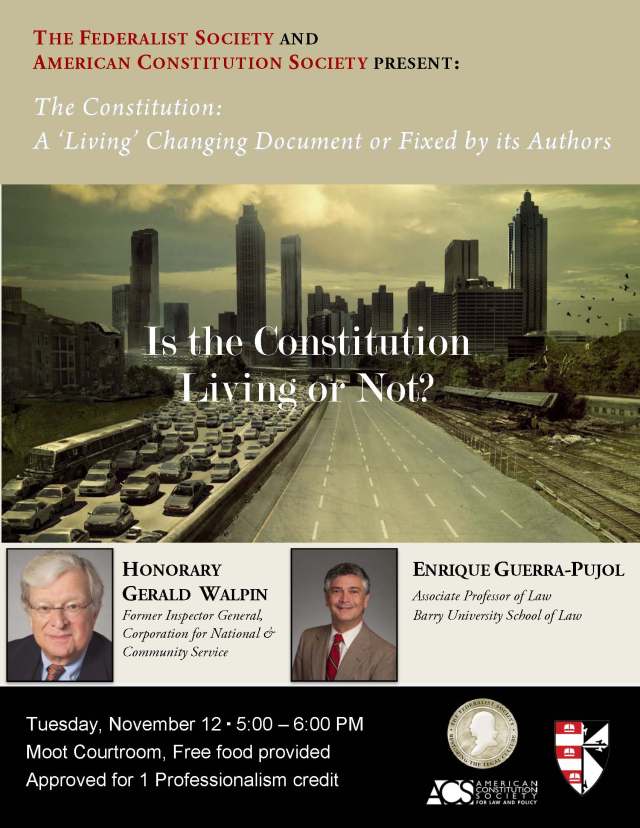
prior probability and Gerald Walpin will be discussing originalism and “the living Constitution” tomorrow at 5pm at Barry Law School
prior probability and Gerald Walpin will be discussing originalism and “the living Constitution” tomorrow at 5pm at Barry Law School










Welcome to the online home of the IASS
Hopefully It’s Interesting.
In Conversation with Legal and Moral Philosophers
Relitigating Our Favorite Disputes
PhD, Jagiellonian University
Inquiry and opinion
Life is all about being curious, asking questions, and discovering your passion. And it can be fun!
Books, papers, and other jurisprudential things
Ramblings of a retiree in France
BY GRACE THROUGH FAITH
Natalia's space
hoping we know we're living the dream
Lover of math. Bad at drawing.
We hike, bike, and discover Central Florida and beyond
Making it big in business after age 40
Reasoning about reasoning, mathematically.
I don't mean to sound critical, but I am; so that's how it comes across
remember the good old days...
"Let me live, love and say it well in good sentences." - Sylvia Plath
a personal view of the theory of computation
Submitted For Your Perusal is a weblog wherein Matt Thomas shares and writes about things he thinks are interesting.
Logic at Columbia University
Just like the Thesis Whisperer - but with more money
the sky is no longer the limit
Technology, Culture, and Ethics
Just like the horse whisperer - but with more pages
Poetry, Other Words, and Cats

 prior probability
I believe this has been a question that has been asked since the time the framers ratified the Constitution. It is interesting to think that one of the the founding strict constructionists (or originalists), Thomas Jefferson, went back on his belief that the Constitution was a strict document that should only be interpreted by its words. He believed that the Constitution was to be interpreted strictly when the debate of the National Bank came about because he was against the National Bank, but when it came to the Louisiana Purchase he broadened his executive powers to make the transaction for the largest land purchase in American History, because he wanted to make that purchase. If one of the founding originalists believed the Constitution to be a living document, then it is very hard to argue otherwise. It almost appears that the Constitution is strict when it is convenient and flexible/living if a strict interpretation is inconvenient for an agenda.
Also, it appears the framers left the Constitution broad enough to allow for it to “stretch” or move with the times. If the Constitution was not meant to be a “living” document, then why did the framers allow for amendments. If it was meant to be a “strict” document then amendments would not have been allowed to accommodate future issues, such as slavery, women’s suffrage, voting for young people, etc.
This is a debate that could be very lengthy but I believe these two reasons are the two biggest reasons why I believe the Constitution is a living document. Because the framers themselves did not intend for the document to be strict and also because they wanted to leave room for future changes and amendments to go with the times. We would not be where we are today, as a country, if we relied on the original intentions of the framers because if we did we would most likely still have slavery, lack of voting rights, and other concepts that we find immoral today, if it was not for the belief that the Constitution is a “living document”. That living document is what makes this country free, free to interpret a document one way or another, that is what allows for the ebb and flow ideas. If the Constitution was interpreted strictly we would never be able to learn from mistakes (such as slavery) because we would be forced to make those mistakes over and over again because the Constitution is only meant to be interpreted one way, the original way; which is why it almost seems impractical to not believe the Constitution is a living document.