
Our friend and colleague Jeremy E.C. Genovese recently brought this short theoretical paper to our attention. The paper, which was written by Eric-Jan Wagenmakers, Richard D. Morey, and Michael D. Lee, is titled “Bayesian benefits for the pragmatic researcher,” and we strongly recommend it. In brief, their paper explains how we can use Bayesian methods to answer to practical but non-experimental questions that standard statistical methods are unable to answer, e.g. is there any correlation between the box office success and the quality of Adam Sandler movies? What we liked most about the paper, however, is the authors’ Popperian discussion about the role of prediction in Bayesian models. Here is an excerpt (emphasis in original):
For a Bayesian, the crucial task is to specify [his] model generatively, before it has made contact with the observed data. In the other words, the model needs to be specified in such a way that it generates data and thereby makes predictions. Without making predictions, a model cannot be tested in a meaningful way.
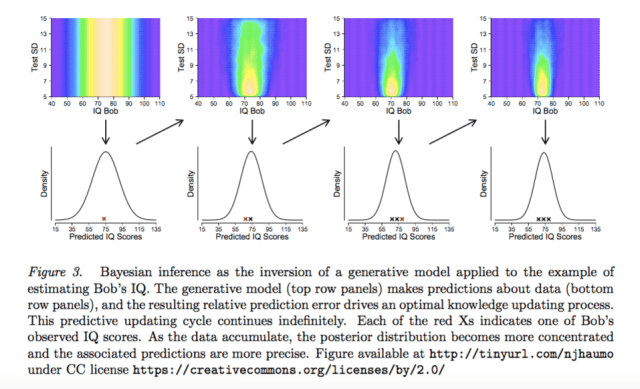
Credit: Eric-Jan Wagenmakers, Richard Morey, and Michael Lee










 prior probability