
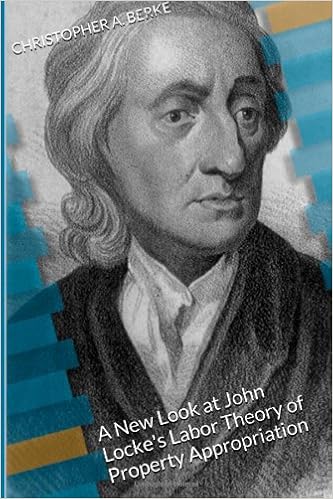
Nozick devotes the next few pages of Chapter 7 (pp. 174-182) to Locke’s “sweat equity” or labor theory of property rights acquisition and to the so-called “Lockean proviso” — the moral claim that everyone has a right to acquire land so long as no one else is made worse off. Let’s talk about Locke’s labor theory today. (Entire books have been written about this theory. See, for example, Christopher Aaron Berke, A New Look at John Locke’s Labor Theory of Property Appropriation, (2013), pictured below. But Nozick’s explanation in ASU is still the best!) According to Nozick (p. 174), “Locke views property rights in an unowned object as originating through someone’s mixing his labor with it.” But as Nozick correctly notes, Locke’s mixing criterion generates many embarrassing line-drawing questions. For example: how much work or labor is required to own a plot of land, or how big a plot does my labor entitle me to? More fundamentally, (ibid.), “Why does mixing one’s labor with something make one the owner of it?” For our part, we would add the following query to Nozick’s already extensive list: does this Lockean or “natural ownership” right include only an inalienable right of possession (while the owner is alive), or does it also include the right of transfer? If the latter (ownership rights are alienable), how can we test the truth of such a claim, or is it just because we say so? We will turn to the Lockean proviso tomorrow …










 prior probability
Pingback: Nozick’s Lockean digression | prior probability