
Thus far, Nozick has considered two possible extremes: an individualistic or Hobbesian society in which persons do not cooperate with each other (no cooperation), and a Rousseauian or Panglossian society in which everyone cooperates for the greater good (general cooperation). In the next subsection of the second part of Chapter 7 (pp. 189-197), Nozick makes two additional moves. First, he presents a third level of cooperation: intragroup or limited cooperation. Next, he uses this possibility of intragroup cooperation to turn Rawls’s theory of justice on its head.
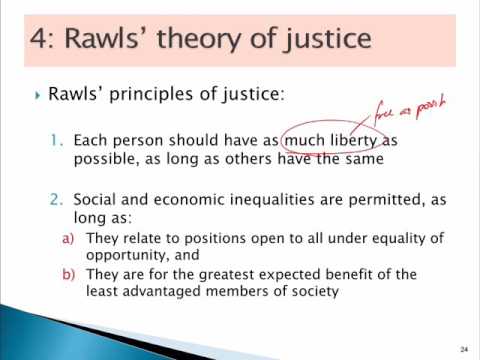
To appreciate Nozick’s critique of Rawls, let’s revisit the latter’s two principles of justice. According to Rawls, a society is just if everyone is assigned equal rights and duties and if the least advantaged members of society are materially better off in that society than they would be in any other type of society. (Cf. image below by Gavin Nicholson.) According to Nozick, this second principle–the difference principle–invites us to divide society into broad groups: (1) losers, i.e. the least-advantaged or worst-off members of society, and (2) winners, who are “better endowed or more fortunate in their social position.” (Rawls, 1971, p. 15.)
The division of society into these two broad groups also opens up the possibility of limited or intragroup cooperation, or in the words of Nozick (p. 193): “… we [can] imagine less extensive schemes of partitioned social cooperation in which the better endowed cooperate only among themselves and the worse endowed cooperate only among themselves, with no cross-cooperation.” In short, winners cooperate with other winners; losers cooperate with other losers. (As an aside, the terms winners and losers are my own, not Nozick’s or Rawls’s. I will use these simplifying terms to convey the essence of Nozick’s critique of Rawls.)
Here is where Nozick turns Rawls’s theory of justice on its head. For Rawls, if you want to live in a just society, the winners must somehow compensate the losers in exchange for the losers’ cooperation. Nozick, however, turns this formulation on its head. In particular, he wonders whether it is the losers who must compensate the winners! Why? Because as long as intragroup or limited cooperation is a viable option for the winners, it is the losers who benefit more from a world of general cooperation than the winners do. Or to put it bluntly, as Nozick does (p. 194, emphasis in original): “… it is difficult to avoid concluding that the less well endowed gain more than the better endowed do from the scheme of general cooperation.”
To the extent this premise is true (i.e. the fact that the losers benefit more than the winners from a system of general cooperation), Nozick wins round 2. But Nozick fails to consider a fourth possibility. In place of no cooperation, limited cooperation, and general cooperation, there is also the possibility of violence and collusion by the losers against the winners, and it is this possibility that keeps Rawls’s theory alive. (We thus score round 2 a draw.) Nevertheless, Nozick presents yet another critique of Rawls in the next subsection of Chapter 7 (“The Original Position and End-Result Principles”). We will explore that subsection in our next blog post.










 prior probability
Pingback: Nozick and Rawls: round 3 | prior probability
For what it’s worth, Rawls’s later reply to Nozick here is as follows: “the more advantaged, when they view the matter from a general perspective, recognize that the well-being of each depends on a scheme of social cooperation without which no one could have a satisfactory life; they recognize also that they can expect the willing cooperation of all only if the terms of the scheme are reasonable. So they regard themselves as already compensated, as it were, by the advantages to which no one (including themselves) had a prior claim. They forego the idea of maximizing a weighted mean and regard the difference principle as a fair basis for regulating the basic structure.”
Indeed, given that, in a previous post, you noted that cooperation is better for everyone than none, it’s not clear that Nozick’s critique works here. The most well-off only get a chunk of the much better T, where T>>S, under cooperation. They only get that if they enter into a society that anyone could reasonably accept. So they’ve already “won” and it doesn’t really matter if they could form another group with just the well-off and be even more well-off. First, you don’t really have full control over who’s in your society. Second, even in a well-off society that branched off to form their own little utopia, there will be some that are worst-off, and they’ll only agree under some principle that prioritizes them (even if it’s not as extreme as the difference principle).