
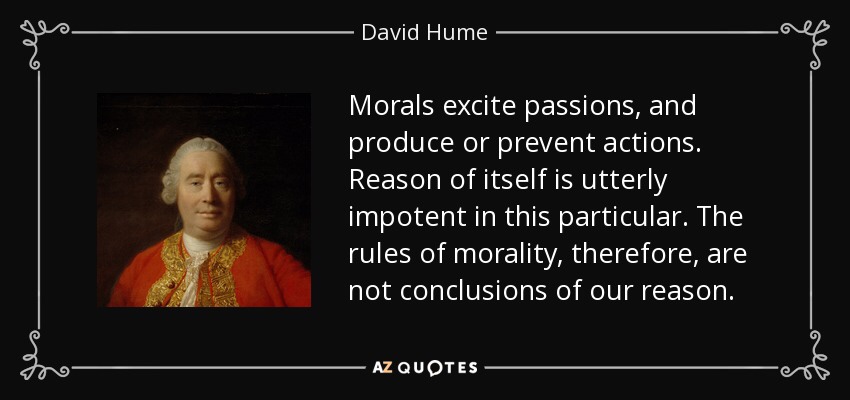
Before we discuss the main features of Adam Smith’s approach to moral philosophy (sympathy or fellow-feeling, the imaginary impartial spectator, and virtue), I want to share with you two quotes by David Hume: one about the limited role of reason in matters of morality; the other on Hume’s famous “is-ought” distinction, i.e. the notion that facts and values are two different domains. In many ways, Smith’s Theory of Moral Sentiments can be seen as an extended reply to Hume. (An in-depth survey of Hume’s moral philosophy can be found here.)










 prior probability
As a side-bar note: I have always personally preferred David Hume to Adam Smith. As unpopular as that may be. I stand by this outlier opinion. When it came to economics both were very similar, heavily influenced by Richard Cantillon (among other french physiocrats). I found Hume to be a better writer.
I agree
Hume > Smith
but in fairness to Smith, hardly anyone ever reads “the theory of moral sentiments” (confession: I finally cracked this book open for the first time last summer, and the more I read about it and study it for myself, the more respect I have for Smith and the more upset I become at the was Smith has been caricatured by many scholars and the public at large)
I think Russ Roberts may have renewed interest in TMS. I believe that Smith intended for TMS and WONs were meant to be read in tandem.