
Happy New Year! Today, I will review Chapter 2 of Paul Sagar’s 2022 book Adam Smith Reconsidered. This chapter — titled “Domination, Liberty, and the Rule of Law” — is the most lengthy part of Sagar’s work, but it is an intellectual tour de force and should be required reading among Smith scholars. Among many other things, Professor Sagar explores the relation between law and liberty from a Smithian perspective and presents a novel but compelling reading of The Wealth of Nations — and of the larger “classical liberal” tradition that the Scottish philosopher-economist founded. To the point, Sagar concludes that Adam Smith should not only be seen as a great classical liberal champion of free trade and economic freedom; he should also be considered “a theorist of liberty as [political] nondomination” (p. 60).
For starters, what does Adam Smith have to say about the relation between law and liberty? Alas, this question is not an easy one to answer, for as I mentioned in my previous post, Smith never published his promised book on law, and furthermore as Professor Sagar correctly notes, the Scottish scholar does not bother to define the concept of liberty in his magnum opus The Wealth of Nations (see, e.g., Sagar 2022, p. 56). Instead, Sagar shows how Smith prefers historical case studies over abstract or philosophical definitions of liberty and how, as a result, Smith ends up concluding that “the normal condition of politics is not likely to be equality based on the mutual recognition of the equal worth of each person … but [rather] the tyrannic domination of the many by [the] few …” (ibid., p. 67).
Or to put it even more bluntly, according to Sagar’s reading of Smith “law was originally an invention of the rich to secure themselves [and their riches] against the depredations of the poor …” (Sagar 2022, p. 59), or better yet, in the immortal words of Adam Smith himself: “Laws and government … [are] a combination of the rich to oppress the poor …” (see Smith, Lectures on Jurisprudence (A), iv.22-23, quoted in Sagar, p. 69). Let’s put aside my standing objection that the “Lectures on Jurisprudence” (quoted above and repeatedly in Sagar’s book) must be taken with a grain of salt, since as I explained in my previous post, Smith never published them. The key point that Professor Sagar is trying to make here is that, for Smith, the historical or actual relation between law and liberty has almost always been an inverse one. (I shall hereafter call this insight — i.e. the historical reality that law and liberty are inversely related — the “law as domination” paradigm for reference.)
At the same time, Adam Smith rejects this oppressive status quo, for as Sagar shows (see especially pp. 83-85 in chapter 2), The Wealth of Nations not only touts the benefits of free markets at home and abroad; it also contains a devastating critique of both economic oppression and political domination. Furthermore, Smith was in many ways ahead of his times, since he was opposed to all forms of unjust domination on both economic and moral grounds, including the institution of slavery. (On this important note, see Sagar, pp. 62-67.) But this observation begs the key question: how do we escape the “law as domination” paradigm? Put another way, how is modern liberty possible when law is just a conspiracy of the rich to exploit the poor?
Professor Sagar’s attempt to reconstruct Adam Smith’s jurisprudential answer to this question was music to my law professor ears. Spoiler alert: the answer is not democracy, for as Professor Sagar correctly notes, Smith was skeptical of civic republicanism (see, e.g., Sagar 2022, pp. 99-100). Instead, according to Sagar’s close reading of Smith’s Wealth of Nations, there can be no liberty — no end to the “law as domination” paradigm — until “those who [hold] political power [are] themselves meaningfully subject to law …” (Sagar, p. 79). For Smith, then, the secret ingredient for modern liberty is the “rule of law”: the few who make and enforce the law must themselves be bound by their own laws. Simply put, without rule of law, there can be no modern liberty.
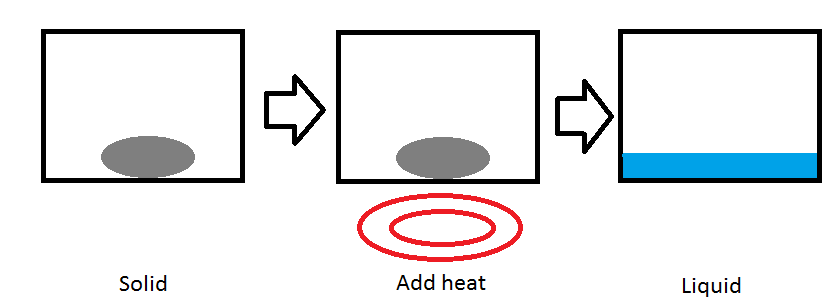
Alas, I hate to be that guy (especially considering how much I enjoyed reading this chapter), but there is one big blind spot in Sagar’s — and Adam Smith’s — analysis of modern liberty. If State A represents the “law as domination” paradigm and State B the “rule of law” ideal, then how does the transition from A to B occur? By way of analogy, consider the phase transition from a solid state to a liquid state (pictured below). If heat converts a solid into a liquid, what must be added (or taken away) from State A to create State B? How do we get from “law as domination” in which the few use the law to oppress the many to the “rule of law” in which the people in power are themselves bound by law? That is the $64 question!
Let’s keep this key question in mind when I resume my review on Tuesday, January 2.








Pingback: Smith versus Rousseau: round 1 | prior probability
Pingback: The Real Adam Smith Problem: Part 2 | prior probability
Pingback: Assorted links of my review of Sagar 2022 | prior probability