
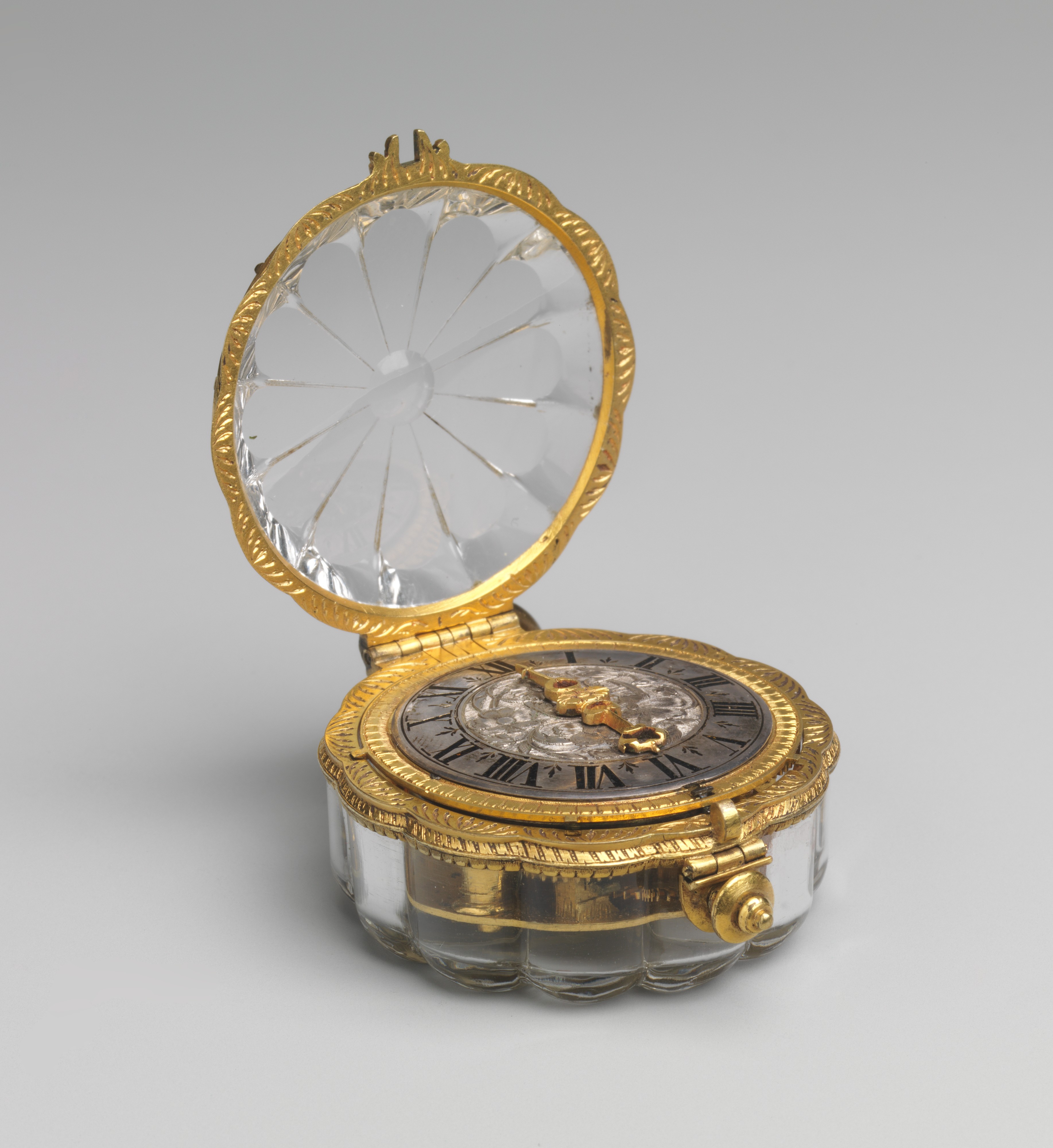
Jean-Jacques Rousseau (1712–1778) descended from a long-line of Genevan watchmakers, for his father Isaac Rousseau (1672–1747) and his grandfather David Rousseau (1641–1738) — as well as his great- and great-great grandfathers! — were master clockmakers in the city-state of Geneva. The beautiful 17th-century Geneva miniature clock pictured above, for example — which is now part of the Met’s fine art collection [see Clare Vincent & Jan Hendrik Leopold (with Elizabeth Sullivan), Highlights of the Collection of European Clocks and Watches in the Metropolitan Museum of Art (Yale University Press, 2015), pp. 70-73, available here] — is believed to be the product of the master clockmaker (maître horloger) Jean Rousseau the Younger (1606–1684), the great-grandfather of none other than the famed man of letters.
More relevant than Rousseau’s clockmaker family pedigree to someone like Adam Smith — who visited Geneva in late 1765-early 1766 — is the fact that the celebrated Swiss philosopher’s forefathers most likely belonged to the old Watchmakers Guild of Geneva, which was established as early as 1601 in order to curtail competition under the guise of quality control. Among other things, mass production of clocks and watches was banned, the number of apprentices kept artificially low, and entry into the guild (and thus permission to make watches) strictly controlled. [See generally David S. Landes, “Watchmaking: A Case Study in Enterprise and Change”, Business History Review, Vol. 53, No. 1 (1979), pp. 1-39.]
So, why did Jean-Jacques Rousseau not follow in his forebears’ footsteps and become a watchmaker himself? Instead, according to his best-selling but posthumously-published autobiography The Confessions of Jean-Jacques Rousseau (available here), he was an engraver’s apprentice before running away from Geneva at the age of 15 and becoming a man of letters. In any case, was Adam Smith aware of the protectionist apprenticeship policies of the Watchmakers Guild of Geneva? How could he not be, for the Scottish philosopher-economist has this to say about apprenticeships in the watchmaking industry in Book 1, Chapter 10, Part 2, paras. 16-17 of The Wealth of Nations (Glasgow edition, pp. 139-140):
Long apprenticeships are altogether unnecessary. The arts, which are much superior to common trades, such as those of making clocks and watches, contain no such mystery as to require a long course of instruction. The first invention of such beautiful machines, indeed, and even that of some of the instruments employed in making them, must, no doubt, have been the work of deep thought and long time, and may justly be considered as among the happiest efforts of human ingenuity. But when both have been fairly invented and are well understood, to explain to any young man, in the completest manner, how to apply the instruments and how to construct the machines, cannot well require more than the lessons of a few weeks: perhaps those of a few days might be sufficient. ***
It is to prevent this reduction of price, and consequently of wages and profit, by restraining that free competition which would most certainly occasion it, that all corporations, and the greater part of corporation laws, have been established.
So, was Adam Smith speaking from his own personal knowledge when he wrote this scathing critique of watchmaker apprenticeships — as an aside, plus ça change, plus c’est la même chose; compare our oppressive and outdated rules of “occupational licensure” today — and was this personal experience based on his 1765/66 sojourn in Switzerland? For his part, it is worth noting that Rousseau himself confirms in passing in Book 1 of his autobiographical Confessions that “it required no very extraordinary abilities to attain perfection as a watchcase engraver” (my translation). [Cf. Texte du manuscrit de Genève (1782), pp. 30-31: “… le talent du graveur pour l’horlogerie est très-borné …”, available here.] Rousseau’s autobiography, however, did not see the light of day until 1782, while Smith’s magnum opus was published six years earlier in 1776, so it is safe to say that Smith was indeed writing from his own personal knowledge when he condemned watchmaker apprenticeships in The Wealth of Nations.







 prior probability
Fascinating and informative, thank you
thanks for reading my stuff!
Pingback: Adam Smith in Switzerland | prior probability