
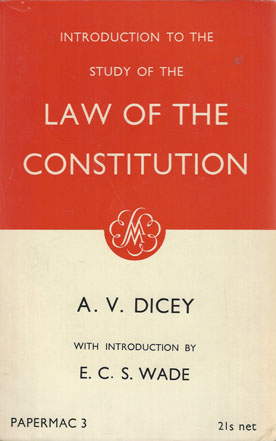
My next rule-of-law puzzle is definitional: what do we mean by the “rule of law” anyways? In the Anglo-American world, this ideal can be traced as far back to Henry de Bracton’s medieval treatise De legibus et consuetudinibus Angliae (“On the Laws and Customs of England”), but the term “rule of law” itself is a relatively recent one: it was coined by an Oxford don, the great A. V. Dicey, in the 19th century!
For his part, Professor Dicey identifies no less than three different meanings or conceptions of “rule of law” in his 1885 treatise The Law of the Constitution. First off, the rule of law requires a law of rules, or to quote Dicey: “no man is punishable … except for a distinct breach of law established in the ordinary legal manner before the ordinary courts of the land.” In other words, the content of the ‘law’ must be clear and its meaning must be subject to judicial review; i.e. it is the judges who get to decide whether the ‘law’ is clear or not. [1]
Alas, today there are so many cases, laws, and regulations on the books that it is all but impossible, even for a trained lawyer, to know what the ‘law’ really is, and this observation, in turn, poses a troubling question: how can there be “rule of law” — as opposed to what I like to call the “rule of politics”, i.e. rule by the arbitrary whims of men — if we don’t even know how many laws there are in the first place?
This problem is especially acute in the United States, where legal experts don’t even know how many federal crimes there are! (See here, for example.) In fact, the problem is perchance worse than that, for even if we could use some method of “machine learning” or artificial intelligence to identify all the State, federal, and international laws that make up the U.S. legal environment, we would soon discover that many of these rules are either incomplete or vague or, worse yet, in contradiction with each other!
Is this a soluble problem, or is the concept of rule of law an incoherent one? (To be continued …)
[1] I am enclosing the word ‘law’ in single quotation marks because, at some point, we are also going to need a working definition of the concept of law. But if there is one thing that most philosophers of law do NOT agree on, it is how to define the word law.










 prior probability
Intriguing