
In the immortal words of Marcus Aurelius: “First, nothing aimless or without ulterior reference. Second, no reference to any end other than the common good.” (Meditations, xii.20) In other words, our moral duties have a social dimension, not just a personal one, for we are not only born for cooperation—just like our hands, feet, and other limbs and body parts—we also share an even more general and inexorable moral duty to act on behalf of the common good, not just in our private self-interest.
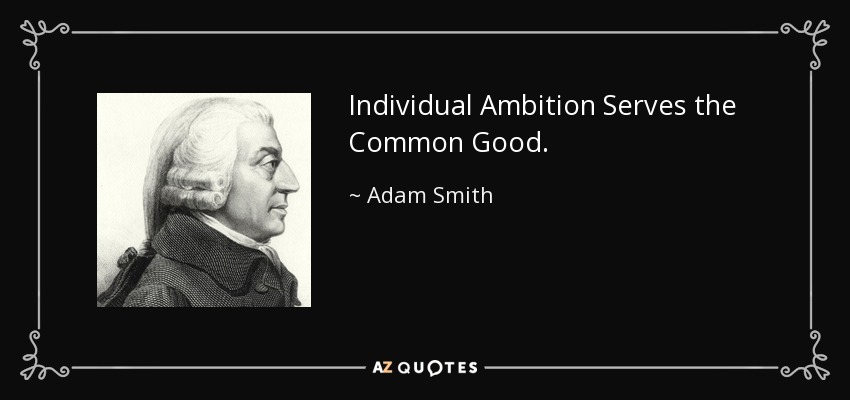
On the surface, however, if there were ever an area of ethics where Stoic ideals and capitalist realities were most incompatible or incongruent, this would be it. After all, the logic of Stoicism is to promote the common good, while the logic of the capitalist system is to promote one’s own ends or self-interest and let the “invisible hand” work its magic.[1] But such a superficial interpretation of Stoic versus capitalist motives is incomplete, because as Robert Rosenkranz explains in The Stoic Capitalist, “Building a successful business adds something to society: perhaps important technological innovation, or a better way of meeting the needs of its customers, or a more efficient use of capital and other scarce resources, or a better opportunity for your employees to thrive ….” (Rosenkranz 2025, p. 186) Or in the immortal words of Adam Smith:
“By preferring the support of domestic to that of foreign industry, he [the capitalist] intends only his own security; and by directing that industry in such a manner as its produce may be of the greatest value, he intends only his own gain, and he is in this, as in many other cases, led by an invisible hand to promote an end which was no part of his intention. Nor is it always the worse for the society that it was no part of it. By pursuing his own interest he frequently promotes that of the society more effectually than when he really intends to promote it.” (Wealth of Nations, IV.ii.9)
By way of further example, after presenting his woolen coat example in Book I, Chapter 1 of The Wealth of Nations, Adam Smith explains how capitalism has raising the standard of living of everyone, including ordinary “day-labourers”:
“Were we to examine, in the same manner, all the different parts of [the day-labourer’s] dress and household furniture, the coarse linen shirt which he wears next his skin, the shoes which cover his feet, the bed which he lies on, and all the different parts which compose it, the kitchen-grate at which he prepares his victuals, the coals which he makes use of for that purpose, dug from the bowels of the earth, and brought to him perhaps by a long sea and a long land carriage, all the other utensils of his kitchen, all the furniture of his table, the knives and forks, the earthen or pewter plates upon which he serves up and divides his victuals, the different hands employed in preparing his bread and his beer, the glass window which lets in the heat and the light, and keeps out the wind and the rain, with all the knowledge and art requisite for preparing that beautiful and happy invention, without which these northern parts of the world could scarce have afforded a very comfortable habitation, together with the tools of all the different workmen employed in producing those different conveniencies ….” (Wealth of Nations, I.i.11)
The contributions of the capitalist system to the common good thus become even more undeniable as soon as we take a step back and take a look at the big picture, as Marcus Aurelius enjoins himself (and us) to.[2] From a macro perspective, capitalism has improved the standard of living of more people and whole nations than any other economic or philosophical system in the history of the world. (Smith 1976) In short, what better or more effective method of promoting the overall good of so many people than global capitalist markets is there?
Alas, we are right back where we started: the impasse between our metaphorical Stoic and capitalist archers. (See my previous two posts on Stoic capitalism: here and here.) What matters for the Stoic archer is the intention to act on behalf of the common good, while what matters for the capitalist archer is the actual promotion of the common good, measured in terms of GDP, per capita income, or some other empirical metric. Does it matter, in short, whether the common good is the unintended result of the invisible hand, of self-regarding individuals pursuing their own self-interest? And what do we mean by “good”? (To be continued …)
[1] As an aside, I have tried to avoid referring to Adam Smith’s “invisible hand, for there is no consensus among Smith scholars about the true meaning of this magical forelimb. See, e.g., Guerra-Pujol & Rashid 2026, Ch. 1.
[2] Cf. Meditations, ix.30: “Take a view from above ….” Stephens (2012, p. 110) refers to this move as “Marcus’ ‘big picture” strategy.”










 prior probability