
Nota bene: Today’s post contains the next installment of my multi-part review of Adam Smith’s “digression on joint stock companies” in his 1784 pamphlet Additions and Corrections to the First and Second Editions of Dr. Adam Smith’s Inquiry into the Nature and Causes of the Wealth of Nations.
Adam Smith traces the sordid history of the Royal African Company in paragraph 20 of the last part of his 1784 pamphlet (Part #13). But what is most revealing about Smith’s little history lesson is what he leaves out. For me, the following two omissions stand out:
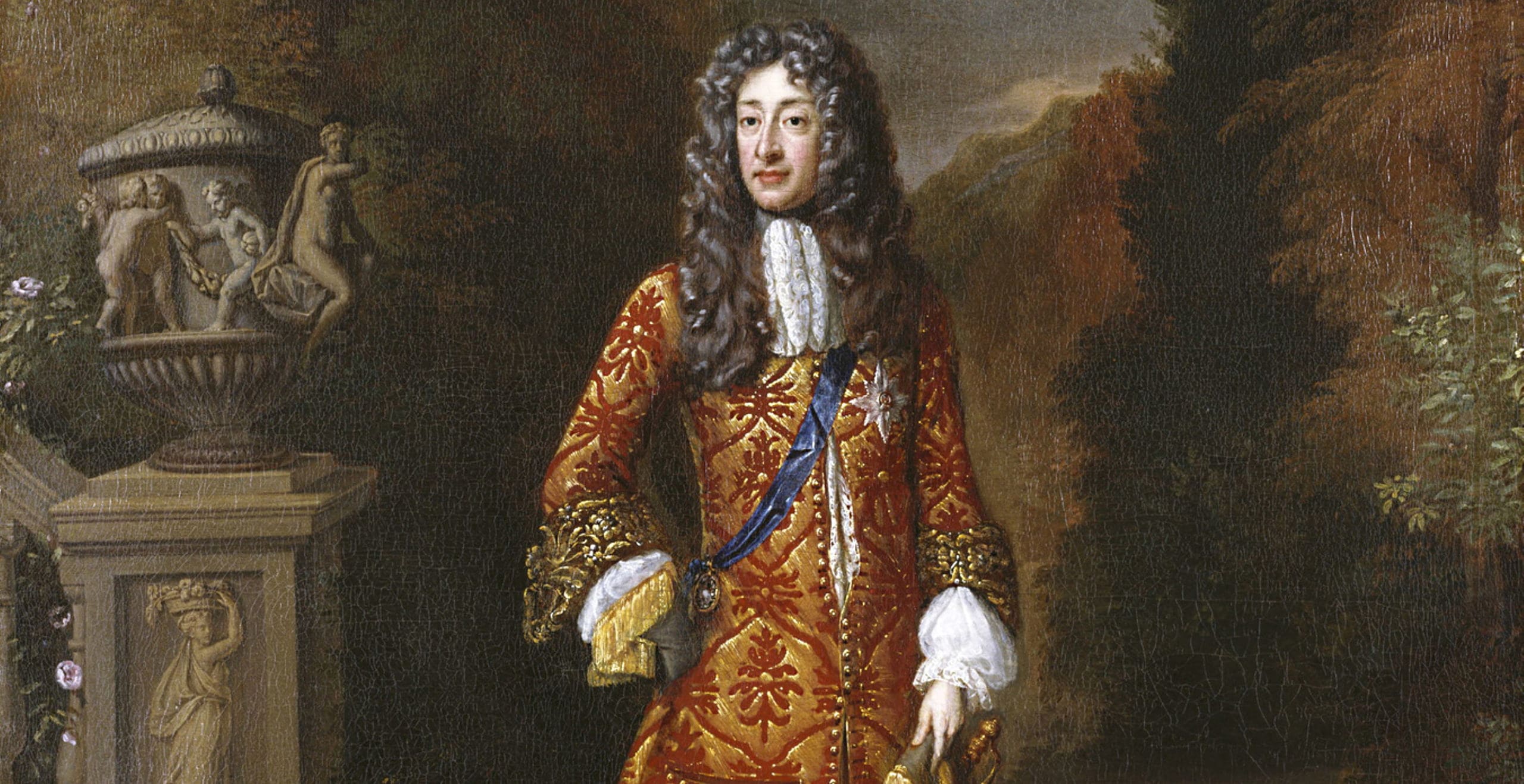
- Omission #1: The Royal African Company (RAC) was first led by James Stuart, Duke of York (see here, for example), who later became King James II in 1685 (pictured below).
- Omission #2: The RAC shipped more enslaved African men, women, and children to the Americas than any other single institution during the entire period of the transatlantic slave trade (see here and here)
Instead, Smith begins his history of the RAC not with its royal pedigree or its sordid slave trading but with the RAC’s inability to maintain its royal monopoly rights:
“The Royal African Company soon found that they could not maintain the competition against private adventurers, whom, notwithstanding the Declaration of Rights, they continued for some time to call interlopers, and to persecute as such.” (Smith 1784, p. 60)
As I mentioned in my previous post (see here), the reference to “the Declaration of Rights” in the above passage refers to the 1689 Declaration of Rights of 1689, after James II was overthrown in the Glorious Revolution of 1688. Both of these political developments not only shifted the center of political power in Britain from the monarchy to Parliament; they also ended up undermining the RAC’s attempt to monopolize the slave trade. Since the RAC’s erstwhile royal monopoly was never ratified by Parliament, independent slave traders (or “interlopers” in the eyes of the RAC) were now free to compete with the RAC.
Next, Smith describes how, in 1698, these “private adventurers [i.e. the independent slave traders or interlopers described above] were subjected to a duty of ten per cent upon almost all the different branches of their trade [sound familiar?], to be employed by the company in the maintenance of their forts and garrisons.” (Id. at p. 61) Alas, Smith reports that “notwithstanding this heavy tax, the company [RAC] were still unable to maintain the competition” and that “[t]heir stock and credit gradually declined.” (Id.) In fact, the RAC’s finances became so dire that Parliament had to intervene on many occasions:
“In 1712, their debts had become so great that a particular Act of Parliament was thought necessary, both for their security and for that of their creditors. It was enacted that the resolution of two-thirds of these creditors in number and value should bind the rest, both with regard to the time which should be allowed to the company for the payment of their debts, and with regard to any other agreement which it might be thought proper to make with them concerning those debts. In 1730, their affairs were in so great disorder that they were altogether incapable of maintaining their forts and garrisons, the sole purpose and pretext of their institution. From that year, till their final dissolution [in 1750], the Parliament judged it necessary to allow the annual sum of ten thousand pounds for that purpose.” (Smith 1784, p. 61)
The Royal African Company eventually decided to get out of the slave trading business altogether in 1732:
“In 1732, after having been for many years losers by the trade of carrying negroes to the West Indies, they at last resolved to give it up altogether; to sell to the private traders to America the negroes which they purchased upon the coast; and to employ their servants in a trade to the inland parts of Africa for gold dust, elephants’ teeth, dyeing drugs, etc.” (Id.)
The RAC, however, was unable to recover it finances and was eventually dissolved by Parliament in 1750:
“But their success in this more confined trade was not greater than in their former extensive one. Their affairs continued to go gradually to decline, till at last, being in every respect a bankrupt company, they were dissolved by Act of Parliament, and their forts and garrisons vested in the present regulated company of merchants trading to Africa.” (Id.)
Smith then concludes his paragraph on the RAC (para. 20 of Part #13 of his 1784 pamphlet) with the following observation:
“Before the erection of the Royal African Company, there had been three other joint stock companies successively established, one after another, for the African trade. They were all equally unsuccessful. They all, however, had exclusive charters, which, though not confirmed by Act of Parliament, were in those days supposed to convey a real exclusive privilege.” (Id. at pp. 61-62)
But this observation begs an important question: why were all these slave trading companies “all equally unsuccessful” in the first place? Was it because they were organized as joint stock companies, or was it because the slave trade itself was not an economically productive, let alone profitable, activity? I will turn to the Hudson’s Bay Company in my next post. (To be continued …)











Pingback: Adam Smith’s survey of the Hudson’s Bay Company | prior probability
Pingback: Adam Smith’s postmortem of the South Sea Company | prior probability
Pingback: Adam Smith’s very long paragraph: part 1 of 3 | prior probability
Pingback: Adam Smith’s digression on joint stock companies (compendium of my recent blog posts) | prior probability