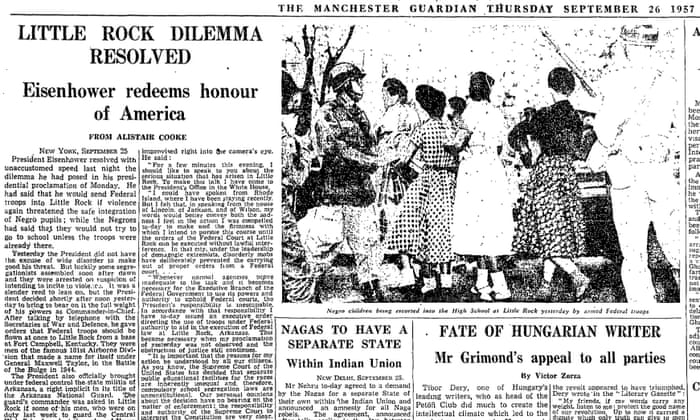
On this day (24 September) in 1957, President Dwight D. Eisenhower deploys the legendary 101st Airborne Division (based out of Fort Campbell, Kentucky) to Central High School in Little Rock, Arkansas, after the Arkansas Guard (under orders of the Governor, Orval Faubus) had blocked the “Little Rock Nine” from desegregating the school. [The Little Rock Nine are Minnijean Brown (b. 1941), Elizabeth Eckford (b. 1941), Ernest Green (b. 1941), Gloria Ray Karlmark (b. 1942), Carlotta Walls LaNier (b. 1942), Thelma Mothershed (1940-2024), Melba Pattillo Beals (b. 1941), Terrence Roberts (b. 1941), and Jefferson Thomas (1942-2010).]
But was Ike’s historic order constitutional? Can a president deploy the armed forces of the United States to quell a purely domestic disturbance? And if so, what are the limits, if any, to his emergency powers? I explore this fundamental legal question in my 2019 law review article “Domestic Constitutional Violence,” which has been cited several times since its publication. See, for example (in alphabetical order, by author):
- “Trump(ing) Tradition: Old Laws, New Norms, and the Danger to Civil-Military Relations” by Ryan Burke (Air Force Academy) and Jahara Matisek (Naval War College)
- “The Presidential Coup” by Anthony Ghiotto (University of Illinois)
- “Why the President Should Remain Commander in Chief of the D.C. National Guard” by Christopher F. Melling (Judge Advocate, United States Marine Corps)
- Föderalismus-Rhetorik-Dekonstruktionen — Rechtsdogmatik als Literaturdogmatik by Rico David Neugärtner (LL.M., Cornell)
- “Dangerous to the Liberties of a Free People: Secret Societies and the Right to Assemble” by Nathan J. Ristuccia (Institute for Free Speech)