
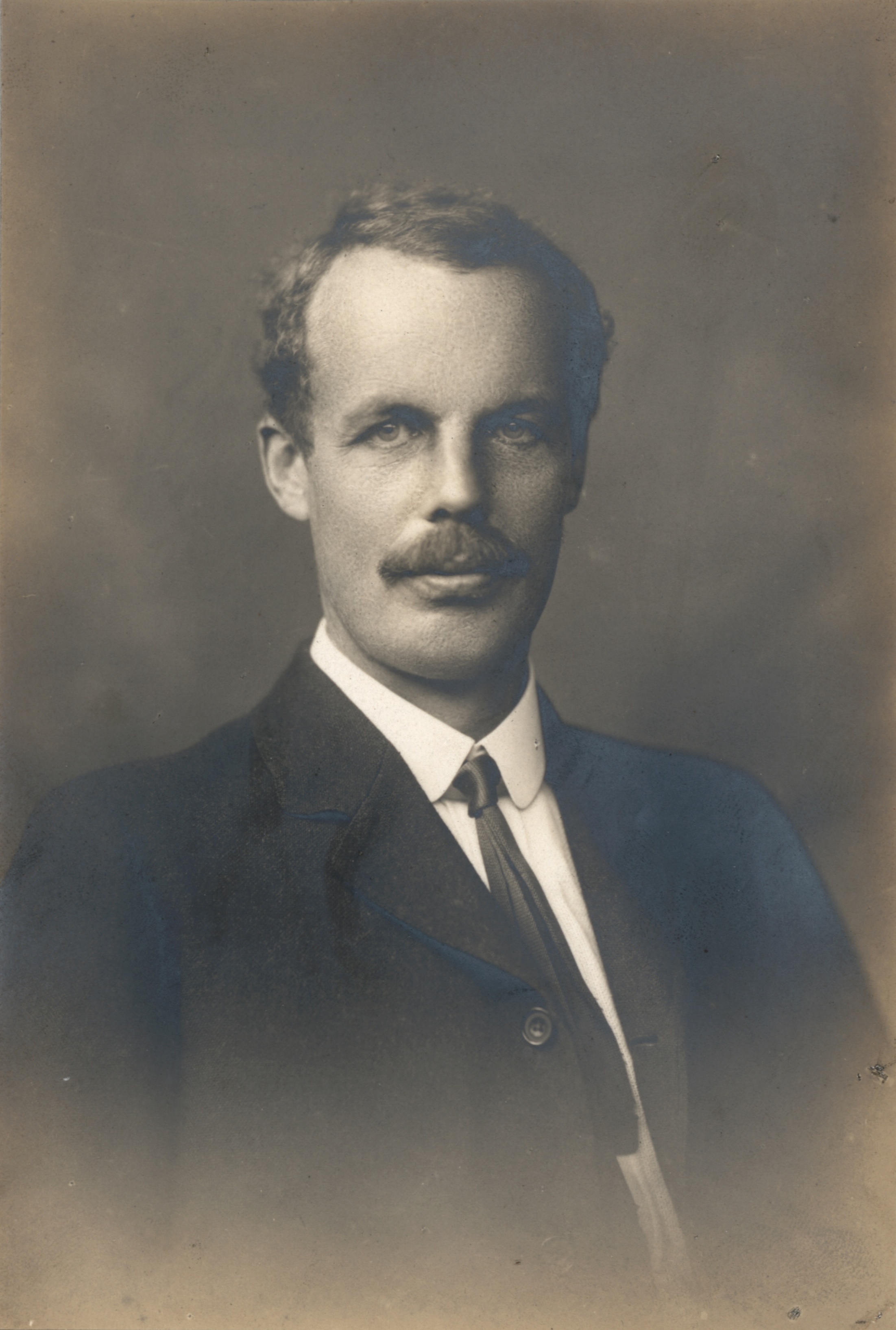
Was it the University of Cambridge economist A. C. Pigou (pictured below) who unwittingly inspired Ronald Coase’s notion of reciprocal harms?
We spent most of last week tracing the origins of Ronald Coase’s axiom that harms are a reciprocal problem, i.e. the counter-intuitive idea that victims are just as responsible for harms as wrongdoers. Among other possibilities, potential precursors that may have inspired Coase include (1) Wesley Hohfeld’s theory of legal relations, (2) what economist Jim Buchanan has called the “LSE tradition in cost theory“, and (3) Sir Arnold Plant, the British economist who had the largest influence on Coase’s intellectual development.
Today, it’s Pigou’s turn, for Coase’s critique of Pigou in “The Problem of Social Cost” — i.e. the work that contains Coase’s reciprocal-harm axiom — can be traced back to a paper by Frank H. Knight titled “Some Fallacies in the Interpretation of Social Cost” (Knight 1924, 1952), which was first published in the Quarterly Journal of Economics in 1924 and reprinted in 1952 in a collection of essays Readings in Price Theory edited by George J. Stigler and Kenneth Boulding. To begin, as I explained in my previous post in this series, we now know that the title of Ronald Coase’s paper “The Problem of Social Cost” — i.e. the work that contains Coase’s reciprocal-harm axiom — can be traced back to Knight’s social cost paper.
But in addition to similar titles, both Knight’s paper and Coase’s also share a common intellectual enemy: the English economist A. C. Pigou. By way of background, Pigou had created an entirely new field of economics — now known as welfare economics — when he published his landmark work The Economics of Welfare in 1920. (Pigou’s textbook is available here. As an aside, the word “welfare” in this context refers to the general well-being of society overall, not to specific welfare programs like Social Security, farm subsidies, etc.) Pigou had used the example of traffic congestion in the first edition of his textbook to illustrate the general problem of market failure and to make the case for government intervention in order to correct such failures:
“Suppose there are two roads ABD and ACD both leading from A to D. If left to itself, traffic would be so distributed that the trouble involved in driving a ‘representative’ cart along each of the two roads would be equal. But, in some circumstances, it would be possible, by shifting a few carts from route B to route C, greatly to lessen the trouble of driving those still left on B, while only slightly increasing the trouble of driving along C. In these circumstances a rightly chosen measure of differential taxation against road B would create an ‘artificial’ situation superior to the ‘natural’ one. But the measure of differentiation must be rightly chosen.” (Pigou 1920, p. 194)
Pigou thus uses the example of road congestion in his welfare economics textbook to make two crucial points: (1) congestion is a market failure because each individual driver imposes time costs on other drivers, and (2) the government can solve this problem by imposing a corrective tax on the overcrowded road in order to divert traffic into the less crowded road. But both Coase and Knight in their respective social cost papers would launch blistering attacks against Pigou. Here is Knight’s opening salvo against Pigou:
“Professor Pigou’s …. weakness is … that [his] assumptions diverge in essential respects from the facts of real economic situations. The most essential feature of competitive conditions is reversed, the feature namely, of the private ownership of the factors practically significant for production. If the roads are assumed to be subject to private appropriation and exploitation, precisely the ideal situation which would be established by the imaginary tax will be brought about through the operation of ordinary economic motives. The owner of the broad road could not under effective competition charge anything for its use. If an agency of production is not subject to diminishing returns, and cannot be monopolized, there is, in fact, no incentive to its appropriation, and it will remain a free good. But the owner of the narrow road can charge for its use a toll representing its ‘superiority’ over the free road, in accordance with the theory of rent, which is as old as Ricardian economics.” (Knight 1924, pp. 586-587; Knight 1952, pp. 162-163; footnote omitted; my emphases)
The most essential feature of competitive conditions is reversed, the feature namely, of the private ownership of the factors practically significant for production. If the roads are assumed to be subject to private appropriation and exploitation, precisely the ideal situation which would be established by the imaginary tax will be brought about through the operation of ordinary economic motives. The owner of the broad road could not under effective competition charge anything for its use. If an agency of production is not subject to diminishing returns, and cannot be monopolized, there is, in fact, no incentive to its appropriation, and it will remain a free good. But the owner of the narrow road can charge for its use a toll representing its ‘superiority’ over the free road, in accordance with the theory of rent, which is as old as Ricardian economics.” (Knight 1924, pp. 586-587; Knight 1952, pp. 162-163; footnote omitted; my emphases)
In other words, the problem of traffic congestion is not so much a market failure as a legal one: the lack of property rights over roads! If roads were privately owned, the owner of the narrow, congested road could reduce congestion and thus solve the externality by charging a toll — i.e. by imposing a cost on the drivers of the narrow road — without the need for any further government intervention (beyond the creation and enforcement of property rights in roads). For Knight, no government intervention at all is required to solve the so-called market failure in Pigou’s traffic congestion example.
Knight then illustrates his legal failure argument — as well as his devastating critique of Pigou’s market failure argument — with a diagram, and he will use the word “reciprocal” to describe the relationship between two of the cost curves in his diagram. I will reproduce Knight’s diagram and discuss their possible significance for Coase in my next post. (To be continued …)











Pingback: Ronald Coase and reciprocal harms (continued): Frank Knight’s reciprocal framing of A. C. Pigou’s road congestion hypothetical | prior probability