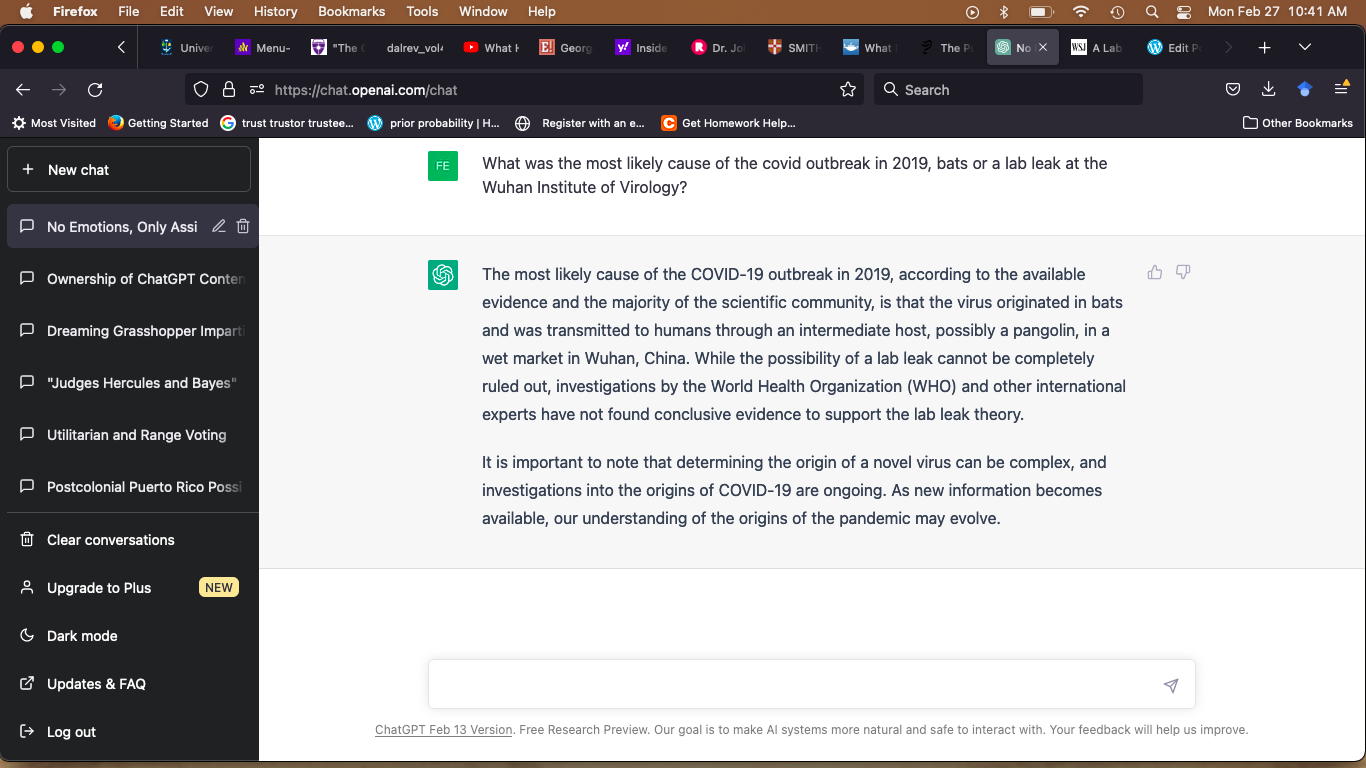
What does GPT-3 a/k/a ChatGPT think about the Wuhan lab-leak theory? In light of this Wall Street Journal report describing how officials at the FBI and the Department of Energy recently concluded with varying degrees of confidence that it was an accidental lab leak in Wuhan that most likely triggered the Covid pandemic, I asked the popular AI chatbot to weigh in. Alas, as of this writing (27 February 2023), the cutoff date of the data used to train the GPT-3 large language model is September 2021, so the chatbot still tows the official line that is was wild bats, not sloppy scientists, who caused the outbreak.
My favorite part of this all-time classic starts 55 seconds in and goes on from there until the end, but the jam around the three-minute mark is especially spicy!
Hello folks, today (Feb. 25) is my half-birthday! After a short hiatus this weekend, I will get back to it in the month of March. Among other things, I will continue my “Taking Posner Seriously” series , wrap up my review of Rule of Law by Tom Bingham (I have reviewed the first 7 of 12 chapters of Bingham’s book thus far), and revisit my “Truth Markets” paper (I received a great deal of critical but excellent feedback from no less than five colleagues since I first posted “Truth Markets” to SSRN on 16 January).
Thus far, I have reviewed the first six chapters of Rule of Law by Tom Bingham and have identified a host of problems–logical fallacies, omissions, and blind spots–with Judge Bingham’s work. The next chapter, Chapter 7, which is devoted to “human rights” and which forms the longest part of Bingham’s book, will be no exception. Judge Bingham begins this chapter by stating that “the law must afford adequate protection of fundamental human rights”, while the rest of this chapter then surveys a series of such rights, but there are three fatal flaws with Bingham’s analysis.
The first is “the level of generality” problem, a complication that often bedevils legal reasoning (see here, for example). No one is opposed to “fundamental human rights”, but what counts as a human right and how should such rights be defined? By way of example, do fundamental human rights include a right to housing, or a right to health care, or a right to a universal basic income? And if so, who will be required to pay for the provision of these rights, and how much income or what level of housing or health care must be provided to all?
The next problem, however, is even more fundamental (pun intended!). Even if we could agree on what rights counts as “fundamental human rights”, what happens when these rights come into conflict with each other. Consider, for example, the right to life and the right to liberty, two of the fundamental rights on Bingham’s laundry list of human rights. What happens when the right to liberty conflicts with the right to life? Doesn’t a woman’s right to choose an abortion violate the right to life of unborn children? Or vice versa, doesn’t an unborn child’s right to life interfere with abortion rights? Either way, which right should prevail?
But the biggest problem with Bingham’s analysis of human rights is that our erudite author makes no mention of the natural law tradition, which might be able to help us address the first two problems described above. For my part, instead of having to trudge through Bingham’s rather pedestrian survey of human rights, I would have preferred a survey of, say, the Hart-Fuller debate or an in-depth discussion of “The Grudge Informer Case” from post-WWII Germany (see, here, for example). Next time, I will assign my students the 1/2 hour video below instead of Bingham’s laundry list of human rights:
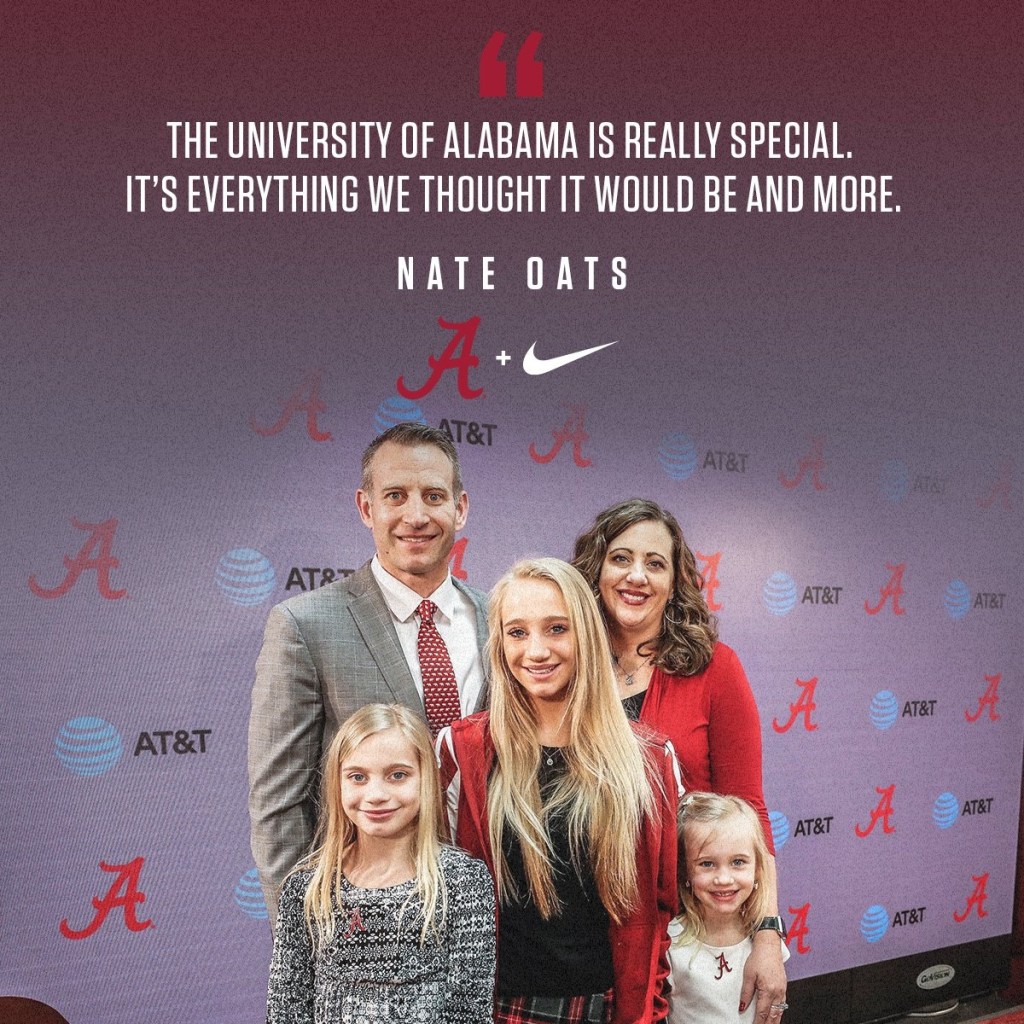
Greg Byrne is the Athletics Director at the University of Alabama, while Nate Oats is the head coach of the University of Alabama’s basketball team. Two of the “student-athletes” on their squad were involved in the murder of Jamea Jonae Harris, a 23-year old woman and mother, and one of them (Brandon Miller) is not only still on the team; Bryne and Oats (both of whom are pictured below) allowed Miller to play in last night’s away-game against the University of South Carolina. This state of affairs is absolutely disgraceful. Also, why hasn’t Dr. Stuart R. Bell, the president of the University of Alabama, asked both men to resign their positions?
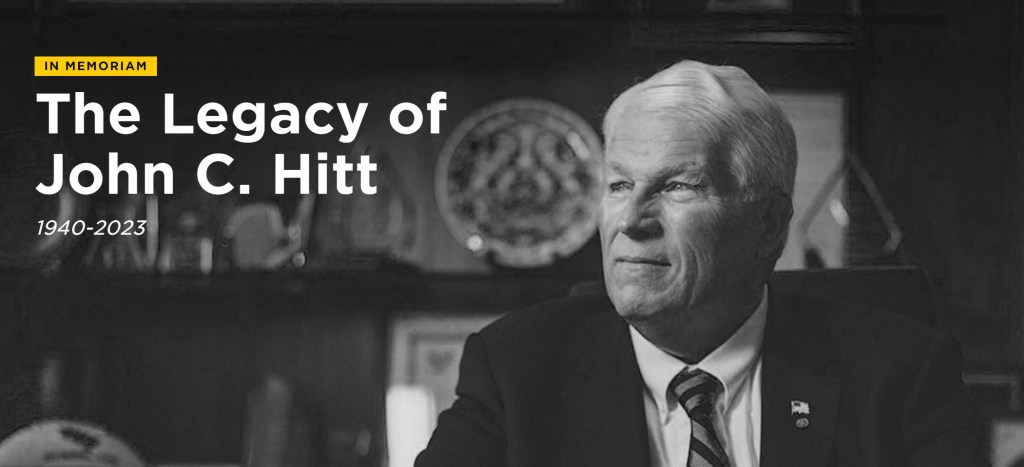
My home institution the University of Central Florida (UCF) has announced that John C. Hitt, our president from 1992 to 2018, has died at the age of 82. It was under President Hitt’s forward-looking leadership that UCF went from a medium-sized commuter school to the largest research university in the world.
Today (22 February 2023) is George Washington’s 292nd birthday! Two reasons I like to mark this occasion is Washington’s decision to resign his military commission after the rebels won the American Revolution as well as his fateful decision not to seek a third term when he was president. To commemorate the anniversary of Washington’s birth, I am posting the song “Right Hand Man” from the musical Hamilton.
Note: This is the third in a series of blog posts in honor of Richard Posner
My independent study of the works of Richard A. Posner began in December of 2000, when I visited a used bookstore called Brand Bookshop in Glendale, California for the very first time–the first of many future visits. It was there, among dozens of law books on the shelves of Brand Bookshop, that I found a pristine first edition of Posner’s Law and Literature: A Misunderstood Relation–the cover of which is pictured below and which is available here, by the way. (As an aside, I remember the month and year of this moment because I was visiting my mother and father during the holidays, right after the Supreme Court had effectively appointed George W. Bush as president, perhaps the worst and most illegitimate decision in SCOTUS history.)
As I mentioned in my previous Posner post, however, I had already formed an unfavorable impression of Posner during my law school days at Yale for purely ad hominem reasons–specifically, because of Posner’s close association with the so-called “Chicago school” and “law & economics” more generally. As a result, when I began my academic career at the Pontifical Catholic University in the summer of 1998, I purposely avoided Posner’s economic oeuvre. But a book about literature intrigued me. At the time, I did not know that Posner had majored in English Literature at Yale, but I had majored in Spanish Literature at UC Santa Barbara, and I was sufficiently open-minded to give Judge Posner another hearing!
Suffice it say that when I finally read Law and Literature: A Misunderstood Relation on my own, my appreciation of Posner’s literary wit and intellectual genius was a true but unexpected revelation. Among other things, Posner’s initial chapter on revenge literature showed me how economics could explain the tit-for-tat logic of such a powerful and dangerous human emotion like vengeance as well as illuminate the ancient history of informal norms regarding retribution. But the passage that made the deepest impact on my intellectual development was Posner’s extended discussion of Oliver Wendell Holmes’ eloquent dissent in the landmark case of Lochner v. New York. (See pp. 266-272 of Posner’s Law and Literature.)
As it happens, I had studied Lochner in law school, and to this day I still remember that this case is supposed to symbolize the dangers of “judicial activism”–an omnipresent danger that was alive and well in 1905, the year Lochner was decided, decades before SCOTUS abolished school prayer, expanded the legal rights of vagrants and criminals, legalized the murder of unborn children, appointed an illegitimate president, and unilaterally legalized gay marriage. Because Posner’s analysis of Lochner marks a turning my point in my intellectual development, I will discuss this great case, Holmes’ dissent in Lochner, and Posner’s brilliant analysis of Holmes’ dissent in my next Posner post.
IP history: On this day (21 Feb.) in 1842, the first U.S. patent for the sewing machine is granted. (Charles Fredrick Wiesenthal, a German-born engineer working in England, was awarded the first British patent in 1755 for a mechanical device to aid the art of sewing.)
Military history: On this day (21 Feb.) in 1808, Russian troops invade Sweden at Abborfors in eastern Finland, thus beginning the Finnish War. Sweden will lose the eastern half of the country (i.e. Finland) to Russia. (Sound familiar?)
Sports history: On this day (21 Feb.) in 1948, NASCAR is created at the Ebony Bar of the Streamline Hotel (pictured below) in Daytona Beach, Florida.















 prior probability