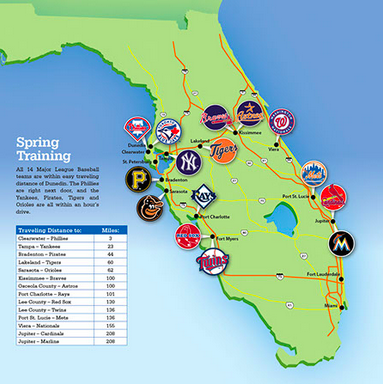
I wish every profession were organized like Major League Baseball: spring training (February and March), the regular season (April to September), the playoffs (October), and the off-season or winter break (November to January). In any case, I will take a break from blogging today to see a ball game in Dunedin, Florida (Grapefruit League rules!) and catch up on some reading, but I will revisit my work on “Truth Markets” and resume my “Taking Posner Seriously” series on Monday or Tuesday …
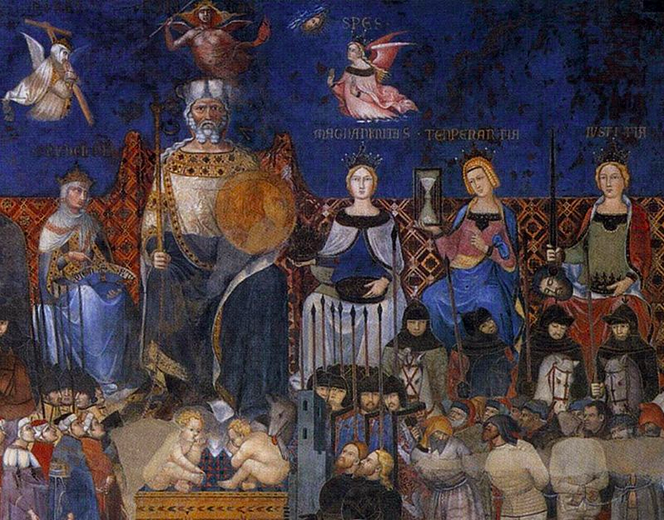
With this post I shall bring my chapter-by-chapter review of Rule of Law by Tom Bingham to a close. In the epilogue to his book, Judge Bingham concludes by describing “The Allegory of Good Government” (pictured in part above), a series of three fresco murals painted by the Italian artist Ambrogio Lorenzetti in the fourteenth century:
In the Hall of the Nine in the Palazzo Pubblico in Siena is Ambrogio Lorenzetti’s depiction of the Allegory of Good Government. Justice, as always, is personified as a woman, gesturing towards the scales of justice, held by the personification of Wisdom. At her feet is Virtue, also a woman. A judge sits in the centre, surrounded by figures including Peace. The Allegory is flanked by two other paintings, illustrating the Effects of Good Government and the Effects of Bad Government. In the first, well-to-do merchants ply their trade, the populace dance in the streets and in the countryside well-tended fields yield a plentiful harvest. The second (badly damaged) is a scene of violence, disease and decay.
With this visual description of this vivid allegory, Judge Bingham then asks the $64 question: “What makes the difference between Good and Bad Government?” Or more to the point, what explains the difference between a stable, peaceful, and prosperous polity and an unstable, crime-ridden, and impoverished one? Or more specifically, what variable best explains the difference between Australia and El Salvador, between Haiti and Japan?
The last chapter of Tom Bingham’s book Rule of Law (Chapter 12) explores a fascinating constitutional anomaly, at least in Britain where the Parliament is the ultimate sovereign. On the one hand, the rule of law at a minimum means that the government itself must obey its own laws. (Or in the eloquent words of Mr S. Jayakumar, Deputy Prime Minister of Singapore, who is quoted in the book’s epilogue, “there should be clear limits to the power of the state.”) But at the same time, the doctrine of parliamentary sovereignty, the cornerstone of Britain’s unwritten constitution, means that it is Parliament, not the courts, that has the ultimate authority to decide what counts as “law”, or in the words of Judge Bingham himself:
“The courts [in Britain] have no inherent powers to invalidate, strike down, supersede or disregard the provisions of an unambiguous statute duly enacted by the Queen in Parliament, and, indeed, an extremely limited power to enquire whether a statute has been duly enacted.”
As a result, this state of affairs produces a peculiar paradox: how can there be “rule of law” in Britain if the Parliament can enact any legislation it chooses and no court of law has any power to review, let alone annul or modify, such enactment?
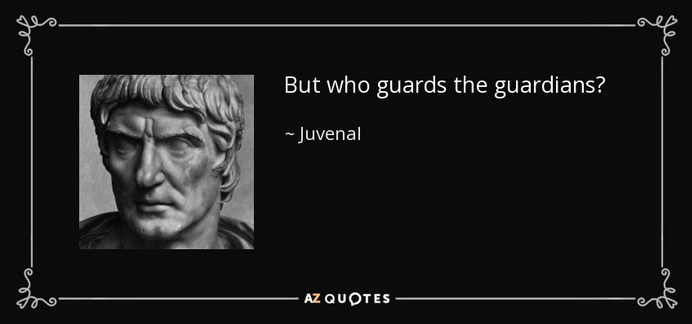
For his part, Judge Bingham has saved the best for last, for his long and rambling response to this paradox is ultimately on point. In short, for Bingham parliamentary sovereignty is the lesser of two evils. Why? Because the alternative to parliamentary sovereignty is the god-awful U.S. system of judicial supremacy, where a small and unaccountable committee of lawyers deliberating in secret (i.e. five of nine judges of the Supreme “Court” of the United States) get to have the last word. To paraphrase the immortal words of Juvenal (pictured below), the problem with the U.S. system of judicial supremacy can be summed in four words: who judges the judges?
I am lumping together my review of Chapters 9, 10, and 11 of Rule of Law by Tom Bingham because all three chapters deal with one aspect or another of today’s post-9/11 world, a world in which the rule of law is now all but dead–death by a thousand cuts, like the Taylor Swift song. Chapter 9 (“A Fair Trial”), for example, highlights the existence of so-called “hybrid procedures”–i.e. legal actions that are neither civil nor criminal in nature, such as parole board decisions or preventive detentions of “enemy combatants”, while Chapter 10 (“The Rule of Law in the International Order”) and Chapter 11 (“Terrorism and the Rule of Law”) focus on the illegal invasion of Iraq in 2003 and the misnamed “war on terror” in response to 9/11.
Combined, these chapters–especially chapters 10 and 11, the best part of the entire book–explain how the USA’s–and to a lesser extent, the UK’s–response to 9/11 contravened our most cherished rule of law values. Among other things, Bingham presents a stinging critique of mass surveillance, extraordinary renditions, torture, and all the other emergency measures used to fight the Bush-Obama-Trump “war on terror”. (Point of order: Although it was President Bush Jr. who ordered these extra-legal measures; Presidents Obama and Trump inherited them and kept them in place. Also, the fact that Bingham’s book was published several years before Edward Snowden revealed the United States Government’s indiscriminate and illegal mass surveillance of its population makes Bingham’s case all the more compelling.)
For my part, instead of rehashing Bingham’s legalistic arguments against the invasion of Iraq and the ill-defined war on terror, I will conclude with the following observation. Recently, the U.S. Government accused Russia of committing war crimes in the Ukraine (see here, for example). But this accusation begs the question, If Vladimir Putin is a war criminal (which he is), then what about George W. Bush?
Since 20 January (see here), I have reviewed in fits and starts the first half of Rule of Law by Tom Bingham (Chs. 1 to 7). This weekend, I will try to bring this project to a close by reviewing the rest of the book, starting with Chapter 8, which is on dispute resolution. In brief, Bingham begins this chapter thus: “Means must be provided for resolving, without prohibitive cost or inordinate delay, bona fide civil disputes [that] the parties themselves are unable to resolve.” Without prohibitive cost or inordinate delay, he says? Very funny! [Insert your favorite “LOL emoji” here.]
To his credit, after a quick detour through mediation and arbitration (i.e. dispute resolution methods that are used to avoid or opt-out of the formal court system), Judge Bingham quickly concedes that civil litigation is an extremely expensive and time-consuming process. Alas, what Bingham doesn’t do, however, is point out the positive correlation or direct link between both phenoms: the growing use of such alternate methods of dispute resolution as mediation and arbitration on the one hand and the drawn-out and costly nature of civil litigation on the other.
Worse yet, Bingham’s shallow analysis of civil litigation is radically incomplete, marred by an important omission: the fact that civil litigation is not only a costly and time-consuming affair; it can also be a super-risky one. That is, cost and delay are not the whole civil-litigation story. The other key problem with going to court is the variable of uncertainty. Simply put, whenever a case goes all the way to trial, it is next to impossible to predict with any degree of certainty what the outcome of that case will be. As a result, even when the parties have all the time and money in the world to fight their battles in court, they may not want to take their chances with a judge or jury.
(If you want a more accurate picture of the civil litigation process, check out this textbook chapter I wrote in 2014, which explores the interplay between cost and uncertainty, or my 5 April 2014 blog post on “Litigation and the game of poker” or my 10 June 2020 blog post “Settle or go to trial?“, both of which survey the strategic aspects of litigation more generally.)
Back to Bingham though. Maybe Bingham is totally wrong about the relationship between civil litigation and rule of law. Maybe the rule of law does not require a court system that can resolve disputes quickly and cheaply as along as private courts (arbitration) or informal procedures (mediation) can do the job.
My previous Posner post was devoted to my accidental discovery of Richard A. Posner’s Law and Literature: A Misunderstood Relation in December of 2000 and how this tome radically altered my negative Posnerian priors. For me, the most memorable part of Posner’s book was his irreverent analysis of Justice Oliver Wendell Holmes’s dissenting opinion in Lochner v. New York, especially the passage on page 271 (pictured above) where Posner asks what grade Holmes’s dissent might have received on a law school exam in 1905, the year Lochner was decided. After pointing out the many logical flaws in Holmes’s reasoning — how it was not well researched, gets the facts of the case wrong, and launches an unfair ad hominem attack against Herbert Spencer (a best-selling author at the time) — Posner somehow concludes:
“It is not, in short, a good judicial opinion. It is merely the greatest judicial opinion of the last hundred years.”
How could Judge Posner have reached such an extraordinary conclusion given his critical premises? In a word, to paraphrase Holmes himself, because the law is not just about logic; it is also about experience. In a pluralistic place like New York State, different factions will have dramatically different opinions about the wisdom of regulating bakeries (the issue in the Lochner case) and how far those regulations should go. Progressives, for example, will emphasize such goals as health and safety, as well as the need to protect workers from exploitation, while libertarians (i.e. classical liberals like myself) will find such meddlesome regulations paternalistic and counter-productive at best. Holmes’s point, however, is that courts should generally defer to legislatures, for it is not the job of judges to favor one faction over another.
More importantly, Posner’s analysis of Lochner v. New York invites us to further explore the creative and rhetorical aspects of legal reasoning. For Posner, Holmes’s three-paragraph dissenting opinion in Lochner is a minor work of art, a literary jewel that merits inclusion in the Anglo-American literary canon, along with such timeless classics as Lincoln’s Gettysburg Address or the second paragraph of the Declaration of Independence. A law professor in 1905 might have given Holmes’s dissent a C+. An English lit professor, though, would have assigned it an A.
Either way, with my newfound appreciation of Posner’s enormous intellect, I would soon turn my attention to his most controversial work: Sex and Reason. At the time (the early 2000s), I was trying to solve an empirical puzzle relating to domestic violence in the Commonwealth of Puerto Rico, and Sex and Reason would help me see this puzzle in a new light. I will therefore describe my analytical foray through the pages of this titillating and thought-provoking book next week in my upcoming installment of “Taking Posner Seriously.” (In the meantime, I will conclude my review of Tom Bingham’s Rule of Law this weekend.)
On this day (2 March) in 1824, the Supreme Court of the United States announced its landmark decision in Gibbons v. Ogden (see also here), which forbade States from enacting protectionist legislation, i.e. local laws that interfere with the power of Congress to regulate interstate commerce.
Check out this excellent essay by Tom McTague, a London-based staff writer at The Atlantic. Among other things, McTague compares and contrasts the bravery of Ukraine with the shameful and calculating cowardice of her pusillanimous NATO allies. Below the fold is an extended excerpt from McTague’s essay — links in the original; hat tip: Eugene Volokh.
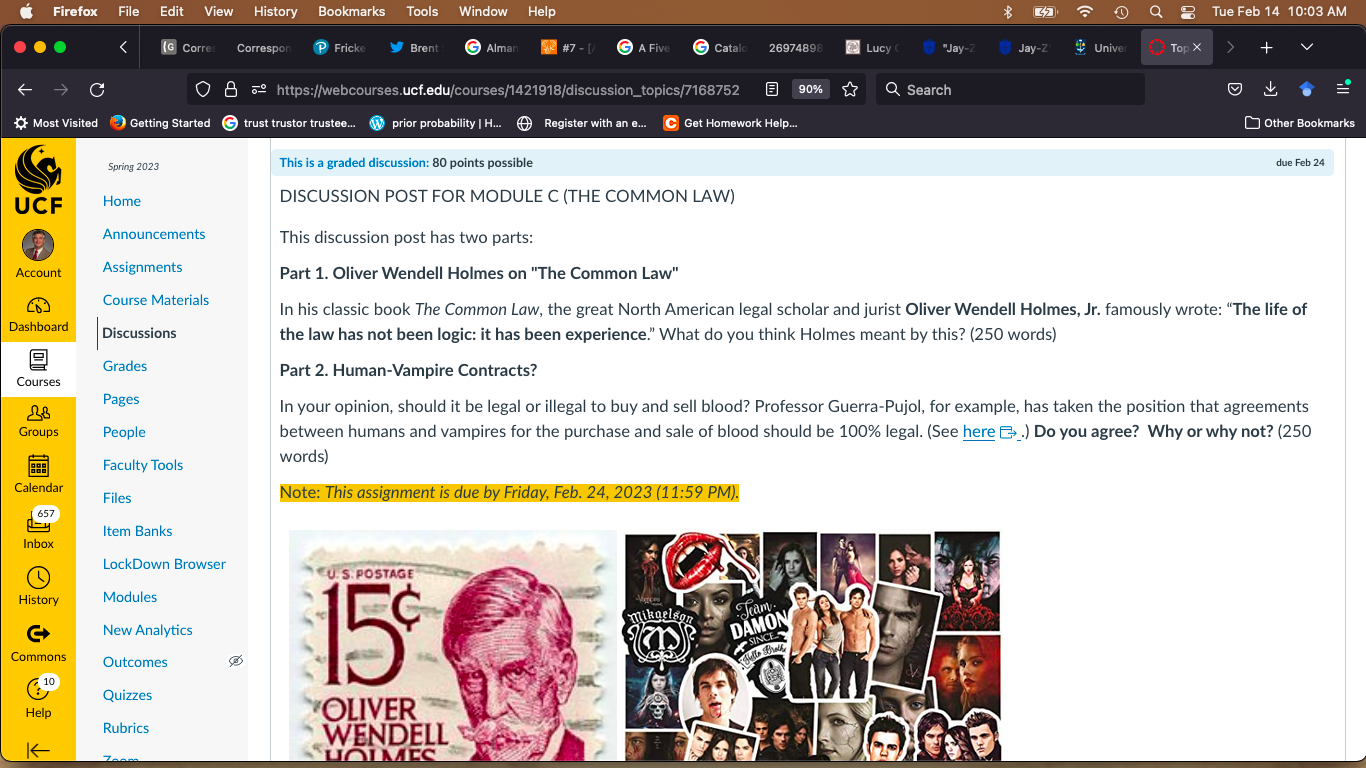
Pictured below are the short-essay questions in my module on “The Common Law”. The first question asks students to explain what did the great North American jurist and legal scholar Oliver Wendell Holmes mean when he wrote, “The life of the law has not been logic; it has been experience,” perhaps the most famous quote about the common law of all time.
Below the fold is ChatGPT’s response to this very question:
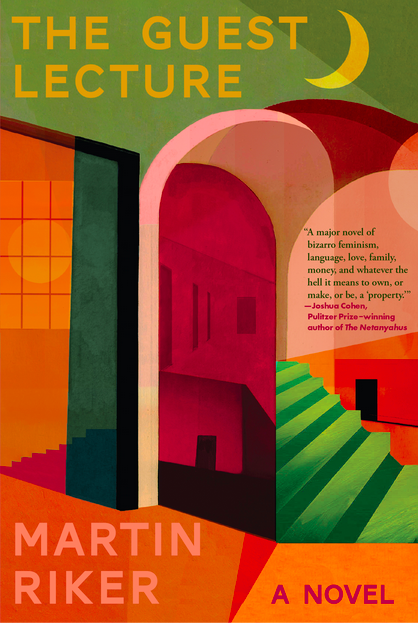
On the strength of this review by the Amazing Tyler Cowen, I ordered and read The Guest Lecture, a magnificent piece of “intellectual fiction” about the world of academia by one Martin Riker, who teaches English literature at Washington University in St Louis. Ignore the lame blurb on the book’s cover (pictured below); the centerpiece of this dreamlike novel is a fascinating seven-page essay by John Maynard Keynes, “Economic Possibilities for Our Grandchildren”, which was first published in 1930 and which you can read for yourself here.














 prior probability